




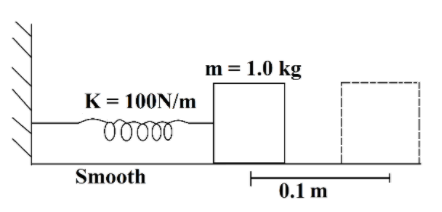
A block of mass m = 1kg is placed on a smooth surface and is connected with a spring of constant K = 100N/m and another end of spring is connected to a fixed wall as shown. The block is pulled by a distance A = 0.10 m from its natural length and released at t = 0
(A) The maximum speed is after $t=\dfrac{\pi }{20}s$
(B) Time taken to cover the first 0.10 m, $t=\dfrac{\pi }{20}s$
(C) Time taken to cover the first 0.05 m, $t=\dfrac{\pi }{40}s$
(D) Time taken to cover the first 0.05 m, $t=\dfrac{\pi }{30}s$
Answer
 Verified
583.8k+ views
Hint: In the question, a smooth floor is given which means that there is no friction in between the block and the floor, so, no amount of energy will be lost due to friction. Also, this case is a case of simple harmonic motion of a spring, which means it will oscillate at a specific frequency for a particular time period.
Formula used:
For solving this question, we will be using the formula for angular frequency of a spring in simple harmonic motion, i.e.,
$\omega =\sqrt{\dfrac{K}{m}}$
And, the formula
$T=\dfrac{2\pi }{\omega }$
Complete answer:
First, let us take a look at the given parameters,
K = 100N/m
m = 1 kg
L = 1 m
Now, using the formula for the angular frequency of a spring in simple harmonic motion,
$\omega =\sqrt{\dfrac{K}{m}}$
Using the given parameters
$\Rightarrow \omega =\sqrt{\dfrac{100}{1}}$
$\Rightarrow \omega =10rad/s$
Now that we have the angular acceleration,
So, using
$T=\dfrac{2\pi }{\omega }$
Now, the maximum speed of the spring will be at its natural length,
So,
$\Rightarrow \dfrac{T}{4}=\dfrac{2\pi }{10\times 4}$
$\Rightarrow \dfrac{T}{4}=\dfrac{\pi }{20}s$
Now, the time taken to cover 0.1m is $\dfrac{T}{4}=\dfrac{\pi }{20}s$
Now, Time taken to cover 0.05 m will be
$\Rightarrow \dfrac{T}{4}\times \dfrac{2}{3}$
$\Rightarrow \dfrac{\pi }{20}\times \dfrac{2}{3}$
$\Rightarrow \dfrac{\pi }{30}s$
So, the correct options will be,
Option (A) The maximum speed is after $t=\dfrac{\pi }{20}s$ , Option (B) Time taken to cover the first 0.10 m, $t=\dfrac{\pi }{20}s$ and Option (D) Time taken to cover the first 0.05 m, $t=\dfrac{\pi }{30}s$
Note:
Simple harmonic motion is a special form of periodic motion in dynamics and physics where the restoring force on the moving object is directly proportional to the displacement magnitude of the object and works against the equilibrium position of the object.
Formula used:
For solving this question, we will be using the formula for angular frequency of a spring in simple harmonic motion, i.e.,
$\omega =\sqrt{\dfrac{K}{m}}$
And, the formula
$T=\dfrac{2\pi }{\omega }$
Complete answer:
First, let us take a look at the given parameters,
K = 100N/m
m = 1 kg
L = 1 m
Now, using the formula for the angular frequency of a spring in simple harmonic motion,
$\omega =\sqrt{\dfrac{K}{m}}$
Using the given parameters
$\Rightarrow \omega =\sqrt{\dfrac{100}{1}}$
$\Rightarrow \omega =10rad/s$
Now that we have the angular acceleration,
So, using
$T=\dfrac{2\pi }{\omega }$
Now, the maximum speed of the spring will be at its natural length,
So,
$\Rightarrow \dfrac{T}{4}=\dfrac{2\pi }{10\times 4}$
$\Rightarrow \dfrac{T}{4}=\dfrac{\pi }{20}s$
Now, the time taken to cover 0.1m is $\dfrac{T}{4}=\dfrac{\pi }{20}s$
Now, Time taken to cover 0.05 m will be
$\Rightarrow \dfrac{T}{4}\times \dfrac{2}{3}$
$\Rightarrow \dfrac{\pi }{20}\times \dfrac{2}{3}$
$\Rightarrow \dfrac{\pi }{30}s$
So, the correct options will be,
Option (A) The maximum speed is after $t=\dfrac{\pi }{20}s$ , Option (B) Time taken to cover the first 0.10 m, $t=\dfrac{\pi }{20}s$ and Option (D) Time taken to cover the first 0.05 m, $t=\dfrac{\pi }{30}s$
Note:
Simple harmonic motion is a special form of periodic motion in dynamics and physics where the restoring force on the moving object is directly proportional to the displacement magnitude of the object and works against the equilibrium position of the object.
Recently Updated Pages
Master Class 12 Economics: Engaging Questions & Answers for Success

Master Class 12 Physics: Engaging Questions & Answers for Success
Master Class 12 English: Engaging Questions & Answers for Success
Master Class 12 Social Science: Engaging Questions & Answers for Success
Master Class 12 Maths: Engaging Questions & Answers for Success
Master Class 12 Business Studies: Engaging Questions & Answers for Success
Trending doubts
Which are the Top 10 Largest Countries of the World?
What are the major means of transport Explain each class 12 social science CBSE
Draw a labelled sketch of the human eye class 12 physics CBSE
Why cannot DNA pass through cell membranes class 12 biology CBSE
Differentiate between insitu conservation and exsitu class 12 biology CBSE
Draw a neat and well labeled diagram of TS of ovary class 12 biology CBSE