




A block is supported on the vertical surface of a hollow cylindrical drum, which is rotating about its axis at an angular speed $600/2\pi {\text{rpm}}$. Find the minimum coefficient of friction between the block and wall of cylinder so that block should not fall, $g = 10{\text{ m}}{{\text{s}}^{ - 2}}$ , radius $1{\text{ m}}$.
A. $0.3$
B. $0.2$
C. $0.1$
D. $0.01$
Answer
 Verified
577.8k+ views
Hint:The concepts of frictional force and rotational motion will be used to solve the problem. For the box to not fall the force acting downwards should be balanced by the frictional force between the block and the wall of the cylinder.
Complete step by step answer:
It is given that the block is placed in the wall so rotating a cylindrical drum about its axis at the angular speed of $600/2\pi {\text{ rpm}}$. Now let us consider a figure for better understanding
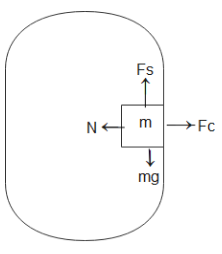
${F_s}$ is the frictional force between the block and the wall, ${F_c}$ is the centrifugal force, $N$ is the normal force and $mg$ is the force due to the weight of the body. The figure above shows all the components of force acting in the block. For the block to not fall it needs to be in the equilibrium position, therefore, equating the upward and downward forces we get,
${F_s} = mg$
Now as we know the formula for frictional force substituting the formula we get,
$ \Rightarrow \mu N = mg$
$\mu $ is the coefficient of friction which we need to find out.
$ \Rightarrow N = \dfrac{{mg}}{\mu } - - - - (1)$
Now we will equate the centrifugal force with the normal,
We know that ${F_c} = \dfrac{{m{v^2}}}{R}$
$R$ is the radius of the curved path in which the block is rotating and $v$ is the velocity.
Therefore we get,
$N = {F_c}$
Using the results from equation (1)
$ \Rightarrow \dfrac{{mg}}{\mu } = \dfrac{{m{v^2}}}{R}$
Substituting the values of linear velocity in terms of angular velocity we get
$ \Rightarrow \dfrac{{mg}}{\mu } = m{\omega ^2}R$
$ \Rightarrow \mu = \dfrac{g}{{{\omega ^2}R}}$
Putting the values we get,
$ \Rightarrow \mu = \dfrac{{10}}{{\left( {\dfrac{{600}}{{2\pi }}} \right) \times 1}}$
$ \therefore \mu = 0.01$
Hence, option D is the correct answer.
Note: Normal force is the perpendicular force to the surface on which the block is rotating. The frictional force is the resisting force that prevents surfaces and layers to slip against each other. Centrifugal force is the apparent force experienced by a rotating body that is necessary to keep the body in the curved path and is directed outwardly from the centre of rotation.
Complete step by step answer:
It is given that the block is placed in the wall so rotating a cylindrical drum about its axis at the angular speed of $600/2\pi {\text{ rpm}}$. Now let us consider a figure for better understanding
${F_s}$ is the frictional force between the block and the wall, ${F_c}$ is the centrifugal force, $N$ is the normal force and $mg$ is the force due to the weight of the body. The figure above shows all the components of force acting in the block. For the block to not fall it needs to be in the equilibrium position, therefore, equating the upward and downward forces we get,
${F_s} = mg$
Now as we know the formula for frictional force substituting the formula we get,
$ \Rightarrow \mu N = mg$
$\mu $ is the coefficient of friction which we need to find out.
$ \Rightarrow N = \dfrac{{mg}}{\mu } - - - - (1)$
Now we will equate the centrifugal force with the normal,
We know that ${F_c} = \dfrac{{m{v^2}}}{R}$
$R$ is the radius of the curved path in which the block is rotating and $v$ is the velocity.
Therefore we get,
$N = {F_c}$
Using the results from equation (1)
$ \Rightarrow \dfrac{{mg}}{\mu } = \dfrac{{m{v^2}}}{R}$
Substituting the values of linear velocity in terms of angular velocity we get
$ \Rightarrow \dfrac{{mg}}{\mu } = m{\omega ^2}R$
$ \Rightarrow \mu = \dfrac{g}{{{\omega ^2}R}}$
Putting the values we get,
$ \Rightarrow \mu = \dfrac{{10}}{{\left( {\dfrac{{600}}{{2\pi }}} \right) \times 1}}$
$ \therefore \mu = 0.01$
Hence, option D is the correct answer.
Note: Normal force is the perpendicular force to the surface on which the block is rotating. The frictional force is the resisting force that prevents surfaces and layers to slip against each other. Centrifugal force is the apparent force experienced by a rotating body that is necessary to keep the body in the curved path and is directed outwardly from the centre of rotation.
Recently Updated Pages
If x a + bt + ct2 where x is in meters and t is in class 11 physics CBSE

A car covers the first half distance between two places class 11 physics CBSE
The resultant of two vectors overrightarrow P and overrightarrow class 11 physics CBSE
Find the value of cos 135 class 11 maths CBSE
A mass M is held in place by an applied force F and class 11 physics CBSE
A solution of glucose in water is labelled as 10 dfracwv class 11 chemistry CBSE
Trending doubts
One Metric ton is equal to kg A 10000 B 1000 C 100 class 11 physics CBSE
Find the value of the expression given below sin 30circ class 11 maths CBSE
What do you mean by retardation What is its SI uni class 11 physics CBSE
Draw a diagram of nephron and explain its structur class 11 biology CBSE
10 examples of friction in our daily life
Difference between physical and chemical change class 11 chemistry CBSE