




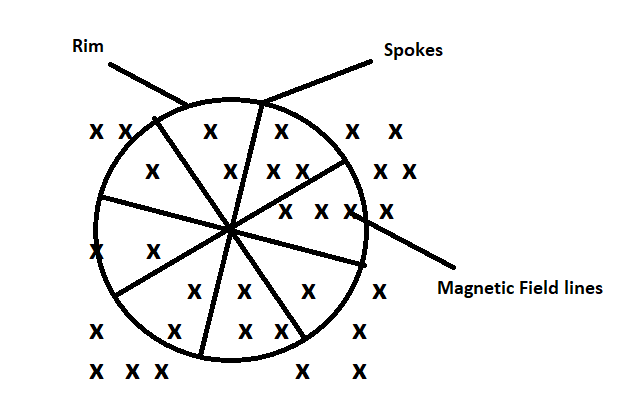
A bicycle wheel of radius \[0.5{\rm{ }}m\]has \[32\] spokes. It is rotating at the rate of \[120\]revolutions per minute, horizontal component of earth of earth’s magnetic field ${\beta _H} = 4 \times {10^{ - 5}}T$. The emf induced between the rim and the centre of wheel will be:
A.$6.28 \times {10^{ - 5}}V$
B.$4.8 \times {10^{ - 5}}V$
C.$6 \times {10^{ - 5}}V$
D.$1.6 \times {10^{ - 5}}V$
Answer
 Verified
568.8k+ views
Hint: An electromotive force, is the electrical action produced by a non-electrical source. Hence emf is directly proportional to magnetic field, area swept by spoke and revolutions made by wheel per second.
Complete Step by step answer: Radius = \[r{\rm{ }} = {\rm{ }}0.5{\rm{ }}m\]
Earth’s magnetic field ${\beta _H} = 4 \times {10^{ - 5}}T$.
Number of spokes = \[n{\rm{ }} = {\rm{ }}32\]
Number of rotations completed per minutes by wheel \[ = {\rm{ }}120\]
Hence rotations completed per second by a wheel = $\dfrac{{120}}{{60}} = 2$ revolutions per second.
Since radius of the wheel is \[0.5m\], the length of each spoke = \[0.5m\]
The rate of change of an angle with respect to velocity is called angular velocity. The SI unit of angular velocity id radian per second.
Hence angular velocity = $w = 2\pi n$
In time period of $T$the area swept by one spoke = $\pi {r^2}$
The time period of $T$the area swept by one spoke = $\pi \times {(0.5)^2}$= $0.25\pi {m^2}$
The emf induced in the $e = \dfrac{{d\phi }}{{dt}}$
The emf induced in the $e = \dfrac{{d(BA)}}{{dt}}$………………………………………………………….. (I)
Where $B$= magnetic field and
$A$= surface area
We can write equation (I) as $e = \dfrac{{BA}}{T}$………………………………………………………. (II)
Since the frequency is the number of occurrences of a repeating event per unit of time,
$T = \dfrac{1}{f}$
\[\Rightarrow f = \dfrac{w}{{2\pi }}\]
$\Rightarrow f = \dfrac{{4\pi }}{{2\pi }}$
$\Rightarrow f = 2Hz$
Now, we can write equation (II) as:
\[e{\rm{ }} = {\rm{ }}BAf\]
Means emf is directly proportional to magnetic field, area swept by spoke and revolutions made by wheel per second.
$\Rightarrow e = 4 \times {10^{ - 5}} \times 0.25\pi \times 2$
$\Rightarrow e = 6.28 \times {10^{ - 5}}V$
Therefore the emf induced between the rim and the centre of the wheel will be = $e = 6.28 \times {10^{ - 5}}V$. So, the correct option is A.
Note: E.M.F always opposes the change in magnetic flux associated with a conducting loop. Depending on the direction of the induced current it can be signed negative or positive.
Complete Step by step answer: Radius = \[r{\rm{ }} = {\rm{ }}0.5{\rm{ }}m\]
Earth’s magnetic field ${\beta _H} = 4 \times {10^{ - 5}}T$.
Number of spokes = \[n{\rm{ }} = {\rm{ }}32\]
Number of rotations completed per minutes by wheel \[ = {\rm{ }}120\]
Hence rotations completed per second by a wheel = $\dfrac{{120}}{{60}} = 2$ revolutions per second.
Since radius of the wheel is \[0.5m\], the length of each spoke = \[0.5m\]
The rate of change of an angle with respect to velocity is called angular velocity. The SI unit of angular velocity id radian per second.
Hence angular velocity = $w = 2\pi n$
In time period of $T$the area swept by one spoke = $\pi {r^2}$
The time period of $T$the area swept by one spoke = $\pi \times {(0.5)^2}$= $0.25\pi {m^2}$
The emf induced in the $e = \dfrac{{d\phi }}{{dt}}$
The emf induced in the $e = \dfrac{{d(BA)}}{{dt}}$………………………………………………………….. (I)
Where $B$= magnetic field and
$A$= surface area
We can write equation (I) as $e = \dfrac{{BA}}{T}$………………………………………………………. (II)
Since the frequency is the number of occurrences of a repeating event per unit of time,
$T = \dfrac{1}{f}$
\[\Rightarrow f = \dfrac{w}{{2\pi }}\]
$\Rightarrow f = \dfrac{{4\pi }}{{2\pi }}$
$\Rightarrow f = 2Hz$
Now, we can write equation (II) as:
\[e{\rm{ }} = {\rm{ }}BAf\]
Means emf is directly proportional to magnetic field, area swept by spoke and revolutions made by wheel per second.
$\Rightarrow e = 4 \times {10^{ - 5}} \times 0.25\pi \times 2$
$\Rightarrow e = 6.28 \times {10^{ - 5}}V$
Therefore the emf induced between the rim and the centre of the wheel will be = $e = 6.28 \times {10^{ - 5}}V$. So, the correct option is A.
Note: E.M.F always opposes the change in magnetic flux associated with a conducting loop. Depending on the direction of the induced current it can be signed negative or positive.
Recently Updated Pages
Master Class 12 Economics: Engaging Questions & Answers for Success

Master Class 12 Physics: Engaging Questions & Answers for Success
Master Class 12 English: Engaging Questions & Answers for Success
Master Class 12 Social Science: Engaging Questions & Answers for Success
Master Class 12 Maths: Engaging Questions & Answers for Success
Master Class 12 Business Studies: Engaging Questions & Answers for Success
Trending doubts
Which are the Top 10 Largest Countries of the World?
What are the major means of transport Explain each class 12 social science CBSE
Draw a labelled sketch of the human eye class 12 physics CBSE
Why cannot DNA pass through cell membranes class 12 biology CBSE
Differentiate between insitu conservation and exsitu class 12 biology CBSE
Draw a neat and well labeled diagram of TS of ovary class 12 biology CBSE