




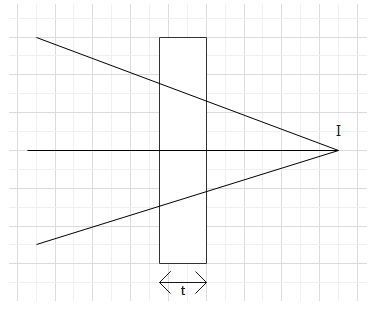
A beam of light is converging towards a point L. A plane parallel plate of glass of thickness t, refractive index $\mu$ is introduced in the path of the beam. The convergent point is shifted by:
(Assume near normal incidence)
$
A.{\text{ }}t\left( {1 - \dfrac{1}{\mu }} \right)away \\
B.{\text{ }}t\left( {1 + \dfrac{1}{\mu }} \right)away \\
C.{\text{ }}t\left( {1 - \dfrac{1}{\mu }} \right)nearer \\
D.{\text{ }}t\left( {1 + \dfrac{1}{\mu }} \right)nearer \\
$
Answer
 Verified
563.9k+ views
Hint: When light passes from one medium to another it undergoes refraction. When it moves from rarer to denser medium, it shifts towards the normal and when it moves from denser to rarer medium; it bends away from the normal.
Formula used:
Snell’s Law: $\mu=\dfrac{{\sin i}}{{\sin r}}$
where $\mu$=refractive index, i=angle of incidence and r=angle of refraction.
$\angle I = \angle e$
where e is the angle of emergence.
For a very small value of $\theta$, cos$\theta$=1.
Complete step by step solution:
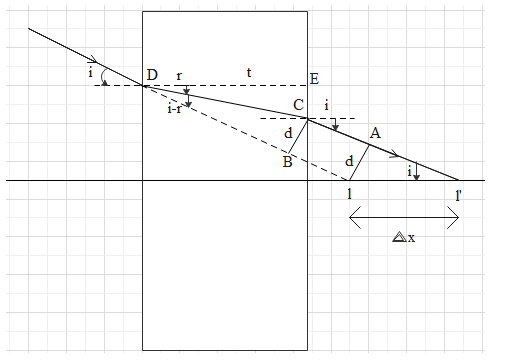
In this question, we have a glass plate of thickness t and refractive index $\mu$. A light ray incident on the left side undergoes refraction, travels through the glass and then re-emerges on the right side as shown in the figure below.
If the ray had not undergone refraction then it would have gone straight but due to refraction, it bends and when it re-emerges, it is parallel and at distance of d from original ray. In order to calculate the distance $\Delta$x, we need to find this distance d first.
In right triangle DEC,
$\cos r=\dfrac{DE}{DC}=\dfrac{t}{DC} \\
\Rightarrow DC=\dfrac{t}{\cos r}\\$
In $\Delta$CBD,
$ \sin (i-r) = \dfrac{BC}{DC} = \dfrac{d \cos r}{t} \\
\Rightarrow d=\dfrac{t \sin (i-r)}{\cos r} \\
\Rightarrow d=\dfrac{t (\sin i \cos r - \sin r \cos i)}{\cos r} \\
\Rightarrow d= t \left(\sin i - \sin r \dfrac{\cos i}{\cos r} \right)\\$
In right $\Delta$Al’l,
$ \sin i = \dfrac{Al}{ll’} = \dfrac{d}{\Delta x} \\
\Rightarrow \Delta x = \dfrac{d}{\sin i} = t \left(\dfrac{\sin i}{\sin i} - \dfrac{\sin r}{\sin i} \dfrac{\cos i}{\cos r} \right) \\
\Rightarrow \Delta x = t \left(1- \dfrac{1}{\mu} \dfrac{\cos i}{\cos r} \right)\\$
Here we have used Snell's law. The near normal incidence implies that the angle of incidence is very small, corresponding to which angle of refraction is also very small. Therefore, the final expression we have is
$$\Delta x = t \left(1- \dfrac{1}{\mu}\right)$$
And as we can see in the diagram, the ray is away from the direction of the original ray by a factor of $\Delta $x. Therefore, the correct answer is option A.
Note: Here, refractive index of glass is greater than air and image is formed farther but if it’s the opposite case then image will be formed nearer. It depends on the refractive index of a medium and greater the refractive index, more is the bending of light in that medium and vice-versa.
Formula used:
Snell’s Law: $\mu=\dfrac{{\sin i}}{{\sin r}}$
where $\mu$=refractive index, i=angle of incidence and r=angle of refraction.
$\angle I = \angle e$
where e is the angle of emergence.
For a very small value of $\theta$, cos$\theta$=1.
Complete step by step solution:
In this question, we have a glass plate of thickness t and refractive index $\mu$. A light ray incident on the left side undergoes refraction, travels through the glass and then re-emerges on the right side as shown in the figure below.
If the ray had not undergone refraction then it would have gone straight but due to refraction, it bends and when it re-emerges, it is parallel and at distance of d from original ray. In order to calculate the distance $\Delta$x, we need to find this distance d first.
In right triangle DEC,
$\cos r=\dfrac{DE}{DC}=\dfrac{t}{DC} \\
\Rightarrow DC=\dfrac{t}{\cos r}\\$
In $\Delta$CBD,
$ \sin (i-r) = \dfrac{BC}{DC} = \dfrac{d \cos r}{t} \\
\Rightarrow d=\dfrac{t \sin (i-r)}{\cos r} \\
\Rightarrow d=\dfrac{t (\sin i \cos r - \sin r \cos i)}{\cos r} \\
\Rightarrow d= t \left(\sin i - \sin r \dfrac{\cos i}{\cos r} \right)\\$
In right $\Delta$Al’l,
$ \sin i = \dfrac{Al}{ll’} = \dfrac{d}{\Delta x} \\
\Rightarrow \Delta x = \dfrac{d}{\sin i} = t \left(\dfrac{\sin i}{\sin i} - \dfrac{\sin r}{\sin i} \dfrac{\cos i}{\cos r} \right) \\
\Rightarrow \Delta x = t \left(1- \dfrac{1}{\mu} \dfrac{\cos i}{\cos r} \right)\\$
Here we have used Snell's law. The near normal incidence implies that the angle of incidence is very small, corresponding to which angle of refraction is also very small. Therefore, the final expression we have is
$$\Delta x = t \left(1- \dfrac{1}{\mu}\right)$$
And as we can see in the diagram, the ray is away from the direction of the original ray by a factor of $\Delta $x. Therefore, the correct answer is option A.
Note: Here, refractive index of glass is greater than air and image is formed farther but if it’s the opposite case then image will be formed nearer. It depends on the refractive index of a medium and greater the refractive index, more is the bending of light in that medium and vice-versa.
Recently Updated Pages
Master Class 12 Economics: Engaging Questions & Answers for Success

Master Class 12 English: Engaging Questions & Answers for Success
Master Class 12 Social Science: Engaging Questions & Answers for Success
Master Class 12 Maths: Engaging Questions & Answers for Success
Master Class 12 Physics: Engaging Questions & Answers for Success
Master Class 12 Business Studies: Engaging Questions & Answers for Success
Trending doubts
Which are the Top 10 Largest Countries of the World?
Draw a labelled sketch of the human eye class 12 physics CBSE
Differentiate between homogeneous and heterogeneous class 12 chemistry CBSE
Why is the cell called the structural and functional class 12 biology CBSE
Draw ray diagrams each showing i myopic eye and ii class 12 physics CBSE
Which is the correct genotypic ratio of mendel dihybrid class 12 biology CBSE