




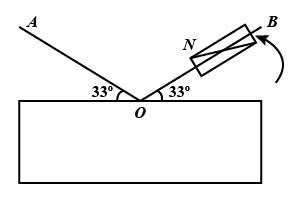
A beam of light AO is incident on a glass slab in a direction as shown in figure. The reflected ray OB is passed through a Nicol prism on viewing through a Nicol prism, we find on rotating the prism that
Answer
 Verified
591k+ views
Hint: Nicol prism is an optical instrument that converts un-polarized light into polarised light. Nicol prism is made up of calcite crystal (\[CaC{O_3}\]) and is fabricated with Canada Balsam whose refractive index \[\left( \mu \right){\text{ }} = 1.55\].
Complete step-by-step solution:
In the arrangement shown, the un-polarised light is incident at a polarising angle of\[{90^ \circ } - {33^ \circ } = {57^ \circ }\]. The reflected light is thus plane polarised light. When plane polarised light is passed through a Nicol prism, the intensity gradually reduces to zero and finally increases.
Additional information:
A beam of unpolarized light falls on a surface of the prism and gets divided into two refracted rays i.e. ordinary ray and extraordinary ray. These refracted rays are plane and polarized in nature, vibrations form right angles with each other. For an extraordinary ray of light \[\left( \mu \right){\text{ }} = 1.55\], Canada Balsam \[\left( {\mu = 1.55} \right)\] acts as an optically denser medium. For ordinary rays of light \[\left( {\mu = 1.65} \right)\], Canada Balsam \[\left( {\mu = 1.55} \right)\] acts as an optically rarer medium.When ordinary ray falls on the Nicol prism and passes through this particular layer (Canada Balsam), it is a transition from a denser medium to a rarer medium, also its incident at a critical angle on Canada Balsam layer and thus a total internal reflection takes place. When an extraordinary ray falls on the Nicol prism and passes through this particular layer (Canada Balsam), it is a transition from a rarer medium to a denser medium, and thus passes through prism after refraction which is totally plane polarised.
Note: Nicol prism was the first type of polarising prism invented in 1828 by William Nicol (1770-1851) of Edinburgh, it consists of a rhombohedral crystal made up of calcite and has been cut at an angle of 68o with respect to the crystal axis, cut again diagonally and then re-joined with the help of a Canada Balsam as a glue.
Complete step-by-step solution:
In the arrangement shown, the un-polarised light is incident at a polarising angle of\[{90^ \circ } - {33^ \circ } = {57^ \circ }\]. The reflected light is thus plane polarised light. When plane polarised light is passed through a Nicol prism, the intensity gradually reduces to zero and finally increases.
Additional information:
A beam of unpolarized light falls on a surface of the prism and gets divided into two refracted rays i.e. ordinary ray and extraordinary ray. These refracted rays are plane and polarized in nature, vibrations form right angles with each other. For an extraordinary ray of light \[\left( \mu \right){\text{ }} = 1.55\], Canada Balsam \[\left( {\mu = 1.55} \right)\] acts as an optically denser medium. For ordinary rays of light \[\left( {\mu = 1.65} \right)\], Canada Balsam \[\left( {\mu = 1.55} \right)\] acts as an optically rarer medium.When ordinary ray falls on the Nicol prism and passes through this particular layer (Canada Balsam), it is a transition from a denser medium to a rarer medium, also its incident at a critical angle on Canada Balsam layer and thus a total internal reflection takes place. When an extraordinary ray falls on the Nicol prism and passes through this particular layer (Canada Balsam), it is a transition from a rarer medium to a denser medium, and thus passes through prism after refraction which is totally plane polarised.
Note: Nicol prism was the first type of polarising prism invented in 1828 by William Nicol (1770-1851) of Edinburgh, it consists of a rhombohedral crystal made up of calcite and has been cut at an angle of 68o with respect to the crystal axis, cut again diagonally and then re-joined with the help of a Canada Balsam as a glue.
Recently Updated Pages
Which of the following graphs shows the variation of class 12 physics CBSE

Draw a labelled diagram of the human male reproductive class 12 biology CBSE
Describe the experiment to compare the emf of two cells class 12 physics CBSE
What is standard hydrogen electrode
What is conventional current and electric current class 12 physics CBSE
2Bromopentane is treated with an alcoholic KOH solution class 12 chemistry CBSE
Trending doubts
Draw a labelled sketch of the human eye class 12 physics CBSE
Which are the Top 10 Largest Countries of the World?
Differentiate between homogeneous and heterogeneous class 12 chemistry CBSE
Draw ray diagrams each showing i myopic eye and ii class 12 physics CBSE
Which is the correct genotypic ratio of mendel dihybrid class 12 biology CBSE
What is the Full Form of PVC, PET, HDPE, LDPE, PP and PS ?