




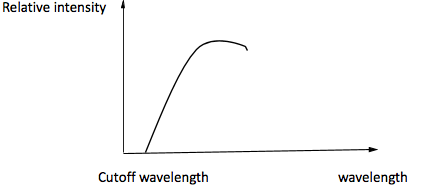
A beam of electrons striking a cooper target produces X-rays. Its spectrum is as shown. Keeping the voltage same if the copper target is replaced with a different metal, the cut-off wavelength and characteristic lines of the new spectrum will change in comparison with old as:
(a) cut-off wavelength will remain unchanged while characteristic lines will be different.
(b) Both cut-off wavelength and characteristic lines will remain unchanged.
(c) Both Cut-off wavelength and characteristic lines will be different
(d) Cut-off wavelength will be different while characteristic lines will remain unchanged
Answer
 Verified
657k+ views
Hint:In order to calculate the cut-off wavelength and characteristic lines of the new spectrum will change in comparison, cut-off wavelength depends on accelerating voltage and characteristic.
Step by step solution:
Wavelength depends on the nature of the target material.
Cut- off wavelength of emitted X-rays depends on maximum kinetic energy of incident electrons on the target and is independent of nature of target. The characteristic lines depend on the nature of the material of the target.
Hence, the correct answer to this question is option (a).
Additional Information: Most X-rays have a wavelength ranging from \[10\] picometers to \[10\] nanometers, corresponding to frequencies in the range \[30\] petahertz to \[30\] exahertz\[\left( 3\times {{10}^{16}}~Hz\text{ }to\text{ }3\times {{10}^{19}}~Hz \right)\] and energies in the range \[124{\text{ }}eV\] to \[124{\text{ }}keV\].
X-ray wavelengths are shorter than those of UV rays and typically longer than those of gamma rays.
Note:While solving this question, we should be careful with the statement given in the question. As the beam of electrons is striking a copper target in order to produce X-rays and spectrum is given with the question. While keeping the voltage the same, the copper target is replaced with a different metal. We need to study and get help with the spectrum. A good knowledge of x-rays spectrum is needed.
Recently Updated Pages
Write structures of the following compounds i 2 Chloro3methylpentane class 11 chemistry CBSE

What is BLO What is the full form of BLO class 8 social science CBSE
Explain the Treaty of Vienna of 1815 class 10 social science CBSE
A Paragraph on Pollution in about 100-150 Words
XIX+XXX A 49 B 51 C 55 D 44 class 5 maths CBSE
If x a + bt + ct2 where x is in meters and t is in class 11 physics CBSE
Trending doubts
One Metric ton is equal to kg A 10000 B 1000 C 100 class 11 physics CBSE
Find the value of the expression given below sin 30circ class 11 maths CBSE
Draw a diagram of nephron and explain its structur class 11 biology CBSE
10 examples of friction in our daily life
Draw a diagram of a plant cell and label at least eight class 11 biology CBSE
Proton was discovered by A Thomson B Rutherford C Chadwick class 11 chemistry CBSE