




A beam of a mixture of $ \alpha $ particles and protons are accelerated through the same potential difference before entering into the magnetic field of strength $ B $ . If $ {r_1} = 5cm $ , then $ {r_2} $ is
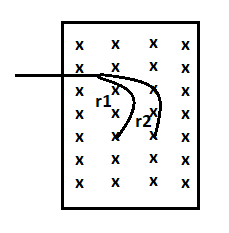
(A) $ 5\;cm $
(B) $ 5\sqrt 2 cm $
(C) $ 10\sqrt 2 cm $
(D) $ 20\;cm $
Answer
 Verified
563.1k+ views
Hint: We know that both alpha particles and protons are charged particles. If a charged particle perpendicular to the uniform magnetic field. The magnetic Lorentz force is acting perpendicular to the velocity. This supplies the necessary centripetal force required for circular motion.
Formula used:
$ v = \dfrac{{qBr}}{m} $
Where $ v $ is the velocity of the particle, $ q $ stands for the charge of the particle, $ B $ stands for the magnetic field, $ r $ is the radius of the circular path, and $ m $ is the mass of the particle.
Complete Step by step solution:
The velocity of a charged particle moving in a circular path in a uniform magnetic field is given by,
$ v = \dfrac{{qBr}}{m} $
From this equation, we can write the expression for radius as,
$ r = \dfrac{{mv}}{{qB}} $
We know that the momentum of the particle,
$ P = mv $
Therefore, the radius can be written as
$ r = \dfrac{P}{{qB}} $
We know that momentum can be written as,
$ P = \sqrt {2mE} $
Substituting in the above equation, we get
$ r = \dfrac{{\sqrt {2mE} }}{{qB}} $
We can write the energy of a charged particle in a potential $ V $ as,
$ E = qV $
Substituting in the above equation, we get
$ r = \dfrac{{\sqrt {2mqV} }}{{qB}} $
This equation can be rearranged as,
$ r = \sqrt {\dfrac{m}{q}} \dfrac{{\sqrt {2V} }}{B} $
The radius $ {r_1} $ can be written as,
$ {r_1} = \sqrt {\dfrac{{{m_1}}}{{{q_1}}}} \dfrac{{\sqrt {2V} }}{B} $
The radius $ {r_2} $ can be written as,
$ {r_2} = \sqrt {\dfrac{{{m_2}}}{{{q_2}}}} \dfrac{{\sqrt {2V} }}{B} $
The ratio of the two radii can be written as,
$ \dfrac{{{r_2}}}{{{r_1}}} = \dfrac{{\sqrt {\dfrac{{{m_2}}}{{{q_2}}}} \dfrac{{\sqrt {2V} }}{B}}}{{\sqrt {\dfrac{{{m_1}}}{{{q_1}}}} \dfrac{{\sqrt {2V} }}{B}}} $
Cancelling the common terms and rearranging, we get
$ \dfrac{{{r_2}}}{{{r_1}}} = \sqrt {\dfrac{{{m_2}}}{{{q_2}}}} \times \sqrt {\dfrac{{{q_1}}}{{{m_1}}}} $
This can be written as,
$ \dfrac{{{r_2}}}{{{r_1}}} = \sqrt {\dfrac{{{m_2}}}{{{m_1}}}} \times \sqrt {\dfrac{{{q_1}}}{{{q_2}}}} $
We know that the mass of an alpha particle is four times that of the mass of protons. i.e.
$ {m_\alpha } = 4{m_p} $
Here $ {m_2} $ is the mass of the alpha particle and $ {m_p} $ is the mass of the proton.
Therefore we can write,
$ \sqrt {\dfrac{{{m_2}}}{{{m_1}}}} = \sqrt {\dfrac{4}{1}} $
Also, the charge of alpha particles are two times that of the charge of protons, i.e.
$ {q_\alpha } = 2{q_p} $
Here $ {q_2} $ is the charge of the alpha particle and $ {q_1} $ is the charge of the proton, then we can write
$ {q_2} = 2{q_p} $
Then the ratio will be
$ \sqrt {\dfrac{{{q_1}}}{{{q_2}}}} = \sqrt {\dfrac{1}{2}} $
Putting these values in the expression
$ \dfrac{{{r_2}}}{{{r_1}}} = \sqrt {\dfrac{{{m_2}}}{{{m_1}}}} \times \sqrt {\dfrac{{{q_1}}}{{{q_2}}}} $
We get,
$ \dfrac{{{r_2}}}{{{r_1}}} = \sqrt {\dfrac{4}{1}} \times \sqrt {\dfrac{1}{2}} = \sqrt 2 $
From this $ {r_2} = {r_1}\sqrt 2 $
It is given that, the value of $ {r_1} = 5cm $
Then,
$ {r_2} = 5\sqrt 2 cm $
The answer is: Option (B): $ 5\sqrt 2 cm $ .
Note:
The radius $ r = \dfrac{{mv}}{{qB}} $ is known as the cyclotron radius. A cyclotron is a device employed to accelerate charged particles to high energies. It works on the principle that a charged particle moving normal to magnetic flux experiences magnetic Lorentz force. Because of this force, the particle moves in a circular path.
Formula used:
$ v = \dfrac{{qBr}}{m} $
Where $ v $ is the velocity of the particle, $ q $ stands for the charge of the particle, $ B $ stands for the magnetic field, $ r $ is the radius of the circular path, and $ m $ is the mass of the particle.
Complete Step by step solution:
The velocity of a charged particle moving in a circular path in a uniform magnetic field is given by,
$ v = \dfrac{{qBr}}{m} $
From this equation, we can write the expression for radius as,
$ r = \dfrac{{mv}}{{qB}} $
We know that the momentum of the particle,
$ P = mv $
Therefore, the radius can be written as
$ r = \dfrac{P}{{qB}} $
We know that momentum can be written as,
$ P = \sqrt {2mE} $
Substituting in the above equation, we get
$ r = \dfrac{{\sqrt {2mE} }}{{qB}} $
We can write the energy of a charged particle in a potential $ V $ as,
$ E = qV $
Substituting in the above equation, we get
$ r = \dfrac{{\sqrt {2mqV} }}{{qB}} $
This equation can be rearranged as,
$ r = \sqrt {\dfrac{m}{q}} \dfrac{{\sqrt {2V} }}{B} $
The radius $ {r_1} $ can be written as,
$ {r_1} = \sqrt {\dfrac{{{m_1}}}{{{q_1}}}} \dfrac{{\sqrt {2V} }}{B} $
The radius $ {r_2} $ can be written as,
$ {r_2} = \sqrt {\dfrac{{{m_2}}}{{{q_2}}}} \dfrac{{\sqrt {2V} }}{B} $
The ratio of the two radii can be written as,
$ \dfrac{{{r_2}}}{{{r_1}}} = \dfrac{{\sqrt {\dfrac{{{m_2}}}{{{q_2}}}} \dfrac{{\sqrt {2V} }}{B}}}{{\sqrt {\dfrac{{{m_1}}}{{{q_1}}}} \dfrac{{\sqrt {2V} }}{B}}} $
Cancelling the common terms and rearranging, we get
$ \dfrac{{{r_2}}}{{{r_1}}} = \sqrt {\dfrac{{{m_2}}}{{{q_2}}}} \times \sqrt {\dfrac{{{q_1}}}{{{m_1}}}} $
This can be written as,
$ \dfrac{{{r_2}}}{{{r_1}}} = \sqrt {\dfrac{{{m_2}}}{{{m_1}}}} \times \sqrt {\dfrac{{{q_1}}}{{{q_2}}}} $
We know that the mass of an alpha particle is four times that of the mass of protons. i.e.
$ {m_\alpha } = 4{m_p} $
Here $ {m_2} $ is the mass of the alpha particle and $ {m_p} $ is the mass of the proton.
Therefore we can write,
$ \sqrt {\dfrac{{{m_2}}}{{{m_1}}}} = \sqrt {\dfrac{4}{1}} $
Also, the charge of alpha particles are two times that of the charge of protons, i.e.
$ {q_\alpha } = 2{q_p} $
Here $ {q_2} $ is the charge of the alpha particle and $ {q_1} $ is the charge of the proton, then we can write
$ {q_2} = 2{q_p} $
Then the ratio will be
$ \sqrt {\dfrac{{{q_1}}}{{{q_2}}}} = \sqrt {\dfrac{1}{2}} $
Putting these values in the expression
$ \dfrac{{{r_2}}}{{{r_1}}} = \sqrt {\dfrac{{{m_2}}}{{{m_1}}}} \times \sqrt {\dfrac{{{q_1}}}{{{q_2}}}} $
We get,
$ \dfrac{{{r_2}}}{{{r_1}}} = \sqrt {\dfrac{4}{1}} \times \sqrt {\dfrac{1}{2}} = \sqrt 2 $
From this $ {r_2} = {r_1}\sqrt 2 $
It is given that, the value of $ {r_1} = 5cm $
Then,
$ {r_2} = 5\sqrt 2 cm $
The answer is: Option (B): $ 5\sqrt 2 cm $ .
Note:
The radius $ r = \dfrac{{mv}}{{qB}} $ is known as the cyclotron radius. A cyclotron is a device employed to accelerate charged particles to high energies. It works on the principle that a charged particle moving normal to magnetic flux experiences magnetic Lorentz force. Because of this force, the particle moves in a circular path.
Recently Updated Pages
Master Class 12 Economics: Engaging Questions & Answers for Success

Master Class 12 Physics: Engaging Questions & Answers for Success
Master Class 12 English: Engaging Questions & Answers for Success
Master Class 12 Social Science: Engaging Questions & Answers for Success
Master Class 12 Maths: Engaging Questions & Answers for Success
Master Class 12 Business Studies: Engaging Questions & Answers for Success
Trending doubts
Which are the Top 10 Largest Countries of the World?
What are the major means of transport Explain each class 12 social science CBSE
Draw a labelled sketch of the human eye class 12 physics CBSE
Why cannot DNA pass through cell membranes class 12 biology CBSE
Differentiate between insitu conservation and exsitu class 12 biology CBSE
Draw a neat and well labeled diagram of TS of ovary class 12 biology CBSE