




A battery of emf $12V$ and internal resistance $2\Omega $ is connected with two resistors A and B of resistance $4\Omega $ and $6\Omega $ respectively joined in series. Find:
(i) Current in the circuit.
(ii) The terminal voltage of the cell.
(iii) The potential difference across $6\Omega $ Resistor.
(iv) Electrical energy spent per minute in $4\Omega $ Resistor.
Answer
 Verified
585.9k+ views
Hint: First calculate the equivalent resistance of the total circuit including the internal resistance of the cell. Then use ohm’s law to calculate the current in the circuit due to these resistance. As the cell has some internal resistance there will be a potential drop across the cell. The terminal voltage of the cell will be the difference between the emf of the cell and the potential drop across the cell. Then as all the resistances are connected in series the same current will flow through them. As you previously calculated the current in the circuit now you can calculate the potential difference across the $6\Omega $ resistor. The Electrical energy spent per minute in $4\Omega $ Resistor can be calculated from the heating effect of electric current formula.
Formula used: $V=iR$
Energy spent, $E={{i}^{2}}Rt$
Equivalent resistance of series connection of three resistance of ${{R}_{1}},{{R}_{2}}\text{ and }{{R}_{3}}$ is
${{R}_{eq}}={{R}_{1}}+{{R}_{2}}+{{R}_{3}}$
Where symbols carry their usual meaning.
Complete step by step answer:
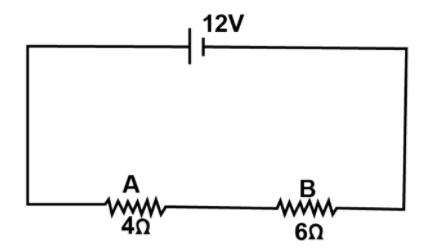
As the internal resistance of the cell and the two resistances are connected in series then the equivalent resistance of the connection will be
${{R}_{eq}}={{R}_{1}}+{{R}_{2}}+{{R}_{3}}=2+4+6=12\Omega $
(i) The current in the circuit due to the equivalent resistance connected to the cell having emf $12V$is
$i=\dfrac{V}{{{R}_{eq}}}=\dfrac{12}{12}=1A$
(ii) The potential drop across the cell is
${{V}_{drop}}=i\times \text{ internal resistance of the cell=1A}\times \text{2}\Omega \text{=2V}$
So the terminal voltage of the cell is
${{V}_{TERMINAL}}=12V-2V=10V$
(iii) The potential difference across $6\Omega $ Resistor is
$V=iR=1A\times 6\Omega =6Volts$
(iv) Electrical energy spent per minute in $4\Omega $ Resistor is
$E={{i}^{2}}Rt={{1}^{2}}\times 4\Omega \times 60s=240J$
Note: In series connection the total resistance of the circuit will increase and the same current will flow through each element of the circuit. So if a Fan, a bulb and a heater were connected in series the same current will flow through the fan, bulb and the heater. But they don’t require the same current so series connection will harm the equipment. But in parallel connection the equivalent resistance will decrease. Furthermore the current will be divided according to the needs of the equipment. So in household connection parallel connection is preferred over series connection.
Formula used: $V=iR$
Energy spent, $E={{i}^{2}}Rt$
Equivalent resistance of series connection of three resistance of ${{R}_{1}},{{R}_{2}}\text{ and }{{R}_{3}}$ is
${{R}_{eq}}={{R}_{1}}+{{R}_{2}}+{{R}_{3}}$
Where symbols carry their usual meaning.
Complete step by step answer:
As the internal resistance of the cell and the two resistances are connected in series then the equivalent resistance of the connection will be
${{R}_{eq}}={{R}_{1}}+{{R}_{2}}+{{R}_{3}}=2+4+6=12\Omega $
(i) The current in the circuit due to the equivalent resistance connected to the cell having emf $12V$is
$i=\dfrac{V}{{{R}_{eq}}}=\dfrac{12}{12}=1A$
(ii) The potential drop across the cell is
${{V}_{drop}}=i\times \text{ internal resistance of the cell=1A}\times \text{2}\Omega \text{=2V}$
So the terminal voltage of the cell is
${{V}_{TERMINAL}}=12V-2V=10V$
(iii) The potential difference across $6\Omega $ Resistor is
$V=iR=1A\times 6\Omega =6Volts$
(iv) Electrical energy spent per minute in $4\Omega $ Resistor is
$E={{i}^{2}}Rt={{1}^{2}}\times 4\Omega \times 60s=240J$
Note: In series connection the total resistance of the circuit will increase and the same current will flow through each element of the circuit. So if a Fan, a bulb and a heater were connected in series the same current will flow through the fan, bulb and the heater. But they don’t require the same current so series connection will harm the equipment. But in parallel connection the equivalent resistance will decrease. Furthermore the current will be divided according to the needs of the equipment. So in household connection parallel connection is preferred over series connection.
Recently Updated Pages
Master Class 12 Economics: Engaging Questions & Answers for Success

Master Class 12 Physics: Engaging Questions & Answers for Success
Master Class 12 English: Engaging Questions & Answers for Success
Master Class 12 Social Science: Engaging Questions & Answers for Success
Master Class 12 Maths: Engaging Questions & Answers for Success
Master Class 12 Business Studies: Engaging Questions & Answers for Success
Trending doubts
Which are the Top 10 Largest Countries of the World?
What are the major means of transport Explain each class 12 social science CBSE
Draw a labelled sketch of the human eye class 12 physics CBSE
Why cannot DNA pass through cell membranes class 12 biology CBSE
Differentiate between insitu conservation and exsitu class 12 biology CBSE
Draw a neat and well labeled diagram of TS of ovary class 12 biology CBSE