




A battery of emf 10V and internal resistance 3Ω is connected to a resistor. If the current in the circuit is 0.5A, what is the resistance of the resistor? What is the terminal voltage of the battery when the circuit is closed?
Answer
 Verified
638.1k+ views
Hint: Draw the circuit diagram according to the question. Internal resistance can be considered to be a series resistance with the battery. Use Kirchhoff's Voltage Law to write the voltage equation for the circuit. Solve it to find the resistor. Terminal voltage of the battery is given by the multiplication of load current and load resistance.
Formula Used:
Ohm’s law gives us,
V=IR
Where,
V is the voltage across the resistor
I is the current through the resistor
R is the resistance of the resistor
Complete step by step answer:
Let us first, look at the circuit diagram.
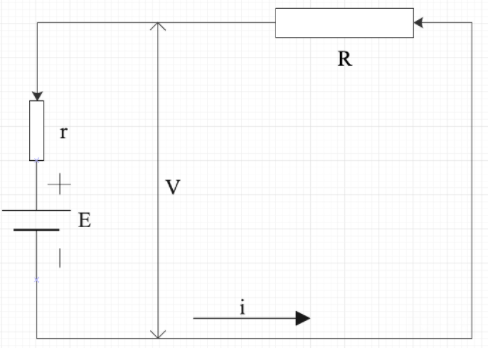
Let’s assume that the current flowing through the circuit is i.
So, we can write,
$\Rightarrow R=\dfrac{E-Ir}{I}$
The value of the external resistance is R
The EMF of the battery is 10 V
Hence, we can write,
$R=\dfrac{E-Ir}{I}$
Internal resistance of the battery, r =3Ω.
We can write the following equation using Kirchhoff’s voltage law,
$E-IR-Ir=0$
$\Rightarrow R=\dfrac{10-(0.5)3}{0.5}=17$
Hence, the value of Resistance R = 17 Ω
Now, we can find the voltage across the battery by calculating the voltage across the load resistor.
Voltage across the battery and voltage across the load resistor should be the same because we can consider them to be in parallel connection.
Hence, we can write,
The terminal voltage of the battery = The load voltage =
$V=IR=(0.5)(17)=8.5$
So, the terminal voltage of the battery is 8.5 V.
Note: The terminal voltage of the battery is less than the EMF of the battery because of the presence of internal resistance. We can find the terminal voltage in another method as well.
The terminal voltage will be given by,
$V=E-Ir=10-(0.5)3=8.5$
Some of the EMF is lost in the voltage drop across the internal resistance.
Formula Used:
Ohm’s law gives us,
V=IR
Where,
V is the voltage across the resistor
I is the current through the resistor
R is the resistance of the resistor
Complete step by step answer:
Let us first, look at the circuit diagram.
Let’s assume that the current flowing through the circuit is i.
So, we can write,
$\Rightarrow R=\dfrac{E-Ir}{I}$
The value of the external resistance is R
The EMF of the battery is 10 V
Hence, we can write,
$R=\dfrac{E-Ir}{I}$
Internal resistance of the battery, r =3Ω.
We can write the following equation using Kirchhoff’s voltage law,
$E-IR-Ir=0$
$\Rightarrow R=\dfrac{10-(0.5)3}{0.5}=17$
Hence, the value of Resistance R = 17 Ω
Now, we can find the voltage across the battery by calculating the voltage across the load resistor.
Voltage across the battery and voltage across the load resistor should be the same because we can consider them to be in parallel connection.
Hence, we can write,
The terminal voltage of the battery = The load voltage =
$V=IR=(0.5)(17)=8.5$
So, the terminal voltage of the battery is 8.5 V.
Note: The terminal voltage of the battery is less than the EMF of the battery because of the presence of internal resistance. We can find the terminal voltage in another method as well.
The terminal voltage will be given by,
$V=E-Ir=10-(0.5)3=8.5$
Some of the EMF is lost in the voltage drop across the internal resistance.
Recently Updated Pages
Master Class 12 Business Studies: Engaging Questions & Answers for Success

Master Class 12 Chemistry: Engaging Questions & Answers for Success
Master Class 12 Biology: Engaging Questions & Answers for Success
Class 12 Question and Answer - Your Ultimate Solutions Guide
Master Class 11 English: Engaging Questions & Answers for Success
Master Class 11 Social Science: Engaging Questions & Answers for Success
Trending doubts
Which are the Top 10 Largest Countries of the World?
Draw a labelled sketch of the human eye class 12 physics CBSE
Differentiate between homogeneous and heterogeneous class 12 chemistry CBSE
Differentiate between Pyramid of energy and pyramid class 12 biology CBSE
Why is the cell called the structural and functional class 12 biology CBSE
Draw the diagram of the pyramid of energy Explain In class 12 biology CBSE