




A battery of 20 cells (each having e.m.f. 1.8V and internal resistance $ 0.1\Omega $ ) is charged by 220 volts and the charging current is 15A. Calculate the resistance to be put in the circuit.
Answer
 Verified
609.9k+ views
Hint: You could get the total emf and the total internal resistance of the battery by multiplying the emf and internal resistance of each cell with the total number of cells. Now you could find the net voltage in the circuit and the net resistance in the circuit. Then, you could do necessary substitutions in Ohm’s law to get the required resistance that should be put in the circuit.
Formula used:
Ohm’s law,
$ V=IR $
Complete step-by-step answer:
In the question, we are given a battery that has 20 cells in it, each of 1.8V emf and $ 0.1\Omega $ internal resistance. This battery is being charged by 220V and the charging current is given as 15A. We are asked to find the resistance has to be put in the circuit with all the above given conditions.
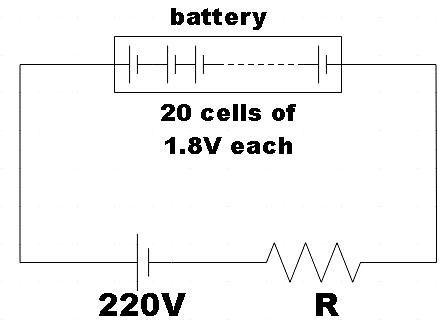
As the battery has 20 cells of 1.8V each, the total emf of the battery is given by,
$ E=20\times 1.8V=36V $
Also, each cell has $ 0.1\Omega $ so the total internal resistance of the battery will be,
$ r=0.1\times 20=2\Omega $
As the battery is being charged by 220V external voltage, their polarity will be opposite to each other, so, the total voltage in the circuit will be given by,
$ {{E}_{net}}=220V-36V=184V $
The total resistance in the circuit will be the sum of unknown resistance to be added and the total internal resistance of the battery that is being charged. So,
$ {{R}_{net}}=R+r=\left( R+2 \right)\Omega $
The charging current is given in the question as 15A. So, by ohm’s law,
$ V=IR $
Substituting all given quantities,
$ 184V=\left( 15A \right)\left( R+2 \right)\Omega $
$ \Rightarrow R+2=12.27 $
$ \therefore R=10.27\Omega $
Therefore, we found the resistance to be put in the circuit to be $ 10.27\Omega $ .
Note: In the solution, we are actually finding the resistance that has to be put in the circuit such that the charging current is 15A in the circuit. Also, you may have noted that the connection of the battery with the external voltage that is done so as to aid the flow of charging current. Also, while considering the total resistance of the circuit, never forget to include the internal resistance of the battery.
Formula used:
Ohm’s law,
$ V=IR $
Complete step-by-step answer:
In the question, we are given a battery that has 20 cells in it, each of 1.8V emf and $ 0.1\Omega $ internal resistance. This battery is being charged by 220V and the charging current is given as 15A. We are asked to find the resistance has to be put in the circuit with all the above given conditions.
As the battery has 20 cells of 1.8V each, the total emf of the battery is given by,
$ E=20\times 1.8V=36V $
Also, each cell has $ 0.1\Omega $ so the total internal resistance of the battery will be,
$ r=0.1\times 20=2\Omega $
As the battery is being charged by 220V external voltage, their polarity will be opposite to each other, so, the total voltage in the circuit will be given by,
$ {{E}_{net}}=220V-36V=184V $
The total resistance in the circuit will be the sum of unknown resistance to be added and the total internal resistance of the battery that is being charged. So,
$ {{R}_{net}}=R+r=\left( R+2 \right)\Omega $
The charging current is given in the question as 15A. So, by ohm’s law,
$ V=IR $
Substituting all given quantities,
$ 184V=\left( 15A \right)\left( R+2 \right)\Omega $
$ \Rightarrow R+2=12.27 $
$ \therefore R=10.27\Omega $
Therefore, we found the resistance to be put in the circuit to be $ 10.27\Omega $ .
Note: In the solution, we are actually finding the resistance that has to be put in the circuit such that the charging current is 15A in the circuit. Also, you may have noted that the connection of the battery with the external voltage that is done so as to aid the flow of charging current. Also, while considering the total resistance of the circuit, never forget to include the internal resistance of the battery.
Recently Updated Pages
Master Class 12 Business Studies: Engaging Questions & Answers for Success

Master Class 12 Chemistry: Engaging Questions & Answers for Success
Master Class 12 Biology: Engaging Questions & Answers for Success
Class 12 Question and Answer - Your Ultimate Solutions Guide
Master Class 11 English: Engaging Questions & Answers for Success
Master Class 11 Social Science: Engaging Questions & Answers for Success
Trending doubts
Which are the Top 10 Largest Countries of the World?
Draw a labelled sketch of the human eye class 12 physics CBSE
The end of compass needle which points towards north class 12 physics CBSE
Differentiate between homogeneous and heterogeneous class 12 chemistry CBSE
In order to find out the different types of gametes class 12 biology NEET_UG
Why is the cell called the structural and functional class 12 biology CBSE