




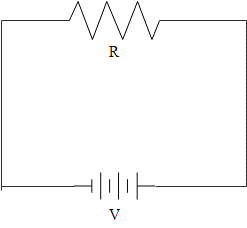
A battery of $10V$ carries $20000C$ of charge through a resistance of $20\Omega $. Calculate the work done in $10s$.
$\begin{align}
& A.2\times {{10}^{3}}J \\
& B.2\times {{10}^{5}}J \\
& C.2\times {{10}^{4}}J \\
& D.2\times {{10}^{2}}J \\
\end{align}$
Answer
 Verified
537.2k+ views
Hint: The work done of a battery is found by taking the product of charge of the battery and the electric potential of the battery. Substitute the values given in the question and find out the value of work done. This will be helpful in solving this question.
Complete step by step answer:
First of all let us mention what all are given in the question. The voltage of the battery has been mentioned as,
$V=10V$
The charge inside the battery is given as,
$q=10000C$
Resistance connected to the battery is given as,
$R=20\Omega $
The time taken for the flow of this much charge through the resistor is mentioned as,
$t=10s$
The work done by the battery can be found by the equation given as,
$w=qV$
Substituting the values in it will be given as,
$w=10\times 20000=2\times {{10}^{5}}J$
So, the correct answer is “Option B”.
Note: A battery is defined as a device which can be used to store chemical energy and then convert it into electrical energy. The chemical reactions in the battery consist of the flow of electrons from one material known as electrode to another electrode, through an external circuit. The flow of electrons is providing an electric current that can be helpful to do work. If a battery is supplying the electric power. In the battery, the positive terminal is named as the cathode and its negative terminal is named as the anode. Batteries are supplying only the DC voltage. The battery casing is a steel container which holds the electrodes, the anode and the cathode. The cathode is a silvery matte ring which is made of manganese dioxide, graphite and electrolyte. The separator keeps the electrodes at a distance to oppose a short circuit.
Complete step by step answer:
First of all let us mention what all are given in the question. The voltage of the battery has been mentioned as,
$V=10V$
The charge inside the battery is given as,
$q=10000C$
Resistance connected to the battery is given as,
$R=20\Omega $
The time taken for the flow of this much charge through the resistor is mentioned as,
$t=10s$
The work done by the battery can be found by the equation given as,
$w=qV$
Substituting the values in it will be given as,
$w=10\times 20000=2\times {{10}^{5}}J$
So, the correct answer is “Option B”.
Note: A battery is defined as a device which can be used to store chemical energy and then convert it into electrical energy. The chemical reactions in the battery consist of the flow of electrons from one material known as electrode to another electrode, through an external circuit. The flow of electrons is providing an electric current that can be helpful to do work. If a battery is supplying the electric power. In the battery, the positive terminal is named as the cathode and its negative terminal is named as the anode. Batteries are supplying only the DC voltage. The battery casing is a steel container which holds the electrodes, the anode and the cathode. The cathode is a silvery matte ring which is made of manganese dioxide, graphite and electrolyte. The separator keeps the electrodes at a distance to oppose a short circuit.
Recently Updated Pages
Basicity of sulphurous acid and sulphuric acid are

Master Class 12 English: Engaging Questions & Answers for Success
Master Class 12 Social Science: Engaging Questions & Answers for Success
Master Class 12 Maths: Engaging Questions & Answers for Success
Master Class 12 Economics: Engaging Questions & Answers for Success
Master Class 12 Physics: Engaging Questions & Answers for Success
Trending doubts
Which are the Top 10 Largest Countries of the World?
Draw a labelled sketch of the human eye class 12 physics CBSE
Which country did Danny Casey play for class 12 english CBSE
Give 10 examples of unisexual and bisexual flowers
Coming together federation is practiced in A India class 12 social science CBSE
Write the formula to find the shortest distance between class 12 maths CBSE