




A battery of 10 volt is connected to a resistance of 20 ohm through a variable resistance $R$, the amount of charge which has passed in the circuit in $4$ minutes, if the variable resistance $R$ is increased at the rate of $5$ ohm/min.
A) $120$ coulomb
B) $120{\log _e}2$ coulomb
C) $120/{\log _e}2$ coulomb
D) $60/{\log _e}2$ coulomb
Answer
 Verified
598.8k+ views
Hint: The resistance prevents the free movement of the charges under a potential difference. The current flow is defined as the rate of amount of charge passed with time. This current, resistance and potential are related which need to be investigated to solve this problem.
Formulae Used:
From Ohm’s law you have
$V = IR$
where, $V$ is potential difference applied, $R$ is the resistance and $I$ is the current flow.
Complete step by step answer:
Given: The potential of the battery is $V = $ $10$ volt.
The variable resistance is $R$ ohm.
The rate of increase of the resistance is $\dfrac{{dR}}{{dt}} = 5$ohm/min.
The time observed is $4$ min.
To get: The amount of charge passed.
Step 1:
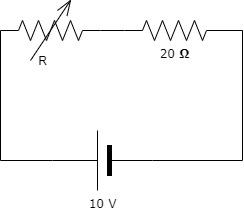
By definition, you know that $I = \dfrac{{dq}}{{dt}}$, where $q$ is the total charge passed through time $t$.
Now express eq (1) in terms of this definition
$
\dfrac{V}{R} = I \\
\Rightarrow \dfrac{{dq}}{{dt}} = \dfrac{V}{R} \\
$
You can represent the expression as
$ \Rightarrow \dfrac{{dq}}{{dR}}\dfrac{{dR}}{{dt}} = \dfrac{V}{R}$
Now you can get
$
dq = V\dfrac{{dt}}{{dR}}\dfrac{{dR}}{R} \\
\Rightarrow dq = \dfrac{V}{{\dfrac{{dR}}{{dt}}}}\dfrac{{dR}}{R} \\
$
By the problem you have $V = 10$ volt and $\dfrac{{dR}}{{dt}} = 5$ ohm/min.
So, finally you have
$
dq = \dfrac{{10}}{{\dfrac{5}{{60}}}}\dfrac{{dR}}{R} \\
\Rightarrow dq = 120\dfrac{{dR}}{R} \\
$
Step 2:
The observed time is $4$ minutes and during that time, the variable resistance increases with the rate of
$\dfrac{{dR}}{{dt}} = 5$ ohm/min.
The total increase in resistance is
$\Rightarrow dR = \dfrac{5}{{60}}dT = \dfrac{5}{{60}} \times 4 \times 60$ ohm $ = 20$ ohm
Calculate the final resistance
$\Rightarrow {R_{final}} = \left( {20 + 20} \right)$ ohm $ = 40$ ohm
Step 3:
Now to calculate the total charge passed during that observed $4$ minutes, you need to integrate eq (2).
$
\int {dq} = 120\int_{20}^{40} {\dfrac{{dR}}{R}} \\
\Rightarrow Q = 120 \times \left[ {{{\log }_e}R} \right]_{20}^{40} \\
\Rightarrow Q = 120 \times [{\log _e}40 - {\log _e}20] \\
\Rightarrow Q = 120 \times {\log _e}\dfrac{{40}}{{20}} \\
\Rightarrow Q = 120 \times {\log _e}2 \\
$
$\therefore Q = 120{\log _e}2$ coulomb
If a battery of $10$ volt is connected to a resistance of $20$ ohm through a variable resistance $R$, the amount of charge which has passed in the circuit in $4$ minutes, if the variable resistance $R$ is increased at the rate of $5$ ohm/min, is $120{\log _e}2$ coulomb. Hence option B is correct.
Note:
Only the resistance is said to be variable. You should treat the rest terms even the rate of increase of the resistance to be constant. When the dependence of the charge and the variable is established, you should understand that a continuous relative change is happening and hence, you should attempt the integration. Be careful in choosing the limits of the resistance during the observed time.
Formulae Used:
From Ohm’s law you have
$V = IR$
where, $V$ is potential difference applied, $R$ is the resistance and $I$ is the current flow.
Complete step by step answer:
Given: The potential of the battery is $V = $ $10$ volt.
The variable resistance is $R$ ohm.
The rate of increase of the resistance is $\dfrac{{dR}}{{dt}} = 5$ohm/min.
The time observed is $4$ min.
To get: The amount of charge passed.
Step 1:
By definition, you know that $I = \dfrac{{dq}}{{dt}}$, where $q$ is the total charge passed through time $t$.
Now express eq (1) in terms of this definition
$
\dfrac{V}{R} = I \\
\Rightarrow \dfrac{{dq}}{{dt}} = \dfrac{V}{R} \\
$
You can represent the expression as
$ \Rightarrow \dfrac{{dq}}{{dR}}\dfrac{{dR}}{{dt}} = \dfrac{V}{R}$
Now you can get
$
dq = V\dfrac{{dt}}{{dR}}\dfrac{{dR}}{R} \\
\Rightarrow dq = \dfrac{V}{{\dfrac{{dR}}{{dt}}}}\dfrac{{dR}}{R} \\
$
By the problem you have $V = 10$ volt and $\dfrac{{dR}}{{dt}} = 5$ ohm/min.
So, finally you have
$
dq = \dfrac{{10}}{{\dfrac{5}{{60}}}}\dfrac{{dR}}{R} \\
\Rightarrow dq = 120\dfrac{{dR}}{R} \\
$
Step 2:
The observed time is $4$ minutes and during that time, the variable resistance increases with the rate of
$\dfrac{{dR}}{{dt}} = 5$ ohm/min.
The total increase in resistance is
$\Rightarrow dR = \dfrac{5}{{60}}dT = \dfrac{5}{{60}} \times 4 \times 60$ ohm $ = 20$ ohm
Calculate the final resistance
$\Rightarrow {R_{final}} = \left( {20 + 20} \right)$ ohm $ = 40$ ohm
Step 3:
Now to calculate the total charge passed during that observed $4$ minutes, you need to integrate eq (2).
$
\int {dq} = 120\int_{20}^{40} {\dfrac{{dR}}{R}} \\
\Rightarrow Q = 120 \times \left[ {{{\log }_e}R} \right]_{20}^{40} \\
\Rightarrow Q = 120 \times [{\log _e}40 - {\log _e}20] \\
\Rightarrow Q = 120 \times {\log _e}\dfrac{{40}}{{20}} \\
\Rightarrow Q = 120 \times {\log _e}2 \\
$
$\therefore Q = 120{\log _e}2$ coulomb
If a battery of $10$ volt is connected to a resistance of $20$ ohm through a variable resistance $R$, the amount of charge which has passed in the circuit in $4$ minutes, if the variable resistance $R$ is increased at the rate of $5$ ohm/min, is $120{\log _e}2$ coulomb. Hence option B is correct.
Note:
Only the resistance is said to be variable. You should treat the rest terms even the rate of increase of the resistance to be constant. When the dependence of the charge and the variable is established, you should understand that a continuous relative change is happening and hence, you should attempt the integration. Be careful in choosing the limits of the resistance during the observed time.
Recently Updated Pages
Three beakers labelled as A B and C each containing 25 mL of water were taken A small amount of NaOH anhydrous CuSO4 and NaCl were added to the beakers A B and C respectively It was observed that there was an increase in the temperature of the solutions contained in beakers A and B whereas in case of beaker C the temperature of the solution falls Which one of the following statements isarecorrect i In beakers A and B exothermic process has occurred ii In beakers A and B endothermic process has occurred iii In beaker C exothermic process has occurred iv In beaker C endothermic process has occurred

Master Class 12 Social Science: Engaging Questions & Answers for Success
Master Class 12 Physics: Engaging Questions & Answers for Success
Master Class 12 Maths: Engaging Questions & Answers for Success
Master Class 12 Economics: Engaging Questions & Answers for Success
Master Class 12 Chemistry: Engaging Questions & Answers for Success
Three beakers labelled as A B and C each containing 25 mL of water were taken A small amount of NaOH anhydrous CuSO4 and NaCl were added to the beakers A B and C respectively It was observed that there was an increase in the temperature of the solutions contained in beakers A and B whereas in case of beaker C the temperature of the solution falls Which one of the following statements isarecorrect i In beakers A and B exothermic process has occurred ii In beakers A and B endothermic process has occurred iii In beaker C exothermic process has occurred iv In beaker C endothermic process has occurred
Master Class 12 Social Science: Engaging Questions & Answers for Success
Master Class 12 Physics: Engaging Questions & Answers for Success
Trending doubts
Which are the Top 10 Largest Countries of the World?
Draw a labelled sketch of the human eye class 12 physics CBSE
Differentiate between homogeneous and heterogeneous class 12 chemistry CBSE
What are the major means of transport Explain each class 12 social science CBSE
Sulphuric acid is known as the king of acids State class 12 chemistry CBSE
Why should a magnesium ribbon be cleaned before burning class 12 chemistry CBSE