




A band playing music at a frequency f is moving towards a wall at a speed ${V_b}$. A motorist is followed by the band with a speed ${V_m}$. If $V$ is the speed of the sound, the expression for the beat frequency heard by the motorist is:
A) $\dfrac{{V + {V_m}}}{{V + {V_b}}}f$
B) $\dfrac{{V + {V_m}}}{{V - {V_b}}}f$
C) $\dfrac{{2{V_b}(V + {V_m})}}{{{V^2} - V_b^2}}f$
D) $\dfrac{{2{V_m}(V + {V_b})}}{{{V^2} - V_m^2}}f$
Answer
 Verified
578.7k+ views
Hint: When the source of the waves is moving with respect to an observer, then Doppler’s effect can be observed. It is the change in the frequency of a wave. Since the Doppler’s effect depends on the moving objects, it can also be used to determine the speed or motion of the object.
Complete step by step answer:
Step I:
Given that the band is playing a music that moves towards the ball with velocity ${V_b}$. Then a motorist is following the band with a speed ${V_m}$. Therefore, the band is the source and the motorist is the observer.
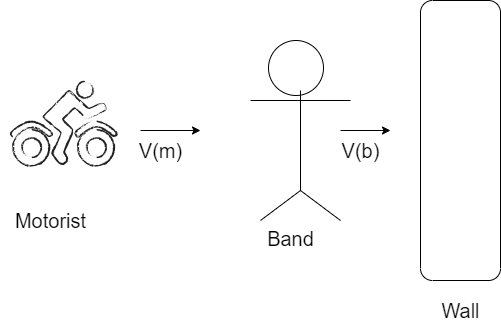
Step II:
So, in this case, according to Doppler’s effect, the observed frequency is given by
$f' = f(\dfrac{{V + {V_m})}}{{V + {V_b}}})$----(i)
$f'$ is the observer frequency of sound
$f$ is actual frequency of sound waves
$V$ is the speed of sound waves
${V_m}$ is the observer velocity
${V_b}$ is the source velocity
Step III:
When the sound waves of the music band strikes the wall, the wall acts as an observer and the band acts as a source. The observer is stationary and not moving so its velocity will be zero.
Again using Doppler’s effect, when the source is approaching towards the observer, the frequency is given as
$f'' = f(\dfrac{V}{{V - {V_b}}})$---(ii)
Step IV:
Now when the sound waves get reflected from the wall, they approach the motorist. Therefore, the wall will be the source and the motorist will be the observer. The wall is stationary and acting as a source, so its velocity will be zero. When the observer is approaching the source, the frequency is
$f''' = f''(\dfrac{{V + {V_m}}}{V})$---(iii)
Step V:
Substitute the value from equation (ii) in equation (iii),
$f''' = f(\dfrac{V}{{V - {V_b}}})(\dfrac{{V + {V_m}}}{V})$
$\Rightarrow f''' = f(\dfrac{{V + {V_m}}}{{V - {V_b}}})$---(iv)
Step VI:
The sound heard by the motorist can be written by using beat frequency. The beat frequency is equal to the difference of the frequency of two waves. Therefore,
${f_b} = f''' - f'$
$\Rightarrow {f_b} = f(\dfrac{{V + {V_m}}}{{V - {V_b}}}) - f(\dfrac{{V + {V_m}}}{{V + {V_b}}})$
$\Rightarrow {f_b} = f(V + {V_m})(\dfrac{1}{{V - {V_b}}} - \dfrac{1}{{V + {V_b}}})$
$\Rightarrow {f_b} = f(V + {V_m})(\dfrac{{V + {V_b} - V + {V_b}}}{{{V^2} - V_b^2}})$
$\Rightarrow {f_b} = f(V + {V_m})(\dfrac{{2{V_b}}}{{{V^2} - V_b^2}})$
$\therefore $ The frequency of the band heard by the motorist is $f(V + {V_m})(\dfrac{{2{V_b}}}{{{V^2} - V_b^2}})$. Hence option C is the right answer.
Note:
It is important to note that the Doppler’s effect does not result because of an actual frequency change of the source. It can be observed for many types of waves like sound, water or light waves. Also sound waves require a medium to propagate. Doppler’s effect is asymmetric for sound waves.
Complete step by step answer:
Step I:
Given that the band is playing a music that moves towards the ball with velocity ${V_b}$. Then a motorist is following the band with a speed ${V_m}$. Therefore, the band is the source and the motorist is the observer.
Step II:
So, in this case, according to Doppler’s effect, the observed frequency is given by
$f' = f(\dfrac{{V + {V_m})}}{{V + {V_b}}})$----(i)
$f'$ is the observer frequency of sound
$f$ is actual frequency of sound waves
$V$ is the speed of sound waves
${V_m}$ is the observer velocity
${V_b}$ is the source velocity
Step III:
When the sound waves of the music band strikes the wall, the wall acts as an observer and the band acts as a source. The observer is stationary and not moving so its velocity will be zero.
Again using Doppler’s effect, when the source is approaching towards the observer, the frequency is given as
$f'' = f(\dfrac{V}{{V - {V_b}}})$---(ii)
Step IV:
Now when the sound waves get reflected from the wall, they approach the motorist. Therefore, the wall will be the source and the motorist will be the observer. The wall is stationary and acting as a source, so its velocity will be zero. When the observer is approaching the source, the frequency is
$f''' = f''(\dfrac{{V + {V_m}}}{V})$---(iii)
Step V:
Substitute the value from equation (ii) in equation (iii),
$f''' = f(\dfrac{V}{{V - {V_b}}})(\dfrac{{V + {V_m}}}{V})$
$\Rightarrow f''' = f(\dfrac{{V + {V_m}}}{{V - {V_b}}})$---(iv)
Step VI:
The sound heard by the motorist can be written by using beat frequency. The beat frequency is equal to the difference of the frequency of two waves. Therefore,
${f_b} = f''' - f'$
$\Rightarrow {f_b} = f(\dfrac{{V + {V_m}}}{{V - {V_b}}}) - f(\dfrac{{V + {V_m}}}{{V + {V_b}}})$
$\Rightarrow {f_b} = f(V + {V_m})(\dfrac{1}{{V - {V_b}}} - \dfrac{1}{{V + {V_b}}})$
$\Rightarrow {f_b} = f(V + {V_m})(\dfrac{{V + {V_b} - V + {V_b}}}{{{V^2} - V_b^2}})$
$\Rightarrow {f_b} = f(V + {V_m})(\dfrac{{2{V_b}}}{{{V^2} - V_b^2}})$
$\therefore $ The frequency of the band heard by the motorist is $f(V + {V_m})(\dfrac{{2{V_b}}}{{{V^2} - V_b^2}})$. Hence option C is the right answer.
Note:
It is important to note that the Doppler’s effect does not result because of an actual frequency change of the source. It can be observed for many types of waves like sound, water or light waves. Also sound waves require a medium to propagate. Doppler’s effect is asymmetric for sound waves.
Recently Updated Pages
Master Class 12 Economics: Engaging Questions & Answers for Success

Master Class 12 Physics: Engaging Questions & Answers for Success
Master Class 12 English: Engaging Questions & Answers for Success
Master Class 12 Social Science: Engaging Questions & Answers for Success
Master Class 12 Maths: Engaging Questions & Answers for Success
Master Class 12 Business Studies: Engaging Questions & Answers for Success
Trending doubts
Which are the Top 10 Largest Countries of the World?
What are the major means of transport Explain each class 12 social science CBSE
Draw a labelled sketch of the human eye class 12 physics CBSE
Why cannot DNA pass through cell membranes class 12 biology CBSE
Differentiate between insitu conservation and exsitu class 12 biology CBSE
Draw a neat and well labeled diagram of TS of ovary class 12 biology CBSE