




A $9 - volt$ battery is connected to four resistors to form a simple circuit as shown below. What would be the electric potential at point $B$ with respect to point $C$ in the above circuit?
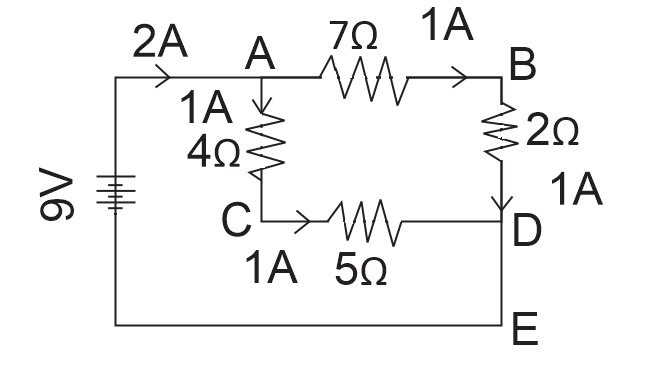
A. $ + 7V$
B. $ + 3V$
C. $0V$
D. $ - 3V$
Answer
 Verified
599.7k+ views
Hint: Simplify the circuit to calculate equivalent resistance along AD.
From this, calculate current through each arm of the circuit. Then use it to solve the question.
Formula used:
For seems:
${R_{eq}} = {R_1} + {R_2}$
$\dfrac{1}{{{R_q}}} = \dfrac{1}{{{R_1}}} + \dfrac{1}{{{R_2}}}$
$v = 1R$
Complete step by step answer:
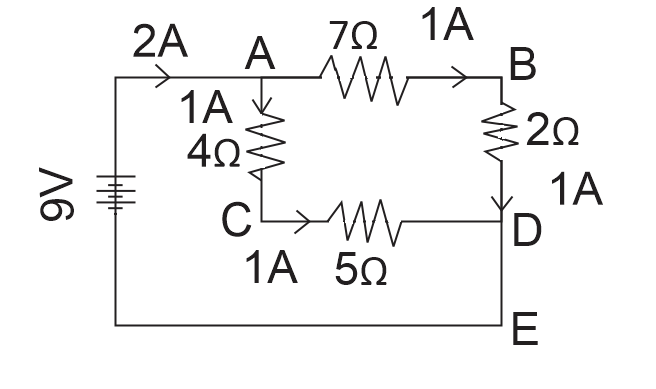
We can clearly observe that the resistances, $7\Omega $ and $2\Omega $, and also, $4\Omega $ and $5\Omega $
Between points A and D are converted in since to each other.
Since, for series resistance
${K_{eq}} = {R_1} + {R_2}$
We get
${R_1} = 7 + 2$and
${R_2} = 4 + 5$
Then the circuit will simplify to
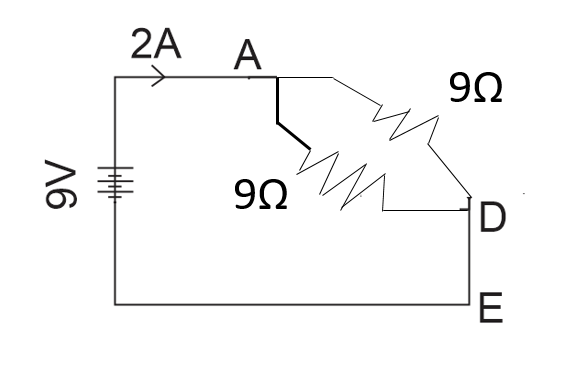
Now, the resistances between A and D are commented is formula.
We know, for parallel commotion.
$\dfrac{1}{{{R_{eq}}}} = \dfrac{1}{{{R_1}}} + \dfrac{1}{{{R_2}}}$
$\dfrac{1}{{{R_{eq}}}} = - \dfrac{1}{9} + \dfrac{1}{9}$
$ = \dfrac{2}{9}$ (By taking LCM and adding)
By taking reciprocal
We get,
${R_{eq}} = \dfrac{9}{2}$
$ \Rightarrow {R_{eq}} = 4.5\Omega $
Now, by ohm’s law
We know that
$v = 1R$
Where, $v$is partial
$I$is correct
$R$is resistance
By re-arranged the equation
We get,
By substituting the values in it,
We get,
$I = \dfrac{9}{{4.5}}$ ($\because v = 9v,R = 4.5\Omega $)
$ \Rightarrow I = 2A$
Therefore, the total current flowing through the circuit is $2A.$
Now, if we observe the last circuit diagram,
We can see that the resistance between both the arms of AD is the same.
Hence, equal current most parts through them
Therefore, we can say that
1A current is passing through ABC.
And 1A current is passing.
Through ACD
Now, for the simplicity of calculation.
Let us imagine that the potential of the negative terminal battery is zero.
Then the potential at the positive terminal will be$9v$.
Therefore, we can writ potential at be
${v_B} = 9 - (7 \times 1)(\because EMF = 9,R = 7,I = 1)$
$ \Rightarrow {v_B} = 2v$
Simplify, potential at $c$
$i.e{V_c} = 9 - (4 \times 1)$
$ \Rightarrow {V_c} = 5V$
Therefore, potential at point BV with respect to potential at point C is
${V_C} = {V_C} - {V_B}$
$ \Rightarrow {V_{BCC}} = 5 - 2$
$ \Rightarrow {V_{BC}} = 3v$
So, the correct answer is “Option B”.
Note:
For this question you need to be able to figure out which resistance are connected in series and which are parallel.
Every given information is important like in this question knowing that the resistance between A and D are equal helped us to understand that equal current will flow through them.
From this, calculate current through each arm of the circuit. Then use it to solve the question.
Formula used:
For seems:
${R_{eq}} = {R_1} + {R_2}$
$\dfrac{1}{{{R_q}}} = \dfrac{1}{{{R_1}}} + \dfrac{1}{{{R_2}}}$
$v = 1R$
Complete step by step answer:
We can clearly observe that the resistances, $7\Omega $ and $2\Omega $, and also, $4\Omega $ and $5\Omega $
Between points A and D are converted in since to each other.
Since, for series resistance
${K_{eq}} = {R_1} + {R_2}$
We get
${R_1} = 7 + 2$and
${R_2} = 4 + 5$
Then the circuit will simplify to
Now, the resistances between A and D are commented is formula.
We know, for parallel commotion.
$\dfrac{1}{{{R_{eq}}}} = \dfrac{1}{{{R_1}}} + \dfrac{1}{{{R_2}}}$
$\dfrac{1}{{{R_{eq}}}} = - \dfrac{1}{9} + \dfrac{1}{9}$
$ = \dfrac{2}{9}$ (By taking LCM and adding)
By taking reciprocal
We get,
${R_{eq}} = \dfrac{9}{2}$
$ \Rightarrow {R_{eq}} = 4.5\Omega $
Now, by ohm’s law
We know that
$v = 1R$
Where, $v$is partial
$I$is correct
$R$is resistance
By re-arranged the equation
We get,
By substituting the values in it,
We get,
$I = \dfrac{9}{{4.5}}$ ($\because v = 9v,R = 4.5\Omega $)
$ \Rightarrow I = 2A$
Therefore, the total current flowing through the circuit is $2A.$
Now, if we observe the last circuit diagram,
We can see that the resistance between both the arms of AD is the same.
Hence, equal current most parts through them
Therefore, we can say that
1A current is passing through ABC.
And 1A current is passing.
Through ACD
Now, for the simplicity of calculation.
Let us imagine that the potential of the negative terminal battery is zero.
Then the potential at the positive terminal will be$9v$.
Therefore, we can writ potential at be
${v_B} = 9 - (7 \times 1)(\because EMF = 9,R = 7,I = 1)$
$ \Rightarrow {v_B} = 2v$
Simplify, potential at $c$
$i.e{V_c} = 9 - (4 \times 1)$
$ \Rightarrow {V_c} = 5V$
Therefore, potential at point BV with respect to potential at point C is
${V_C} = {V_C} - {V_B}$
$ \Rightarrow {V_{BCC}} = 5 - 2$
$ \Rightarrow {V_{BC}} = 3v$
So, the correct answer is “Option B”.
Note:
For this question you need to be able to figure out which resistance are connected in series and which are parallel.
Every given information is important like in this question knowing that the resistance between A and D are equal helped us to understand that equal current will flow through them.
Recently Updated Pages
Three beakers labelled as A B and C each containing 25 mL of water were taken A small amount of NaOH anhydrous CuSO4 and NaCl were added to the beakers A B and C respectively It was observed that there was an increase in the temperature of the solutions contained in beakers A and B whereas in case of beaker C the temperature of the solution falls Which one of the following statements isarecorrect i In beakers A and B exothermic process has occurred ii In beakers A and B endothermic process has occurred iii In beaker C exothermic process has occurred iv In beaker C endothermic process has occurred

Master Class 12 Social Science: Engaging Questions & Answers for Success
Master Class 12 Physics: Engaging Questions & Answers for Success
Master Class 12 Maths: Engaging Questions & Answers for Success
Master Class 12 Economics: Engaging Questions & Answers for Success
Master Class 12 Chemistry: Engaging Questions & Answers for Success
Three beakers labelled as A B and C each containing 25 mL of water were taken A small amount of NaOH anhydrous CuSO4 and NaCl were added to the beakers A B and C respectively It was observed that there was an increase in the temperature of the solutions contained in beakers A and B whereas in case of beaker C the temperature of the solution falls Which one of the following statements isarecorrect i In beakers A and B exothermic process has occurred ii In beakers A and B endothermic process has occurred iii In beaker C exothermic process has occurred iv In beaker C endothermic process has occurred
Master Class 12 Social Science: Engaging Questions & Answers for Success
Master Class 12 Physics: Engaging Questions & Answers for Success
Trending doubts
Which are the Top 10 Largest Countries of the World?
Draw a labelled sketch of the human eye class 12 physics CBSE
Differentiate between homogeneous and heterogeneous class 12 chemistry CBSE
What are the major means of transport Explain each class 12 social science CBSE
Sulphuric acid is known as the king of acids State class 12 chemistry CBSE
Why should a magnesium ribbon be cleaned before burning class 12 chemistry CBSE