




A $6\,V$ battery is connected to the terminals of the three-meter-long wire of uniform thickness and the resistance of $100\,\Omega $. The difference of potential between two points on the wire separated by a distance of $50\,cm$ will be.
(A) $1.5\,V$
(B) $3\,V$
(C) $3.5\,V$
(D) $1\,V$
Answer
 Verified
617.4k+ views
Hint: In this problem, the relation between the voltage, resistance and length is given. The relation between the voltage and resistance and length is given by Ohm’s law. By knowing the relation between these three parameters, the potential difference will be determined.
Formulae Used:
Ohm’s law states that the voltage across any conductor is directly proportional to the resistance.
$V \propto R$ and $R \propto l$
Where, $V$ is the voltage, $R$ is the resistance and $l$ is then length of the conductor.
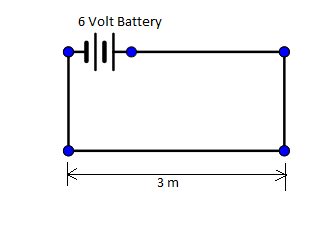
Complete step-by-step solution:
Given that,
The initial voltage, ${V_i} = 6\,V$
Resistance, $R = 100\,\Omega $
Length of the wire, $l = 3\,m$
Potential between two points on the wire separated by a distance, ${l_p} = 50\,cm$
Assume that, the potential difference between two points as ${V_f}$, the length of the wire as ${l_i}$ and the difference of potential between two points on the wire separated by a distance as ${l_f}$.
By Ohm’s law,
$V \propto R$ and $R \propto l$
Then,
$V \propto l$
By taking the ratio of initial voltage and initial length to the final voltage and final length, then
$\dfrac{{{V_i}}}{{{V_f}}} = \dfrac{{{l_i}}}{{{l_f}}}\,..............\left( 1 \right)$
By substituting the initial voltage, initial and final length in the above equation (1), then
$\dfrac{6}{{{V_f}}} = \dfrac{3}{{50 \times {{10}^{ - 2}}}}\,...................\left( 2 \right)$
In the above equation, the final length is substituted in terms of meters.
By taking the ${V_f}$ in one side and the other terms in other side, then the equation (2) is written as,
${V_f} = \dfrac{{6 \times 50 \times {{10}^{ - 2}}}}{3}$
On multiplying the numerator in RHS, then
${V_f} = \dfrac{3}{3}$
By cancelling the same terms, then the above equation is written as,
${V_f} = 1\,V$
Thus, the above equation shows that the difference of potential between two points on the wire separated by a distance of $50\,cm$ is $1\,V$.
Hence, the option (D) is the correct answer.
Note:- For easy calculations some assumptions are made. The difference of potential between two points on the wire separated by a distance of $50\,cm$ will be taken as ${V_f}$, the length of the wire is taken as ${l_i}$ and the difference of potential between two points on the wire separated by a distance is taken as ${l_f}$.
Formulae Used:
Ohm’s law states that the voltage across any conductor is directly proportional to the resistance.
$V \propto R$ and $R \propto l$
Where, $V$ is the voltage, $R$ is the resistance and $l$ is then length of the conductor.
Complete step-by-step solution:
Given that,
The initial voltage, ${V_i} = 6\,V$
Resistance, $R = 100\,\Omega $
Length of the wire, $l = 3\,m$
Potential between two points on the wire separated by a distance, ${l_p} = 50\,cm$
Assume that, the potential difference between two points as ${V_f}$, the length of the wire as ${l_i}$ and the difference of potential between two points on the wire separated by a distance as ${l_f}$.
By Ohm’s law,
$V \propto R$ and $R \propto l$
Then,
$V \propto l$
By taking the ratio of initial voltage and initial length to the final voltage and final length, then
$\dfrac{{{V_i}}}{{{V_f}}} = \dfrac{{{l_i}}}{{{l_f}}}\,..............\left( 1 \right)$
By substituting the initial voltage, initial and final length in the above equation (1), then
$\dfrac{6}{{{V_f}}} = \dfrac{3}{{50 \times {{10}^{ - 2}}}}\,...................\left( 2 \right)$
In the above equation, the final length is substituted in terms of meters.
By taking the ${V_f}$ in one side and the other terms in other side, then the equation (2) is written as,
${V_f} = \dfrac{{6 \times 50 \times {{10}^{ - 2}}}}{3}$
On multiplying the numerator in RHS, then
${V_f} = \dfrac{3}{3}$
By cancelling the same terms, then the above equation is written as,
${V_f} = 1\,V$
Thus, the above equation shows that the difference of potential between two points on the wire separated by a distance of $50\,cm$ is $1\,V$.
Hence, the option (D) is the correct answer.
Note:- For easy calculations some assumptions are made. The difference of potential between two points on the wire separated by a distance of $50\,cm$ will be taken as ${V_f}$, the length of the wire is taken as ${l_i}$ and the difference of potential between two points on the wire separated by a distance is taken as ${l_f}$.
Recently Updated Pages
Master Class 12 Business Studies: Engaging Questions & Answers for Success

Master Class 12 Chemistry: Engaging Questions & Answers for Success
Master Class 12 Biology: Engaging Questions & Answers for Success
Class 12 Question and Answer - Your Ultimate Solutions Guide
Master Class 11 English: Engaging Questions & Answers for Success
Master Class 11 Social Science: Engaging Questions & Answers for Success
Trending doubts
Which are the Top 10 Largest Countries of the World?
Draw a labelled sketch of the human eye class 12 physics CBSE
The end of compass needle which points towards north class 12 physics CBSE
Differentiate between homogeneous and heterogeneous class 12 chemistry CBSE
In order to find out the different types of gametes class 12 biology NEET_UG
Why is the cell called the structural and functional class 12 biology CBSE