




A $60\mu F$ capacitor is connected to a 110 V, 60 Hz a.c. supply. Determine the r.m.s value of current in the circuit.
Answer
 Verified
641.4k+ views
Hint: RMS value mentioned in the question refers to the root mean square values (effective values). The given voltage can be considered as its rms value. Then using ohm’s law, we can calculate the rms value of current. As no resistor is connected, the resistance to the flow of current will be provided by the capacitor only.
Complete Step by step answer: Given:
Capacitance (C) of the capacitor = $60\mu F = 6 \times {10^6}F\left( {\because 1F = {{10}^6}\mu F} \right)$
Root mean square value of voltage = 110 V
Frequency $\left( \nu \right)$ = 60 Hz.
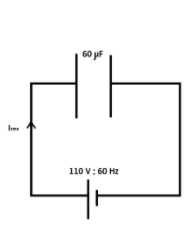
Now, according to ohm’s law:
V = IR but here we are considering root mean square values of both voltage and current, so:
$
{V_{rms}} = {I_{rms}}R \\
\Rightarrow {I_{rms}} = \dfrac{{{V_{rms}}}}{R}......(1) \\
$
Because we need to calculate the r.m.s value of current.
In the circuit, there is no resistor connected. So the net resistance only be provided by the capacitor known as capacitive reactance which is given as:
$
{X_C} = \dfrac{1}{{\omega C}} \\
\Rightarrow {X_C} = \dfrac{1}{{2\pi \nu C}}\left( {\because \omega = 2\pi \nu } \right) \\
$
Substituting the given values of frequency and capacitance, we get:
$
{X_C} = \dfrac{1}{{2\pi \nu C}} \\
\Rightarrow {X_C} = \dfrac{1}{{2 \times 3.14 \times 60 \times 60 \times {{10}^{ - 6}}}} \\
\Rightarrow {X_C} = 44.2\Omega \\
$
As this is the resistance provided by to the flow of current, its SI unit will be ohms $\left( \Omega \right)$
Equation (1) becomes:
${I_{rms}} = \dfrac{{{V_{rms}}}}{{{X_C}}}$
Substituting all the known values, we get:
$
{I_{rms}} = \left( {\dfrac{{110}}{{44.2}}} \right)A \\
\Rightarrow {I_{rms}} = 2.49A \\
$
Therefore, the r.m.s value of current in the circuit is 2.49 Amperes.
Note: Root mean square value is known as effective or virtual value of alternating current (AC). the amount of heating effect produced is equivalent to that produced by direct current (DC) Important SI Units of different quantities are:
Capacitance – Faraday (F), Voltage – Volts (V), Resistance – Ohm’s $\left( \Omega \right)$ , Frequency – Hertz (Hz) and Current – Ampere (A)
From the units only, we can get an idea about the quantity which is talked about in the question.
Complete Step by step answer: Given:
Capacitance (C) of the capacitor = $60\mu F = 6 \times {10^6}F\left( {\because 1F = {{10}^6}\mu F} \right)$
Root mean square value of voltage = 110 V
Frequency $\left( \nu \right)$ = 60 Hz.
Now, according to ohm’s law:
V = IR but here we are considering root mean square values of both voltage and current, so:
$
{V_{rms}} = {I_{rms}}R \\
\Rightarrow {I_{rms}} = \dfrac{{{V_{rms}}}}{R}......(1) \\
$
Because we need to calculate the r.m.s value of current.
In the circuit, there is no resistor connected. So the net resistance only be provided by the capacitor known as capacitive reactance which is given as:
$
{X_C} = \dfrac{1}{{\omega C}} \\
\Rightarrow {X_C} = \dfrac{1}{{2\pi \nu C}}\left( {\because \omega = 2\pi \nu } \right) \\
$
Substituting the given values of frequency and capacitance, we get:
$
{X_C} = \dfrac{1}{{2\pi \nu C}} \\
\Rightarrow {X_C} = \dfrac{1}{{2 \times 3.14 \times 60 \times 60 \times {{10}^{ - 6}}}} \\
\Rightarrow {X_C} = 44.2\Omega \\
$
As this is the resistance provided by to the flow of current, its SI unit will be ohms $\left( \Omega \right)$
Equation (1) becomes:
${I_{rms}} = \dfrac{{{V_{rms}}}}{{{X_C}}}$
Substituting all the known values, we get:
$
{I_{rms}} = \left( {\dfrac{{110}}{{44.2}}} \right)A \\
\Rightarrow {I_{rms}} = 2.49A \\
$
Therefore, the r.m.s value of current in the circuit is 2.49 Amperes.
Note: Root mean square value is known as effective or virtual value of alternating current (AC). the amount of heating effect produced is equivalent to that produced by direct current (DC) Important SI Units of different quantities are:
Capacitance – Faraday (F), Voltage – Volts (V), Resistance – Ohm’s $\left( \Omega \right)$ , Frequency – Hertz (Hz) and Current – Ampere (A)
From the units only, we can get an idea about the quantity which is talked about in the question.
Recently Updated Pages
Which of the following graphs shows the variation of class 12 physics CBSE

Draw a labelled diagram of the human male reproductive class 12 biology CBSE
Describe the experiment to compare the emf of two cells class 12 physics CBSE
What is standard hydrogen electrode
What is conventional current and electric current class 12 physics CBSE
2Bromopentane is treated with an alcoholic KOH solution class 12 chemistry CBSE
Trending doubts
Draw a labelled sketch of the human eye class 12 physics CBSE
Which are the Top 10 Largest Countries of the World?
A member of Simon commission later became Prime Minister class 12 social science CBSE
Differentiate between homogeneous and heterogeneous class 12 chemistry CBSE
Draw ray diagrams each showing i myopic eye and ii class 12 physics CBSE
Which is the correct genotypic ratio of mendel dihybrid class 12 biology CBSE