




A $50kg$ homogeneous smooth sphere rests on the ${{30}^{o}}$ inclined plane at A and bears against the smooth vertical wall B. Calculate the contact forces at A and B.
Answer
 Verified
634.5k+ views
Hint: A sphere is in contact with an inclined plane and a wall and is at rest. This means that the forces acting on the system cancel each other and there is no external force acting on the system. On resolving the forces along the axes, we can find relationships between forces and use it to calculate the normal reactions acting on the spheres.
Formulas used:
$mg={{N}_{1}}\sin {{30}^{o}}$
${{N}_{2}}={{N}_{1}}\cos {{30}^{o}}$
Complete step-by-step solution:
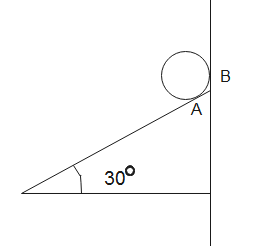
As there is no external force acting on the sphere, the system is isolated. The sphere is at rest on the inclined plane and against the wall. The contact forces, also called normal forces are forces exerted by one surface over the other so as to prevent the surface from passing through it. The forces acting on it will be-
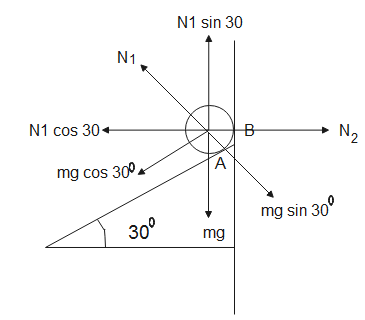
By resolving different internal forces acting on the sphere, we get the following relations,
$mg={{N}_{1}}\sin {{30}^{o}}$ - (1)
Here,
$m$ is the mass of the sphere
$g$ is acceleration due to gravity
${{N}_{1}}$ is the contact force acting between the sphere and the inclined plane
${{N}_{2}}={{N}_{1}}\cos {{30}^{o}}$ - (2)
${{N}_{2}}$ is the contact force between wall and sphere
When we substitute given values in eq (1), we get,
$\begin{align}
& 50\times 10={{N}_{1}}\times \dfrac{1}{2} \\
& \therefore {{N}_{1}}=1000N \\
\end{align}$
We substitute the value from the above equation to get,
$\begin{align}
& {{N}_{2}}=1000\times \dfrac{\sqrt{3}}{2} \\
& \therefore {{N}_{2}}=500\sqrt{3}N \\
\end{align}$
The contact forces acting between the incline and sphere is $1000N$ and the contact forces acting between the wall and sphere is $500\sqrt{3}N$.
Note:
By Newton’s third law of motion, the normal forces are equal and opposite in nature and are perpendicular to the surfaces. The components of a force are perpendicular to each other. Smooth surface means that there is no friction. Since it is an isolated system, the sphere will remain at rest unless an external force is applied on it.
Formulas used:
$mg={{N}_{1}}\sin {{30}^{o}}$
${{N}_{2}}={{N}_{1}}\cos {{30}^{o}}$
Complete step-by-step solution:
As there is no external force acting on the sphere, the system is isolated. The sphere is at rest on the inclined plane and against the wall. The contact forces, also called normal forces are forces exerted by one surface over the other so as to prevent the surface from passing through it. The forces acting on it will be-
By resolving different internal forces acting on the sphere, we get the following relations,
$mg={{N}_{1}}\sin {{30}^{o}}$ - (1)
Here,
$m$ is the mass of the sphere
$g$ is acceleration due to gravity
${{N}_{1}}$ is the contact force acting between the sphere and the inclined plane
${{N}_{2}}={{N}_{1}}\cos {{30}^{o}}$ - (2)
${{N}_{2}}$ is the contact force between wall and sphere
When we substitute given values in eq (1), we get,
$\begin{align}
& 50\times 10={{N}_{1}}\times \dfrac{1}{2} \\
& \therefore {{N}_{1}}=1000N \\
\end{align}$
We substitute the value from the above equation to get,
$\begin{align}
& {{N}_{2}}=1000\times \dfrac{\sqrt{3}}{2} \\
& \therefore {{N}_{2}}=500\sqrt{3}N \\
\end{align}$
The contact forces acting between the incline and sphere is $1000N$ and the contact forces acting between the wall and sphere is $500\sqrt{3}N$.
Note:
By Newton’s third law of motion, the normal forces are equal and opposite in nature and are perpendicular to the surfaces. The components of a force are perpendicular to each other. Smooth surface means that there is no friction. Since it is an isolated system, the sphere will remain at rest unless an external force is applied on it.
Recently Updated Pages
What is BLO What is the full form of BLO class 8 social science CBSE

Explain the Treaty of Vienna of 1815 class 10 social science CBSE
10 examples of friction in our daily life
Draw a diagram of nephron and explain its structur class 11 biology CBSE
Write structures of the following compounds i 2 Chloro3methylpentane class 11 chemistry CBSE
A Paragraph on Pollution in about 100-150 Words
Trending doubts
Draw a labelled sketch of the human eye class 12 physics CBSE
Which are the Top 10 Largest Countries of the World?
Differentiate between homogeneous and heterogeneous class 12 chemistry CBSE
Draw ray diagrams each showing i myopic eye and ii class 12 physics CBSE
Which is the correct genotypic ratio of mendel dihybrid class 12 biology CBSE
What is the Full Form of PVC, PET, HDPE, LDPE, PP and PS ?