




A 200m wide river has a uniform flow speed of 1.1 m/s through a jungle and towards the east. An explorer wishes to leave a small clearing on the south bank and cross the river in a powerboat that moves at a constant speed of 4 m/s with respect to the river. There is a clearing on the north bank 82 m upstream from a point directly opposite to the south bank. (a) in what direction must the boat be pointed in order to travel in a straight line and land on the clearing on the north bank? (b) How long will the boat take to cross the river and land in the clearing?
Answer
 Verified
601.2k+ views
Hint: The boat sails at a speed of 4 m / s compared to the water, which means that if an observer in the water sails at the speed of the river, he can see the boat traveling at a speed of 4 m/s. To solve this question, you must take the help of the diagram, showing the motion in the form of a right-angled triangle.
Complete step-by-step solution
Before we start solving the question that is given to us, let us take a look at all the parameters that are given to us in the above question
The width of the river = w = 200 m
The speed of the river = ${{v}_{r}}$ = 1.1 m/s
Relative speed of the boat = ${{v}_{b}}$ = 4 m/s
North bank distance = d = 82 m
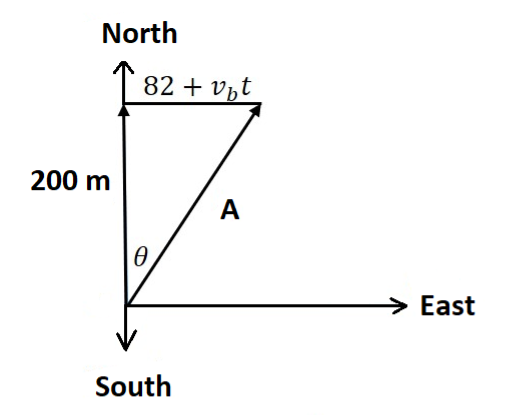
Now let us refer to the diagram for a better understanding of the motion
Now
Drawing a line (200 m long) to the north (upwards in our sketch) across the river, and then a line to the west (upstream, to the left in our sketch) along the north bank for a distance (82m)+(1.1m / s)t;
Now
The hypotenuse of this right triangle (the arrow in our sketch) also depends on t and the speed of the boat (relative to the water) and we set it equal to the Pythagorean "sum" of the triangle's sides.
$\Rightarrow 4t=\sqrt{{{200}^{2}}+{{(82+1.1t)}^{2}}}$
So, we have the equation
$\Rightarrow 14.8{{t}^{2}}-180.4t-46724=0$
On using the quadratic formula
$x=\dfrac{-b\pm \sqrt{{{b}^{2}}-4ac}}{2a}$
Now,
$\Rightarrow x=\dfrac{180.4+\sqrt{{{(-180.4)}^{2}}-4\times 14.8\times }(-180.4)}{2(14.8)}$
$\Rightarrow x=62.611$
Also,
$\Rightarrow x=\dfrac{180.4-\sqrt{{{(-180.4)}^{2}}-4\times 14.8\times }(-180.4)}{2(14.8)}$
$\Rightarrow x=-50.42$
So,
We have two values of t
$\Rightarrow t=62.64s$and -50.42s
Neglecting the negative value as the time can not be negative
Now,
Part (a)
The angle between the north (200 m) leg of the triangle and the hypotenuse (which is measured "west of the north") is then specified (refer the diagram)
So,
$\Rightarrow \theta =ta{{n}^{-1}}(\dfrac{82+1.1t}{200})$
Taking t = 62.64 s
Neglecting the negative value as the time can not be negative
$\Rightarrow \theta =ta{{n}^{-1}}(\dfrac{82+1.1\times 62.611}{200})$
$\Rightarrow \theta =ta{{n}^{-1}}(\dfrac{151}{200})$
$\Rightarrow \theta ={{37}^{\circ }}$
So, the boat must be pointed at $\theta ={{37}^{\circ }}$ in order to travel in a straight line and land on the clearing on the north bank
Now,
For the Part (b)
On solving the equation
$\Rightarrow 14.8{{t}^{2}}-180.4t-46724=0$
On using the quadratic formula
$x=\dfrac{-b\pm \sqrt{{{b}^{2}}-4ac}}{2a}$
Now,
$\Rightarrow x=\dfrac{180.4+\sqrt{{{(-180.4)}^{2}}-4\times 14.8\times }(-180.4)}{2(14.8)}$
$\Rightarrow x=62.611$
Also,
$\Rightarrow x=\dfrac{180.4-\sqrt{{{(-180.4)}^{2}}-4\times 14.8\times }(-180.4)}{2(14.8)}$
$\Rightarrow x=-50.42$
So,
We have two values of t
$\Rightarrow t=62.64s$and -50.42s
Neglecting the negative value as the time can not be negative
So, the boat will take 63.64s to cross the river and land in the clearing.
Note: The spectator on the ground can see that the boat is going at the speed of the river, plus the relative speed of the boat as the speed which is given to us is the relative speed. So the speed of the boat to an observer on the ground will be 5.1 m/s.
Complete step-by-step solution
Before we start solving the question that is given to us, let us take a look at all the parameters that are given to us in the above question
The width of the river = w = 200 m
The speed of the river = ${{v}_{r}}$ = 1.1 m/s
Relative speed of the boat = ${{v}_{b}}$ = 4 m/s
North bank distance = d = 82 m
Now let us refer to the diagram for a better understanding of the motion
Now
Drawing a line (200 m long) to the north (upwards in our sketch) across the river, and then a line to the west (upstream, to the left in our sketch) along the north bank for a distance (82m)+(1.1m / s)t;
Now
The hypotenuse of this right triangle (the arrow in our sketch) also depends on t and the speed of the boat (relative to the water) and we set it equal to the Pythagorean "sum" of the triangle's sides.
$\Rightarrow 4t=\sqrt{{{200}^{2}}+{{(82+1.1t)}^{2}}}$
So, we have the equation
$\Rightarrow 14.8{{t}^{2}}-180.4t-46724=0$
On using the quadratic formula
$x=\dfrac{-b\pm \sqrt{{{b}^{2}}-4ac}}{2a}$
Now,
$\Rightarrow x=\dfrac{180.4+\sqrt{{{(-180.4)}^{2}}-4\times 14.8\times }(-180.4)}{2(14.8)}$
$\Rightarrow x=62.611$
Also,
$\Rightarrow x=\dfrac{180.4-\sqrt{{{(-180.4)}^{2}}-4\times 14.8\times }(-180.4)}{2(14.8)}$
$\Rightarrow x=-50.42$
So,
We have two values of t
$\Rightarrow t=62.64s$and -50.42s
Neglecting the negative value as the time can not be negative
Now,
Part (a)
The angle between the north (200 m) leg of the triangle and the hypotenuse (which is measured "west of the north") is then specified (refer the diagram)
So,
$\Rightarrow \theta =ta{{n}^{-1}}(\dfrac{82+1.1t}{200})$
Taking t = 62.64 s
Neglecting the negative value as the time can not be negative
$\Rightarrow \theta =ta{{n}^{-1}}(\dfrac{82+1.1\times 62.611}{200})$
$\Rightarrow \theta =ta{{n}^{-1}}(\dfrac{151}{200})$
$\Rightarrow \theta ={{37}^{\circ }}$
So, the boat must be pointed at $\theta ={{37}^{\circ }}$ in order to travel in a straight line and land on the clearing on the north bank
Now,
For the Part (b)
On solving the equation
$\Rightarrow 14.8{{t}^{2}}-180.4t-46724=0$
On using the quadratic formula
$x=\dfrac{-b\pm \sqrt{{{b}^{2}}-4ac}}{2a}$
Now,
$\Rightarrow x=\dfrac{180.4+\sqrt{{{(-180.4)}^{2}}-4\times 14.8\times }(-180.4)}{2(14.8)}$
$\Rightarrow x=62.611$
Also,
$\Rightarrow x=\dfrac{180.4-\sqrt{{{(-180.4)}^{2}}-4\times 14.8\times }(-180.4)}{2(14.8)}$
$\Rightarrow x=-50.42$
So,
We have two values of t
$\Rightarrow t=62.64s$and -50.42s
Neglecting the negative value as the time can not be negative
So, the boat will take 63.64s to cross the river and land in the clearing.
Note: The spectator on the ground can see that the boat is going at the speed of the river, plus the relative speed of the boat as the speed which is given to us is the relative speed. So the speed of the boat to an observer on the ground will be 5.1 m/s.
Recently Updated Pages
Three beakers labelled as A B and C each containing 25 mL of water were taken A small amount of NaOH anhydrous CuSO4 and NaCl were added to the beakers A B and C respectively It was observed that there was an increase in the temperature of the solutions contained in beakers A and B whereas in case of beaker C the temperature of the solution falls Which one of the following statements isarecorrect i In beakers A and B exothermic process has occurred ii In beakers A and B endothermic process has occurred iii In beaker C exothermic process has occurred iv In beaker C endothermic process has occurred

Master Class 11 Social Science: Engaging Questions & Answers for Success
Master Class 11 Physics: Engaging Questions & Answers for Success
Master Class 11 Maths: Engaging Questions & Answers for Success
Master Class 11 Economics: Engaging Questions & Answers for Success
Master Class 11 Computer Science: Engaging Questions & Answers for Success
Three beakers labelled as A B and C each containing 25 mL of water were taken A small amount of NaOH anhydrous CuSO4 and NaCl were added to the beakers A B and C respectively It was observed that there was an increase in the temperature of the solutions contained in beakers A and B whereas in case of beaker C the temperature of the solution falls Which one of the following statements isarecorrect i In beakers A and B exothermic process has occurred ii In beakers A and B endothermic process has occurred iii In beaker C exothermic process has occurred iv In beaker C endothermic process has occurred
Master Class 11 Social Science: Engaging Questions & Answers for Success
Master Class 11 Physics: Engaging Questions & Answers for Success
Trending doubts
One Metric ton is equal to kg A 10000 B 1000 C 100 class 11 physics CBSE
There are 720 permutations of the digits 1 2 3 4 5 class 11 maths CBSE
State and prove Bernoullis theorem class 11 physics CBSE
Draw a diagram of a plant cell and label at least eight class 11 biology CBSE
Difference Between Prokaryotic Cells and Eukaryotic Cells
1 Quintal is equal to a 110 kg b 10 kg c 100kg d 1000 class 11 physics CBSE