




A 2 MeV proton is moving perpendicular to a uniform magnetic field of 2.5 tesla.
The force on the proton is
(A) $9.6 \times {10^{15}}N$
(B) $7.6 \times {10^{ - 12}}N$
(C) $9.6 \times {10^{12}}N$
(D) $7.6 \times {10^{12}}N$
Answer
 Verified
632.4k+ views
Hint: To calculate the force on any moving charge particle we use following formula
$\vec F = q(\vec V \times \vec B)$
Where q $ = $ Charge of particle
V $ = $ Velocity of particle
B $ = $ Magnetic field
$\boxed{F = qVB\sin \theta }$
Here $\theta $ is the angle between V & B
Complete step by step solution:
For calculating the magnetic force on protons first we have to analyze motion of the proton with respect to direction of magnetic field.
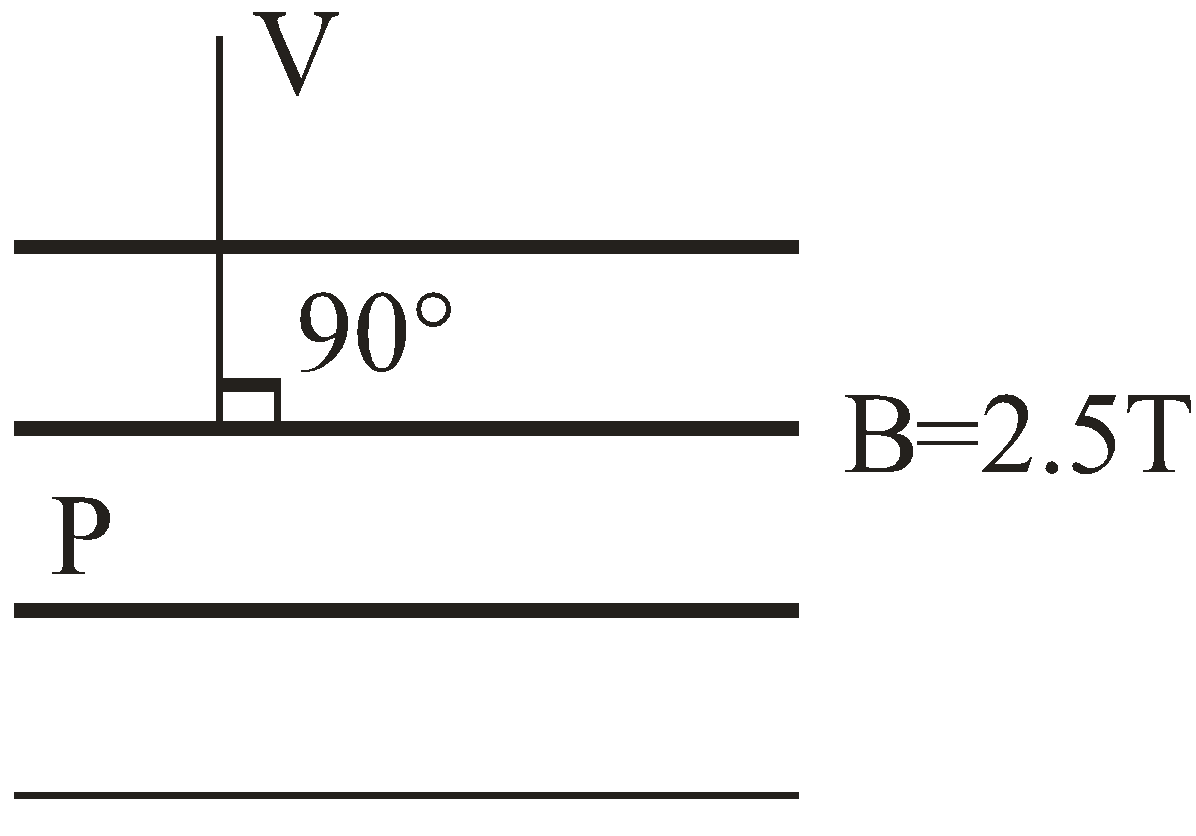
Here given that kinetic charge of proton is 2 MeV
i.e., $K.E = \dfrac{1}{2}m{V^2}$
$\dfrac{1}{2}m{V^2} = 2MeV = 2 \times {10^6} \times 1.6 \times {10^{ - 19}}$
Here m $ = $ mass of proton $ = 1.67 \times {10^{ - 27}}kg$
${V^2} = \dfrac{{2 \times 2 \times {{10}^6} \times 1.6 \times {{10}^{ - 19}}}}{{1.67 \times {{10}^{ - 27}}}}$
${V^2} = \dfrac{{4 \times {{10}^{ - 13}} \times {{10}^{27}} \times 1.6}}{{1.67}}$
${V^2} = 3.832 \times {10^{14}}$
$\boxed{V = 1.957 \times {{10}^7}m/s}$
We know that $\vec F = q(\vec V \times \vec B)$
$F = qVB\sin \theta $
Given that angle between V & B is $90^\circ $
So, $F = qVB\sin 90^\circ $
$F = qVB$
Given $q = 1.6 \times {10^{ - 19}}C,B = 2.5T$
$F = 1.6 \times {10^{ - 19}} \times 1.957 \times {10^7} \times 2.5$
$F \simeq 7.83 \times {10^{ - 12}}N$
So, option B is correct answer.
Note: In order to solve this type of problems first we have to convert the kinetic charge from MeV.
Where $1MeV = 1 \times {10^6} \times 1.6 \times {10^{ - 19}}J$
$\vec F = q(\vec V \times \vec B)$
Where q $ = $ Charge of particle
V $ = $ Velocity of particle
B $ = $ Magnetic field
$\boxed{F = qVB\sin \theta }$
Here $\theta $ is the angle between V & B
Complete step by step solution:
For calculating the magnetic force on protons first we have to analyze motion of the proton with respect to direction of magnetic field.
Here given that kinetic charge of proton is 2 MeV
i.e., $K.E = \dfrac{1}{2}m{V^2}$
$\dfrac{1}{2}m{V^2} = 2MeV = 2 \times {10^6} \times 1.6 \times {10^{ - 19}}$
Here m $ = $ mass of proton $ = 1.67 \times {10^{ - 27}}kg$
${V^2} = \dfrac{{2 \times 2 \times {{10}^6} \times 1.6 \times {{10}^{ - 19}}}}{{1.67 \times {{10}^{ - 27}}}}$
${V^2} = \dfrac{{4 \times {{10}^{ - 13}} \times {{10}^{27}} \times 1.6}}{{1.67}}$
${V^2} = 3.832 \times {10^{14}}$
$\boxed{V = 1.957 \times {{10}^7}m/s}$
We know that $\vec F = q(\vec V \times \vec B)$
$F = qVB\sin \theta $
Given that angle between V & B is $90^\circ $
So, $F = qVB\sin 90^\circ $
$F = qVB$
Given $q = 1.6 \times {10^{ - 19}}C,B = 2.5T$
$F = 1.6 \times {10^{ - 19}} \times 1.957 \times {10^7} \times 2.5$
$F \simeq 7.83 \times {10^{ - 12}}N$
So, option B is correct answer.
Note: In order to solve this type of problems first we have to convert the kinetic charge from MeV.
Where $1MeV = 1 \times {10^6} \times 1.6 \times {10^{ - 19}}J$
Recently Updated Pages
Master Class 12 Business Studies: Engaging Questions & Answers for Success

Master Class 12 Chemistry: Engaging Questions & Answers for Success
Master Class 12 Biology: Engaging Questions & Answers for Success
Class 12 Question and Answer - Your Ultimate Solutions Guide
Master Class 11 English: Engaging Questions & Answers for Success
Master Class 11 Social Science: Engaging Questions & Answers for Success
Trending doubts
Which are the Top 10 Largest Countries of the World?
Draw a labelled sketch of the human eye class 12 physics CBSE
The end of compass needle which points towards north class 12 physics CBSE
Differentiate between homogeneous and heterogeneous class 12 chemistry CBSE
Why is the cell called the structural and functional class 12 biology CBSE
When was the first election held in India a 194748 class 12 sst CBSE