




A 10cm long rod AB moves with its ends on two mutually perpendicular straight lines OX and OY. If the end $A$ be moving at the rate of $2$ $\dfrac{{cm}}{s}$,then when the distance of $A$ from $O$ is $8\,cm$, the rate at which the end $B$ is moving, is
1. $\dfrac{8}{3}$ $\dfrac{{cm}}{s}$
2. $\dfrac{4}{3}$ $\dfrac{{cm}}{s}$
3. $\dfrac{2}{9}$ $\dfrac{{cm}}{s}$
4. None of these
Answer
 Verified
521.7k+ views
Hint: Here we use the concept of rate of change of quantities.
If a quantity $y$ varies with another quantity $x$, then $\dfrac{{dy}}{{dx}}$ represents the rate of change of $y$ with respect to $x$ .
Here it is given that rod AB moves with its ends on two mutually perpendicular straight lines OX and OY. Let the end $A$ of rod move on line OX with respect to time $t$ and end $B$ of rod move on line OY with respect to time $t$ .
Let the distance from point $A$ to point $O$ be $x$ and the distance from point $B$ to point $O$ be $y$
This can be represented by following diagram
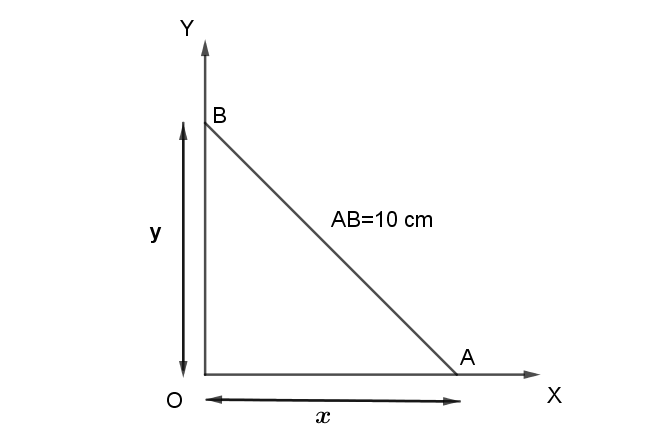
We are asked to find the rate at which the end $B$ is moving i,e $\dfrac{{dy}}{{dt}}$
Complete step-by-step solution:
From the figure, we know that $\Delta BOA$ is a right angled triangle.
Therefore, from Pythagoras theorem we get,
${x^2} + {y^2} = {10^2} ----------- \left( 1 \right)$
Differentiating the above equation with respect to time $t$ , we get
$2x\dfrac{{dx}}{{dt}} + 2y\dfrac{{dy}}{{dt}} = 0 ------ \left( 2 \right)$
It is given that end $A$ is moving at the rate of $2$ $\dfrac{{cm}}{s}$ i,e $\dfrac{{dx}}{{dt}} = 2$ $\dfrac{{cm}}{s}$
and the distance of $A$ from $O$ is $8$$cm$ i,e $x = 8$$cm$
Substituting the value of $x$ in equation $\left( 1 \right)$ , we get
${8^2} + {y^2} = {10^2}$
$ \Rightarrow {y^2} = 100 - 64$
$ \Rightarrow y = \sqrt {36} $
$y = 6$ $cm$
Hence the distance from point $B$ to point $O$ is $6\,cm$.
Now substituting the values in equation $\left( 2 \right)$ , we get
$2 \times 8 \times 2 + 2 \times 6 \times \dfrac{{dy}}{{dt}} = 0$
On simplifying we get,
$12\dfrac{{dy}}{{dt}} = - 32$
$ \Rightarrow \dfrac{{dy}}{{dt}} = \dfrac{{ - 32}}{{12}}$
On cancelling numerator and denominator by 4 , we get
$\dfrac{{dy}}{{dt}} = \dfrac{{ - 8}}{3}$ $\dfrac{{cm}}{s}$
$\therefore \dfrac{{dy}}{{dt}} = \dfrac{8}{3}$ $\dfrac{{cm}}{s}$
The rate at which the end $B$ is moving is $\dfrac{8}{3}$ $\dfrac{{cm}}{s}$ .
Note: It is very important to note that the derivative of a constant is zero.
Many students go wrong here.
In the above equation
${x^2} + {y^2} = {10^2}$
On differentiating the above equation we get
$2x\dfrac{{dx}}{{dt}} + 2y\dfrac{{dy}}{{dt}} = 0$
Not $2x\dfrac{{dx}}{{dt}} + 2y\dfrac{{dy}}{{dt}} = 100$
Also derivative of ${x^2}$ with respect to time $t$ is $2x\dfrac{{dx}}{{dt}}$ as $x$ varies with time $t$ .
If a quantity $y$ varies with another quantity $x$, then $\dfrac{{dy}}{{dx}}$ represents the rate of change of $y$ with respect to $x$ .
Here it is given that rod AB moves with its ends on two mutually perpendicular straight lines OX and OY. Let the end $A$ of rod move on line OX with respect to time $t$ and end $B$ of rod move on line OY with respect to time $t$ .
Let the distance from point $A$ to point $O$ be $x$ and the distance from point $B$ to point $O$ be $y$
This can be represented by following diagram
We are asked to find the rate at which the end $B$ is moving i,e $\dfrac{{dy}}{{dt}}$
Complete step-by-step solution:
From the figure, we know that $\Delta BOA$ is a right angled triangle.
Therefore, from Pythagoras theorem we get,
${x^2} + {y^2} = {10^2} ----------- \left( 1 \right)$
Differentiating the above equation with respect to time $t$ , we get
$2x\dfrac{{dx}}{{dt}} + 2y\dfrac{{dy}}{{dt}} = 0 ------ \left( 2 \right)$
It is given that end $A$ is moving at the rate of $2$ $\dfrac{{cm}}{s}$ i,e $\dfrac{{dx}}{{dt}} = 2$ $\dfrac{{cm}}{s}$
and the distance of $A$ from $O$ is $8$$cm$ i,e $x = 8$$cm$
Substituting the value of $x$ in equation $\left( 1 \right)$ , we get
${8^2} + {y^2} = {10^2}$
$ \Rightarrow {y^2} = 100 - 64$
$ \Rightarrow y = \sqrt {36} $
$y = 6$ $cm$
Hence the distance from point $B$ to point $O$ is $6\,cm$.
Now substituting the values in equation $\left( 2 \right)$ , we get
$2 \times 8 \times 2 + 2 \times 6 \times \dfrac{{dy}}{{dt}} = 0$
On simplifying we get,
$12\dfrac{{dy}}{{dt}} = - 32$
$ \Rightarrow \dfrac{{dy}}{{dt}} = \dfrac{{ - 32}}{{12}}$
On cancelling numerator and denominator by 4 , we get
$\dfrac{{dy}}{{dt}} = \dfrac{{ - 8}}{3}$ $\dfrac{{cm}}{s}$
$\therefore \dfrac{{dy}}{{dt}} = \dfrac{8}{3}$ $\dfrac{{cm}}{s}$
The rate at which the end $B$ is moving is $\dfrac{8}{3}$ $\dfrac{{cm}}{s}$ .
Note: It is very important to note that the derivative of a constant is zero.
Many students go wrong here.
In the above equation
${x^2} + {y^2} = {10^2}$
On differentiating the above equation we get
$2x\dfrac{{dx}}{{dt}} + 2y\dfrac{{dy}}{{dt}} = 0$
Not $2x\dfrac{{dx}}{{dt}} + 2y\dfrac{{dy}}{{dt}} = 100$
Also derivative of ${x^2}$ with respect to time $t$ is $2x\dfrac{{dx}}{{dt}}$ as $x$ varies with time $t$ .
Recently Updated Pages
Master Class 12 Business Studies: Engaging Questions & Answers for Success

Master Class 12 Biology: Engaging Questions & Answers for Success
Master Class 12 Chemistry: Engaging Questions & Answers for Success
Class 12 Question and Answer - Your Ultimate Solutions Guide
Master Class 11 Social Science: Engaging Questions & Answers for Success
Master Class 11 English: Engaging Questions & Answers for Success
Trending doubts
Which is more stable and why class 12 chemistry CBSE
Which are the Top 10 Largest Countries of the World?
Draw a labelled sketch of the human eye class 12 physics CBSE
Differentiate between homogeneous and heterogeneous class 12 chemistry CBSE
What are the major means of transport Explain each class 12 social science CBSE
Sulphuric acid is known as the king of acids State class 12 chemistry CBSE