




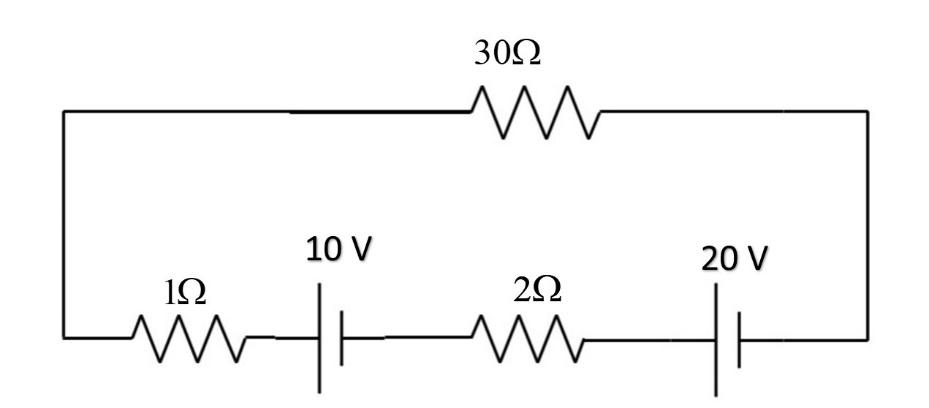
A 10 Volts battery of internal resistance one ohm is connected to a 20 Volts battery of internal resistance 2 ohm. The combination is put across a resistance of 30 ohm. Find the current through each battery.
Answer
 Verified
628.2k+ views
Hint: When the batteries are connected in series, we can assume the algebraic sum of voltages of all the batteries as the voltage of a single battery which can be connected in the circuit to produce the same potential difference as all collectively are producing.
Formula used: Ohm’s law: $V = IR$
Complete step by step answer:
We can replace the combination of different batteries as a single battery with a voltage given by the sum of voltages of individual batteries.
Hence $V_{net} = V_1 +V_2$
$\implies V_{net} = 10 + 20 = 30 V$
Also, when resistors are connected in series, the net resistance of the circuit is given by the algebraic sum of individual resistances. Hence the total resistance of the circuit is given by;
$R_{net} = R_1 + R_2 + R_3+ . . .$
$\implies R_{net}= 30 + 1 + 2 = 33\Omega$
Now, using ohm’s law:
$V = IR$
$\implies I=\dfrac VR$
$\implies I=\dfrac{30}{33} = \dfrac{10}{11}A$
Now, in series circuit, the current is the same for all circuital elements. Hence the current through both the batteries is same as $\dfrac {10}{11}A$
Additional information:
Practically, every battery has its own internal resistance. This is the same as any other external resistance and hence can be treated as a separate resistor in the circuit, placed next to the battery. In series circuit, the concept is simple and straight but for parallel combination, we have to use Kirchhoff’s law to find the result.
Note:
Chance of mistake is that one might think that the voltage of the battery is 20V and resistance $2\ \Omega$, thus using ohm’s law, current is 10 A. This is completely wrong because we have to consider the load of all the resistors present in the circuit. This could be true only when there is no external resistance in the circuit.
Formula used: Ohm’s law: $V = IR$
Complete step by step answer:
We can replace the combination of different batteries as a single battery with a voltage given by the sum of voltages of individual batteries.
Hence $V_{net} = V_1 +V_2$
$\implies V_{net} = 10 + 20 = 30 V$
Also, when resistors are connected in series, the net resistance of the circuit is given by the algebraic sum of individual resistances. Hence the total resistance of the circuit is given by;
$R_{net} = R_1 + R_2 + R_3+ . . .$
$\implies R_{net}= 30 + 1 + 2 = 33\Omega$
Now, using ohm’s law:
$V = IR$
$\implies I=\dfrac VR$
$\implies I=\dfrac{30}{33} = \dfrac{10}{11}A$
Now, in series circuit, the current is the same for all circuital elements. Hence the current through both the batteries is same as $\dfrac {10}{11}A$
Additional information:
Practically, every battery has its own internal resistance. This is the same as any other external resistance and hence can be treated as a separate resistor in the circuit, placed next to the battery. In series circuit, the concept is simple and straight but for parallel combination, we have to use Kirchhoff’s law to find the result.
Note:
Chance of mistake is that one might think that the voltage of the battery is 20V and resistance $2\ \Omega$, thus using ohm’s law, current is 10 A. This is completely wrong because we have to consider the load of all the resistors present in the circuit. This could be true only when there is no external resistance in the circuit.
Recently Updated Pages
Master Class 12 Business Studies: Engaging Questions & Answers for Success

Master Class 12 Chemistry: Engaging Questions & Answers for Success
Master Class 12 Biology: Engaging Questions & Answers for Success
Class 12 Question and Answer - Your Ultimate Solutions Guide
Master Class 11 English: Engaging Questions & Answers for Success
Master Class 11 Social Science: Engaging Questions & Answers for Success
Trending doubts
Which are the Top 10 Largest Countries of the World?
Draw a labelled sketch of the human eye class 12 physics CBSE
Differentiate between homogeneous and heterogeneous class 12 chemistry CBSE
Differentiate between Pyramid of energy and pyramid class 12 biology CBSE
Why is the cell called the structural and functional class 12 biology CBSE
Draw the diagram of the pyramid of energy Explain In class 12 biology CBSE