




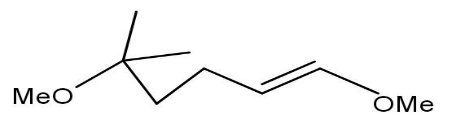
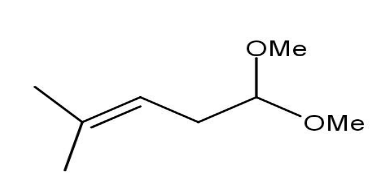
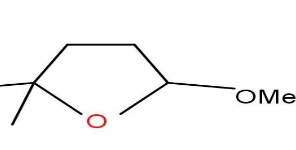
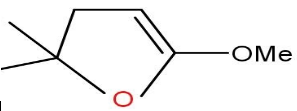
\[4\]-Hydroxy- \[4\]-methyl pentanal on heating with excess of methanol in the presence of an acid catalyst followed by dehydration of the product gives
A)
B)
C)
D)
Answer
 Verified
550.5k+ views
Hint: The carbonyl compounds when heated with excess methanol then two methoxy groups were inserted on the carbonyl carbon.
When alcohols also known as hydroxy compounds undergo dehydration, they form alkenes.
Complete answer: Given compound is \[4 - hydroxy{\text{ }} - 4 - methylpentanal.\]
The parent chain is pentanal, it has five carbon atoms. There is a substitution at fourth carbon.
The numbering should be started from aldehydic carbon.
There are both methyl and hydroxyl groups on \[{4^{th}}\] carbon.
When given compound treats with excess methanol, then the aldehydic carbon converts into the carbon containing methoxy and hydroxyl groups.
As it is treated with excess methanol, the hydroxyl group also converts into methoxy group.
\[{\left( {C{H_3}} \right)_2}C\left( {OH} \right)C{H_2}C{H_2}CH\left( {OH} \right)\left( {C{H_3}} \right) \to {\left( {C{H_3}} \right)_2}C\left( {OH} \right)C{H_2}C{H_2}CH{\left( {OC{H_3}} \right)_2}\]
Now the above product, treated with an acid catalyst, undergoes dehydration.
Dehydration is defined as the loss of water molecules.
The hydroxyl group on \[{4^{th}}\] carbon and hydrogen on \[{3^{rd}}\] carbon ate lost as a water molecule.
Thus, the \[{4^{th}}\] carbon gets positive charge, and the third carbon gets negative charge.
Thereby forms an alkene.
Alkene is an unsaturated organic compound with the presence of a double bond.
Thus, when the given compound undergoes heating with excess methanol in the presence of acid catalyst followed by dehydration it forms a compound namely\[1,1 - dimethoxy - 4 - methyl{\text{ }}3 - pentene\].
Option A will not be formed as the methylation cannot be done on \[{1^{st}}\] carbon.
Option C and D are also not formed as the compound does not undergo cyclisation.
Thus, option B is the correct one.
Note:
The methylation should be done on the aldehydic carbon only. At first one methoxy group attacks on aldehydic carbon, and then due to excess methanol the hydroxyl group can also convert to methoxy group.
The water molecule can be lost from the neighboring carbon atoms only.
When alcohols also known as hydroxy compounds undergo dehydration, they form alkenes.
Complete answer: Given compound is \[4 - hydroxy{\text{ }} - 4 - methylpentanal.\]
The parent chain is pentanal, it has five carbon atoms. There is a substitution at fourth carbon.
The numbering should be started from aldehydic carbon.
There are both methyl and hydroxyl groups on \[{4^{th}}\] carbon.
When given compound treats with excess methanol, then the aldehydic carbon converts into the carbon containing methoxy and hydroxyl groups.
As it is treated with excess methanol, the hydroxyl group also converts into methoxy group.
\[{\left( {C{H_3}} \right)_2}C\left( {OH} \right)C{H_2}C{H_2}CH\left( {OH} \right)\left( {C{H_3}} \right) \to {\left( {C{H_3}} \right)_2}C\left( {OH} \right)C{H_2}C{H_2}CH{\left( {OC{H_3}} \right)_2}\]
Now the above product, treated with an acid catalyst, undergoes dehydration.
Dehydration is defined as the loss of water molecules.
The hydroxyl group on \[{4^{th}}\] carbon and hydrogen on \[{3^{rd}}\] carbon ate lost as a water molecule.
Thus, the \[{4^{th}}\] carbon gets positive charge, and the third carbon gets negative charge.
Thereby forms an alkene.
Alkene is an unsaturated organic compound with the presence of a double bond.
Thus, when the given compound undergoes heating with excess methanol in the presence of acid catalyst followed by dehydration it forms a compound namely\[1,1 - dimethoxy - 4 - methyl{\text{ }}3 - pentene\].
Option A will not be formed as the methylation cannot be done on \[{1^{st}}\] carbon.
Option C and D are also not formed as the compound does not undergo cyclisation.
Thus, option B is the correct one.
Note:
The methylation should be done on the aldehydic carbon only. At first one methoxy group attacks on aldehydic carbon, and then due to excess methanol the hydroxyl group can also convert to methoxy group.
The water molecule can be lost from the neighboring carbon atoms only.
Recently Updated Pages
Basicity of sulphurous acid and sulphuric acid are

Master Class 12 Economics: Engaging Questions & Answers for Success
Master Class 12 Biology: Engaging Questions & Answers for Success
Master Class 11 English: Engaging Questions & Answers for Success
Master Class 11 Physics: Engaging Questions & Answers for Success
Master Class 11 Computer Science: Engaging Questions & Answers for Success
Trending doubts
Draw a labelled sketch of the human eye class 12 physics CBSE
The chemical formula of tear gas is A CO Cl 2 B C 10 class 12 chemistry CBSE
Draw ray diagrams each showing i myopic eye and ii class 12 physics CBSE
Which are the Top 10 Largest Countries of the World?
Differentiate between homogeneous and heterogeneous class 12 chemistry CBSE
Which is the correct genotypic ratio of mendel dihybrid class 12 biology CBSE