




How many 3 letter words can be formed using a, b, c, d, e if
A.repetition of letters is not allowed?
B.repetition of letters allowed?
Answer
 Verified
640.2k+ views
Hint: In this question, we have to find the number of 3 letter words that can be formed using a, b, c, d, and e. If repetition is allowed then we can take that letter again. So, we have 5 intakes for every three places of 3 letter words.
Complete step-by-step answer:
The total number of words \[=5\times 5\times 5=125\] . Now, if repetition is not allowed then we have to take only three letters out of 5 letters. The number of ways to select 3 letters out of 5 letters is \[^{5}{{C}_{3}}\] . But the letter can also be rearranged. The number of ways to rearrange 3 letters are \[3!\] . The total number of 3 letter words is \[^{5}{{C}_{3}}\times 3!\] .
Now, we have to find the number of 3 letter words if repetition is not allowed. That is we have to take 3 letters and we are given 5 letters. The number of 3 letter words that can be formed using 5 letters is \[^{5}{{C}_{3}}\] .
We know that words can be formed after rearranging also. So, the number of rearrangements is \[3!\] .
Now, the total number of words that can be formed \[{{=}^{5}}{{C}_{3}}\times 3!=60\] .
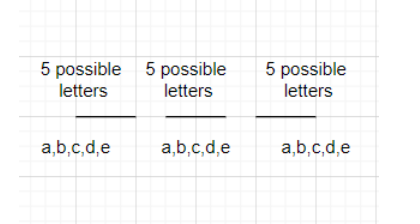
In case (ii), we have to find the number of three-letter words that can be formed if repetition is allowed. As repetition is allowed we can take that letter again if it is taken previously. In the first place, we can take a, b, c, d, and e. So, we have 5 intakes in the first place. Suppose, we take “a” in the first place of 3 letter words. We can also take the letter “a” in the second place too. So, in second place we can take a, b, c, d, and e. In the second place, we have 5 intakes. Similarly, in third place, we have 5 intakes.
The total number of words to be formed \[=5\times 5\times 5=125\] .
Note: In this question, the mistake is generally done in finding the number of words that can be formed without repetition. As we have to take three letters out of five given letters, one can directly write \[^{5}{{C}_{3}}\] . But, the three words can rearrange also. So, we also have to think about the rearrangements.
Complete step-by-step answer:
The total number of words \[=5\times 5\times 5=125\] . Now, if repetition is not allowed then we have to take only three letters out of 5 letters. The number of ways to select 3 letters out of 5 letters is \[^{5}{{C}_{3}}\] . But the letter can also be rearranged. The number of ways to rearrange 3 letters are \[3!\] . The total number of 3 letter words is \[^{5}{{C}_{3}}\times 3!\] .
Now, we have to find the number of 3 letter words if repetition is not allowed. That is we have to take 3 letters and we are given 5 letters. The number of 3 letter words that can be formed using 5 letters is \[^{5}{{C}_{3}}\] .
We know that words can be formed after rearranging also. So, the number of rearrangements is \[3!\] .
Now, the total number of words that can be formed \[{{=}^{5}}{{C}_{3}}\times 3!=60\] .
In case (ii), we have to find the number of three-letter words that can be formed if repetition is allowed. As repetition is allowed we can take that letter again if it is taken previously. In the first place, we can take a, b, c, d, and e. So, we have 5 intakes in the first place. Suppose, we take “a” in the first place of 3 letter words. We can also take the letter “a” in the second place too. So, in second place we can take a, b, c, d, and e. In the second place, we have 5 intakes. Similarly, in third place, we have 5 intakes.
The total number of words to be formed \[=5\times 5\times 5=125\] .
Note: In this question, the mistake is generally done in finding the number of words that can be formed without repetition. As we have to take three letters out of five given letters, one can directly write \[^{5}{{C}_{3}}\] . But, the three words can rearrange also. So, we also have to think about the rearrangements.
Recently Updated Pages
Master Class 12 Economics: Engaging Questions & Answers for Success

Master Class 12 English: Engaging Questions & Answers for Success
Master Class 12 Social Science: Engaging Questions & Answers for Success
Master Class 12 Maths: Engaging Questions & Answers for Success
Master Class 12 Physics: Engaging Questions & Answers for Success
Master Class 10 English: Engaging Questions & Answers for Success
Trending doubts
Explain the Treaty of Vienna of 1815 class 10 social science CBSE
Why is it 530 pm in india when it is 1200 afternoon class 10 social science CBSE
What is the full form of POSCO class 10 social science CBSE
Define Potential, Developed, Stock and Reserved resources
Which Country Has the Largest Border with India?
Complete the sentence with the most appropriate word class 10 english CBSE