




2-phenylethyl bromide when heated with \[NaOEt\] , elimination takes place. No
deuterium exchange takes place when the reaction is carried out in \[{C_2}{H_5}OD\] solvent. The Mechanism will be:
A. E1 elimination
B. E2 elimination
C. E1cB elimination
D. E2 or E1cB
Answer
 Verified
648k+ views
Hint: To find the elimination mechanism we need to know the difference between the three types of elimination reactions. Elimination is an organic reaction in which two substituents are removed from a molecule in one or two step mechanisms.
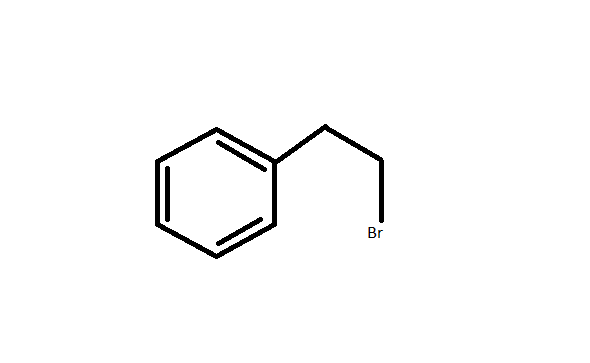
Step by step answer: 2-Ethyl Bromide is an organobromine with molecular formula \[{C_6}{H_5}C{H_2}C{H_2}Br\] . It is a colourless liquid but its older samples had appeared yellow. It is prepared by free radical addition of hydrogen bromide to styrene. Its structure is as given below:
\[NaOEt\] is commonly called Sodium ethoxide. It is an organic compound with the formula \[{C_2}{H_5}Na\] . It is a white solid, although impure samples appear yellow or brown. It dissolves in polar solvents such as ethanol and is a strong base. It is a crystal structure which is determined by crystallography.
In the question \[{C_2}{H_5}OD\] is called Ethanol (ol-d). It is a deuterated NMR solvent useful in NMR based research and analysis. It can be prepared by reacting tetraethyorthosilicate with deuterium oxide. The hydrogen bonding in ethanol has been investigated based on Raman spectral data.
Now, as it is a primary bromide, it will undergo elimination either by E2 or E1cB. Since there is no deuterium exchange in the solvent, the C-H bond is not broken to form carbanion.
Hence the actual mechanism is E2 only. Therefore, the correct option is B.
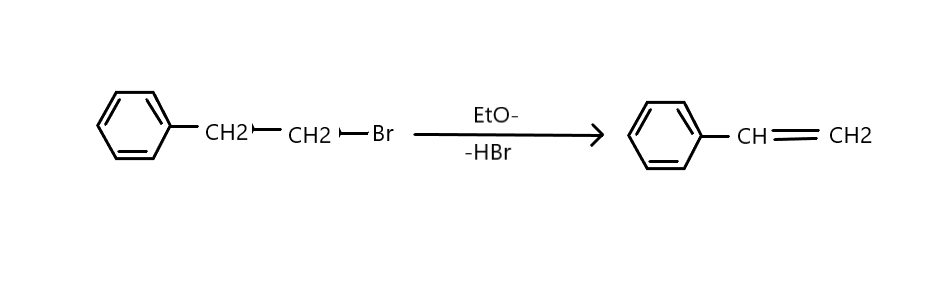
E2 stands for bimolecular elimination. This reaction is a one-step mechanism in which carbon-hydrogen and carbon-halogen bonds break to form a double bond. The reaction rate is second order because it’s influenced by both the alkyl halide and the base.
E1 is an unimolecular elimination reaction in which the removal of an HX substituent results in the formation of a double bond. It is similar to a unimolecular nucleophilic substitution reaction.
E1cB elimination reaction is a type which occurs under basic conditions where the hydrogen to be removed is acidic while the leaving group is a relatively poor one.
Hence the actual mechanism is E2 only. Therefore, the correct option is B.
Note: Here we noted the difference between the types of elimination which are E1, E2 and E1cB and also the difference between them. The student may get confused in the symbols used.
Step by step answer: 2-Ethyl Bromide is an organobromine with molecular formula \[{C_6}{H_5}C{H_2}C{H_2}Br\] . It is a colourless liquid but its older samples had appeared yellow. It is prepared by free radical addition of hydrogen bromide to styrene. Its structure is as given below:
\[NaOEt\] is commonly called Sodium ethoxide. It is an organic compound with the formula \[{C_2}{H_5}Na\] . It is a white solid, although impure samples appear yellow or brown. It dissolves in polar solvents such as ethanol and is a strong base. It is a crystal structure which is determined by crystallography.
In the question \[{C_2}{H_5}OD\] is called Ethanol (ol-d). It is a deuterated NMR solvent useful in NMR based research and analysis. It can be prepared by reacting tetraethyorthosilicate with deuterium oxide. The hydrogen bonding in ethanol has been investigated based on Raman spectral data.
Now, as it is a primary bromide, it will undergo elimination either by E2 or E1cB. Since there is no deuterium exchange in the solvent, the C-H bond is not broken to form carbanion.
Hence the actual mechanism is E2 only. Therefore, the correct option is B.
E2 stands for bimolecular elimination. This reaction is a one-step mechanism in which carbon-hydrogen and carbon-halogen bonds break to form a double bond. The reaction rate is second order because it’s influenced by both the alkyl halide and the base.
E1 is an unimolecular elimination reaction in which the removal of an HX substituent results in the formation of a double bond. It is similar to a unimolecular nucleophilic substitution reaction.
E1cB elimination reaction is a type which occurs under basic conditions where the hydrogen to be removed is acidic while the leaving group is a relatively poor one.
Hence the actual mechanism is E2 only. Therefore, the correct option is B.
Note: Here we noted the difference between the types of elimination which are E1, E2 and E1cB and also the difference between them. The student may get confused in the symbols used.
Recently Updated Pages
Which of the following graphs shows the variation of class 12 physics CBSE

Draw a labelled diagram of the human male reproductive class 12 biology CBSE
Describe the experiment to compare the emf of two cells class 12 physics CBSE
What is standard hydrogen electrode
What is conventional current and electric current class 12 physics CBSE
2Bromopentane is treated with an alcoholic KOH solution class 12 chemistry CBSE
Trending doubts
Draw a labelled sketch of the human eye class 12 physics CBSE
Which are the Top 10 Largest Countries of the World?
Differentiate between homogeneous and heterogeneous class 12 chemistry CBSE
Draw ray diagrams each showing i myopic eye and ii class 12 physics CBSE
Which is the correct genotypic ratio of mendel dihybrid class 12 biology CBSE
What is the Full Form of PVC, PET, HDPE, LDPE, PP and PS ?