




2 cubes each of volume \[64\text{ c}{{\text{m}}^{3}}\] are joined end to end. Find the surface area of the resulting cuboid.
Answer
 Verified
612.3k+ views
Hint: We know that volume of a cube of side a is given by $\text{Volume }={{a}^{3}}$ . We are given that the volume of each cube is \[64\text{ c}{{\text{m}}^{3}}\] . On substituting in the formula of volume, we will get \[a=4\text{ cm}\] . When we join the two cubes of side 4 cm end-to-end, we will get a cuboid with side $a+a\text{ cm}$. We can see that the breadth and height remains unchanged. Now, use the formula Total surface area of the cuboid $=2\left( lb+bh+hl \right)$ to find the required area.
Complete step-by-step answer:
We are given that the volume of each cube is \[64\text{ c}{{\text{m}}^{3}}\] . We know that volume of a cube of side a is given by
$\text{Volume }={{a}^{3}}$
Let us substitute the given volume in the above formula. We will get
${{a}^{3}}=64$
On taking the cube root, we will get
\[a=\sqrt[3]{64}=4\text{ cm}\]
Now, when we join the two cubes of side 4 cm end-to-end, we will get a cuboid with side $a+a\text{ cm}$ . This is shown in the figure below.
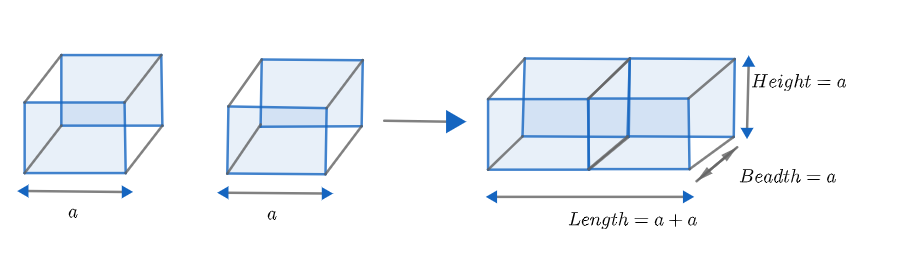
We can see that the breadth and height is unchanged. Hence, we can write the dimensions of the resulting cuboid as follows:
Length, $l=a+a=4+4=8\text{ cm}$
Breadth, $b=4\text{ cm}$
Height, $h=4\text{ cm}$
We need to find the surface area of resultant cuboid. We know that the surface area of a cuboid is given by
Total surface area of the cuboid $=2\left( lb+bh+hl \right)$
Let us substitute the values. We will get
TSA of the cuboid $=2\left( 8\times 4+4\times 4+4\times 8 \right)$
$\begin{align}
& =2\left( 32+16+32 \right) \\
& =2\times 80 \\
& =160\text{ c}{{\text{m}}^{2}} \\
\end{align}$
Hence, the area of the cuboid is $160\text{ c}{{\text{m}}^{2}}$ .
Note: You may make mistakes when joining the top faces of the cubes. This results in a cuboid of height two times than the cube. We have to join the cube end to end as specified in the question. You may make mistakes by finding the curved surface area of the cuboid instead of total surface area. Since only surface area is asked in the question and we obtained a new cuboid, we usually find TSA.
Complete step-by-step answer:
We are given that the volume of each cube is \[64\text{ c}{{\text{m}}^{3}}\] . We know that volume of a cube of side a is given by
$\text{Volume }={{a}^{3}}$
Let us substitute the given volume in the above formula. We will get
${{a}^{3}}=64$
On taking the cube root, we will get
\[a=\sqrt[3]{64}=4\text{ cm}\]
Now, when we join the two cubes of side 4 cm end-to-end, we will get a cuboid with side $a+a\text{ cm}$ . This is shown in the figure below.
We can see that the breadth and height is unchanged. Hence, we can write the dimensions of the resulting cuboid as follows:
Length, $l=a+a=4+4=8\text{ cm}$
Breadth, $b=4\text{ cm}$
Height, $h=4\text{ cm}$
We need to find the surface area of resultant cuboid. We know that the surface area of a cuboid is given by
Total surface area of the cuboid $=2\left( lb+bh+hl \right)$
Let us substitute the values. We will get
TSA of the cuboid $=2\left( 8\times 4+4\times 4+4\times 8 \right)$
$\begin{align}
& =2\left( 32+16+32 \right) \\
& =2\times 80 \\
& =160\text{ c}{{\text{m}}^{2}} \\
\end{align}$
Hence, the area of the cuboid is $160\text{ c}{{\text{m}}^{2}}$ .
Note: You may make mistakes when joining the top faces of the cubes. This results in a cuboid of height two times than the cube. We have to join the cube end to end as specified in the question. You may make mistakes by finding the curved surface area of the cuboid instead of total surface area. Since only surface area is asked in the question and we obtained a new cuboid, we usually find TSA.
Recently Updated Pages
Master Class 11 English: Engaging Questions & Answers for Success

Master Class 11 Social Science: Engaging Questions & Answers for Success
Master Class 11 Maths: Engaging Questions & Answers for Success
Master Class 11 Chemistry: Engaging Questions & Answers for Success
Master Class 11 Biology: Engaging Questions & Answers for Success
Master Class 11 Physics: Engaging Questions & Answers for Success
Trending doubts
Find the sum of series 1 + 2 + 3 + 4 + 5 + + 100 class 9 maths CBSE
Difference Between Plant Cell and Animal Cell
Fill the blanks with the suitable prepositions 1 The class 9 english CBSE
What is pollution? How many types of pollution? Define it
What is the Full Form of ICSE / ISC ?
Name 10 Living and Non living things class 9 biology CBSE