



How is $ 1-cyclohexylmethanol $ prepared by the reaction of a suitable Grignard's reagent on methanal?
Answer
 Verified
591.9k+ views
Hint: We know that as we know that the functional group in ethanol is alcohol and in methanal the functional group is aldehyde (carbonyls). The carbonyls contain carbon and oxygen, so the carbon in carbonyls is very reactive. By the hydrolysis of the intermediate we will get ethanol as a product.
Complete step by step solution:
The methanal is having aldehyde as a functional group and represented as $ HCHO $ . The carbonyl carbon is very electrophilic in nature in aldehydes and can be attacked by any nucleophile. The Grignard reagent is used to convert aldehydes into alcohol. It is represented as where it is in the alkyl group and represents the halogen element. The mechanism involved for the conversion of me
Sauce with Grignard reagent is made to react with formaldehyde. Then derivative of the reaction between the two reagents is made to react with cyclohexyl halide. This results in the exchange of the cyclic group with the alcohol group. This results in the formation of the above compound. In reaction involving Grignard reagent there is a replacement of the halide by alcohol
Methanal reacts with cyclohexyl magnesium bromide, in presence of dry ether, which gives an intermediate product. This intermediate product when reacts with a given reagent, as shown above, gives cyclohexyl methanol as a product.
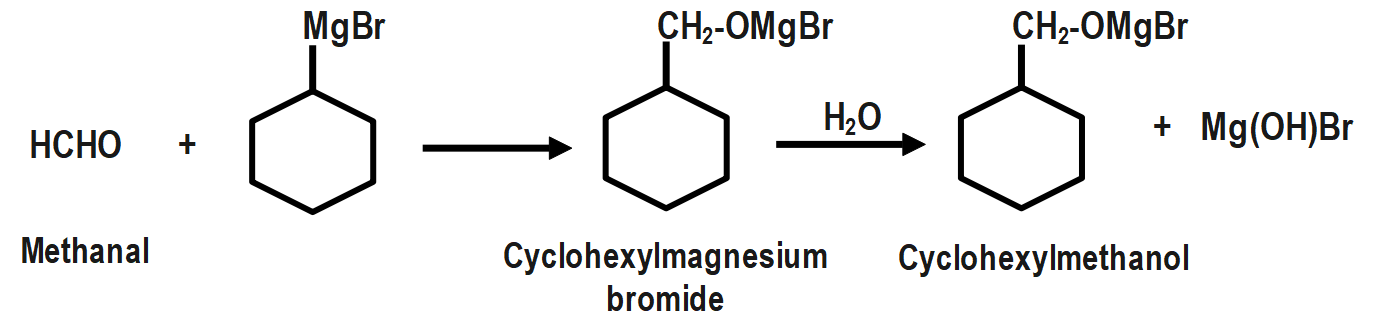
When methanal reacts with methyl magnesium halide, the carbonyl carbon adds methyl group because the magnesium is an alkaline earth metal it gives its electron to methyl group and hence methyl acts as a nucleophile and electropositive magnesium attracts towards carbonyl oxygen.
Note:
Remember that the Grignard reagent is also known as organometallic compound and has several uses such as it can also act as proton abstractor for ketones which have beta hydrogen and it also can be used for the donation of hydride to ketones.
Complete step by step solution:
The methanal is having aldehyde as a functional group and represented as $ HCHO $ . The carbonyl carbon is very electrophilic in nature in aldehydes and can be attacked by any nucleophile. The Grignard reagent is used to convert aldehydes into alcohol. It is represented as where it is in the alkyl group and represents the halogen element. The mechanism involved for the conversion of me
Sauce with Grignard reagent is made to react with formaldehyde. Then derivative of the reaction between the two reagents is made to react with cyclohexyl halide. This results in the exchange of the cyclic group with the alcohol group. This results in the formation of the above compound. In reaction involving Grignard reagent there is a replacement of the halide by alcohol
Methanal reacts with cyclohexyl magnesium bromide, in presence of dry ether, which gives an intermediate product. This intermediate product when reacts with a given reagent, as shown above, gives cyclohexyl methanol as a product.
When methanal reacts with methyl magnesium halide, the carbonyl carbon adds methyl group because the magnesium is an alkaline earth metal it gives its electron to methyl group and hence methyl acts as a nucleophile and electropositive magnesium attracts towards carbonyl oxygen.
Note:
Remember that the Grignard reagent is also known as organometallic compound and has several uses such as it can also act as proton abstractor for ketones which have beta hydrogen and it also can be used for the donation of hydride to ketones.
Recently Updated Pages
Master Class 12 Physics: Engaging Questions & Answers for Success

Master Class 12 Social Science: Engaging Questions & Answers for Success
Master Class 12 English: Engaging Questions & Answers for Success
Master Class 12 Maths: Engaging Questions & Answers for Success
Master Class 12 Business Studies: Engaging Questions & Answers for Success
Master Class 12 Chemistry: Engaging Questions & Answers for Success
Trending doubts
Draw a labelled sketch of the human eye class 12 physics CBSE
Which are the Top 10 Largest Countries of the World?
Draw ray diagrams each showing i myopic eye and ii class 12 physics CBSE
Which is the correct genotypic ratio of mendel dihybrid class 12 biology CBSE
Give 10 examples of unisexual and bisexual flowers
What is the Full Form of PVC, PET, HDPE, LDPE, PP and PS ?