




15 joule of work has to be done against an existing electric field to take a charge of 0.01 C from A to B. Then the potential difference \[\left( {{V_B} - {V_A}} \right)\] is:
A) 1500 volt
B) -1500 volt
C) 0.15 volt
D) None of these.
Answer
 Verified
614.7k+ views
Hint: It is given that the work is done opposite to the direction of electric field. Then according to the direction conventions, we can find the direction of potential difference (positive or negative).
Formula Used: To calculate its magnitude, we can use the formula:
${V_B} - {V_A} = \dfrac{W}{q}$ where V represents the potential at respective points, W is the work done and q is the magnitude of the charge.
Complete step by step answer:
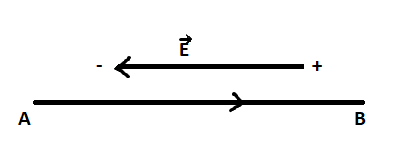
The charge has to be taken from point A to B which will require some work. It is given that this work is in the opposite direction to the electric field, so the direction of the electric field is from point B to A.
The electric field is always directed from positive to negative. Positive has higher potential, therefore the potential increases from point A to B thus the voltage will be positive.
Now, the work done in moving per unit charge from point A to point B is equal to the difference between the potential differences at the two points. It is given as:
${V_B} - {V_A} = \dfrac{W}{q}$
Work to be done (W) = 15 J (given)
Charge (q) = 0.01 C (given)
Substituting these values, we get:
\[
{V_B} - {V_A} = \dfrac{{15}}{{0.01}} \\
{V_B} - {V_A} = 15 \times 100 \\
\Rightarrow {V_B} - {V_A} = 1500 \\
\]
As the SI unit of potential is volts and its direction is positive, the net potential difference \[\left( {{V_B} - {V_A}} \right)\] is 1500 volts and the correct option is A).
Note:In general, the electric potential increases in the direction opposite to that of the electric field. This is because the direction of the electric field is from positive to negative but the potential is higher for the positive one.
For the difference, we considered \[{V_B} - {V_A}\] and not \[{V_A} - {V_B}\] because point B is at higher potential compared to point A and it is the final destination of charge.
Formula Used: To calculate its magnitude, we can use the formula:
${V_B} - {V_A} = \dfrac{W}{q}$ where V represents the potential at respective points, W is the work done and q is the magnitude of the charge.
Complete step by step answer:
The charge has to be taken from point A to B which will require some work. It is given that this work is in the opposite direction to the electric field, so the direction of the electric field is from point B to A.
The electric field is always directed from positive to negative. Positive has higher potential, therefore the potential increases from point A to B thus the voltage will be positive.
Now, the work done in moving per unit charge from point A to point B is equal to the difference between the potential differences at the two points. It is given as:
${V_B} - {V_A} = \dfrac{W}{q}$
Work to be done (W) = 15 J (given)
Charge (q) = 0.01 C (given)
Substituting these values, we get:
\[
{V_B} - {V_A} = \dfrac{{15}}{{0.01}} \\
{V_B} - {V_A} = 15 \times 100 \\
\Rightarrow {V_B} - {V_A} = 1500 \\
\]
As the SI unit of potential is volts and its direction is positive, the net potential difference \[\left( {{V_B} - {V_A}} \right)\] is 1500 volts and the correct option is A).
Note:In general, the electric potential increases in the direction opposite to that of the electric field. This is because the direction of the electric field is from positive to negative but the potential is higher for the positive one.
For the difference, we considered \[{V_B} - {V_A}\] and not \[{V_A} - {V_B}\] because point B is at higher potential compared to point A and it is the final destination of charge.
Recently Updated Pages
Master Class 12 Business Studies: Engaging Questions & Answers for Success

Master Class 12 Chemistry: Engaging Questions & Answers for Success
Master Class 12 Biology: Engaging Questions & Answers for Success
Class 12 Question and Answer - Your Ultimate Solutions Guide
Master Class 11 English: Engaging Questions & Answers for Success
Master Class 11 Social Science: Engaging Questions & Answers for Success
Trending doubts
Which are the Top 10 Largest Countries of the World?
Draw a labelled sketch of the human eye class 12 physics CBSE
Differentiate between homogeneous and heterogeneous class 12 chemistry CBSE
In order to find out the different types of gametes class 12 biology NEET_UG
Why is the cell called the structural and functional class 12 biology CBSE
Draw ray diagrams each showing i myopic eye and ii class 12 physics CBSE