









How To Represent One Sixteenth On A Number Line With Steps And Examples
To understand sixteenth, let’s recall the concept of fractions once again. We know that a fraction is defined as a part of a whole a number. For example, if you have taken a piece of an apple from a whole apple, it means you have taken a fraction of the apple. The values of fractions can be half, one-third, one-fourth, one-tenth, one-sixteenth, etc. If you divide a whole thing into sixteen equal parts, then each part is one-sixteenth of the whole.
Keep reading to know about all important information related to sixteenth such as how to write sixteenth as a fraction and its representation on the number line.
What Is Sixteenth?
We know that sixteenth is a number obtained when you divide the whole number 1 by 16 you get \[\frac{1}{16}\]. Also, one-sixteenth can be expressed as a part of a circle divided into 16 partitions. The dark blue section in the following image is the one-sixteenth of the circle.
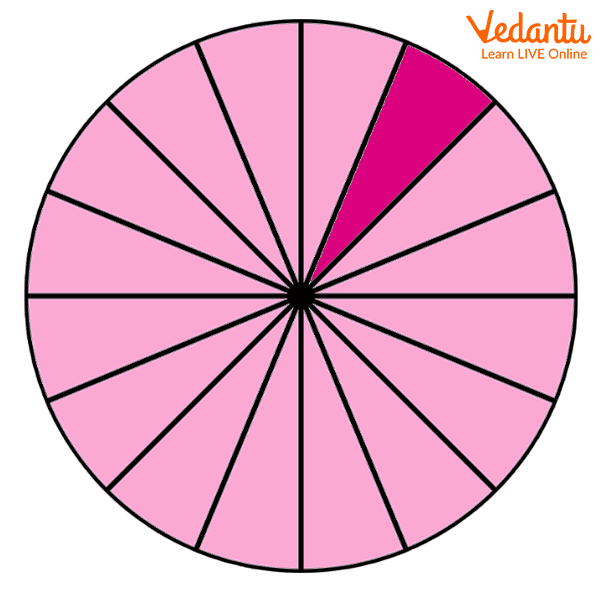
Representation of one-sixteenth in a circle
A sixteenth can also be observed in a square divided into 16 equal parts. If a square is divided into sixteen small squares. The one square will represent the one-sixteenth part of the whole square. The representation of the sixteenth in a square is shown below.
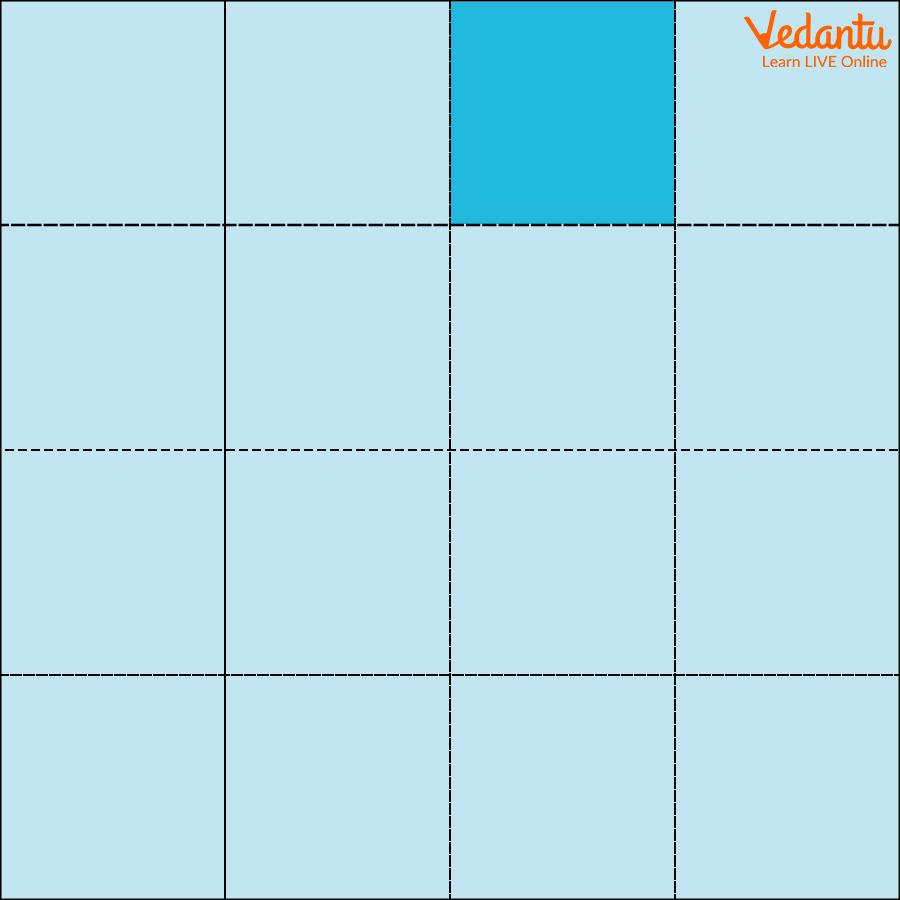
Representation of one-sixteenth in a square
How to Write Sixteenth as a Fraction?
The first thing that you should know about fractions is that they are a part of a whole number. So, one-sixteenth is the 16th part of 1 or unity. In the sixteenth, the numerator and the denominator are 1 and 16, respectively.
To write a sixteenth as a fraction, simply divide the numerator by the denominator:
=1 ÷ 16
= \[\frac{1}{16}\].
Representation of Sixteenth on a Number Line
A number line is a straight line having the numbers placed at equal intervals or segments along its length. To represent\[\frac{1}{16}\] on a number line, you need to divide the number line into sixteen equal parts between the numbers 0 and 1. Then each part will be \[\frac{1}{16}\]. The representation of fraction \[\frac{1}{16}\] on a number line is shown below.
(Image will be uploaded soon)
Conclusion
Kids will understand \[\frac{1}{16}\] with a knowledge of fractions and relevant examples. The concept of fractions is described through an example in the above article. This article will help students learn about \[\frac{1}{16}\] and its representation on a number line. To learn more of such interesting Maths topics, visit our Vedantu today! You will also find worksheets, English grammar-related study materials, stories and poems, and much more.
FAQs on Representation Of One Sixteenths On A Number Line Explained Clearly
1. What does one sixteenth mean on a number line?
One sixteenth on a number line means the whole is divided into 16 equal parts and one part is taken. It is written as 1/16.
- The interval from 0 to 1 is split into 16 equal sections.
- Each small mark represents 1/16.
- The first mark after 0 is 1/16.
2. How do you represent 1/16 on a number line step by step?
To represent 1/16 on a number line, divide the segment from 0 to 1 into 16 equal parts and mark the first division.
- Draw a number line from 0 to 1.
- Divide the line into 16 equal intervals.
- Label the first mark after 0 as 1/16.
3. What is the decimal form of one sixteenth on a number line?
The decimal form of one sixteenth is 0.0625.
- Divide 1 by 16: 1 ÷ 16 = 0.0625.
- This means 1/16 is slightly more than 0.06 on the number line.
4. How far is 1/16 from 0 on a number line?
The distance of 1/16 from 0 is exactly 1/16 of a unit, which equals 0.0625 units.
- Each division between 0 and 1 represents 1/16.
- The first tick mark after 0 is 1/16.
5. How do you mark 5/16 on a number line?
To mark 5/16, count five equal parts out of 16 from 0 toward 1.
- Divide the segment from 0 to 1 into 16 equal parts.
- Count five marks from 0.
- Label that point as 5/16.
6. Why do we divide the number line into 16 equal parts for one sixteenth?
We divide the number line into 16 equal parts because the denominator of 1/16 is 16.
- The denominator shows the total equal parts.
- The numerator shows how many parts are taken.
7. What is the difference between 1/16 and 1/8 on a number line?
The fraction 1/16 is smaller than 1/8 and is located closer to 0 on the number line.
- 1/16 = 0.0625
- 1/8 = 0.125
- Since 0.0625 is less than 0.125, 1/16 lies to the left of 1/8.
8. Can you give an example of placing multiple sixteenths on a number line?
Yes, multiples of sixteenths are placed by counting equal intervals of 1/16 each.
- 1/16 is the first mark.
- 2/16 = 1/8.
- 4/16 = 1/4.
- 8/16 = 1/2.
9. How do you convert sixteenths into equivalent fractions on a number line?
To convert sixteenths into equivalent fractions, simplify the fraction by dividing numerator and denominator by a common factor.
- 2/16 = 1/8
- 4/16 = 1/4
- 8/16 = 1/2
10. What are common mistakes when representing 1/16 on a number line?
A common mistake is not dividing the number line into exactly 16 equal parts.
- Making unequal intervals.
- Confusing 1/16 with 1/6.
- Placing 1/16 too far from 0.
