






Parts Of A Circle Worksheet Questions With Answers And Diagrams
A circle is a closed curve consisting of points equidistant from a common point. The common point is called the centre. The distance between the centre and any point on the closed curve is called the radius. The distance between any two points through the centre is called the diameter.
Questions:
1. What is the name of AC in the circle?

Parts of circle
2. What is a tangent to the circle?
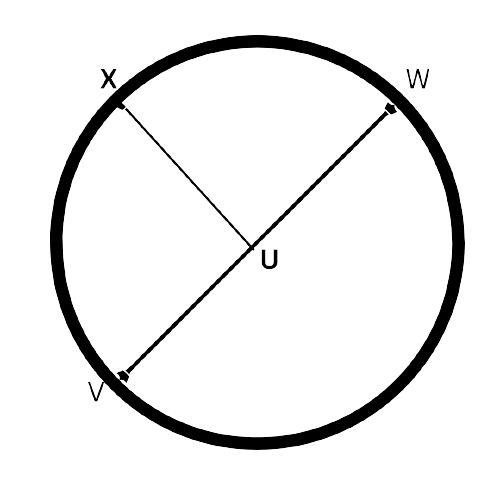
3. Identify VW in the given image:
Parts of circle
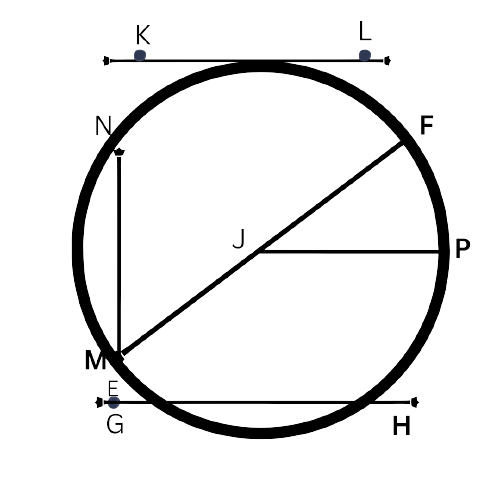
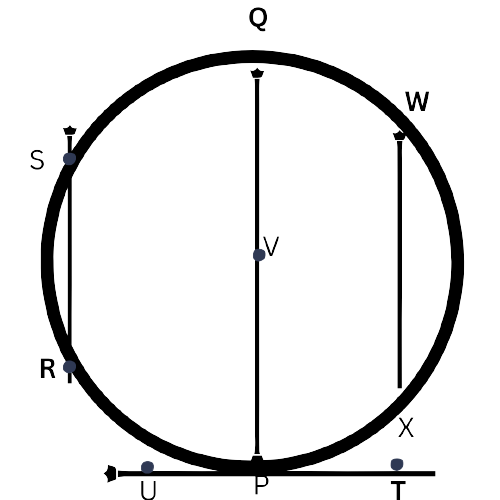
4. Match the images with the radius of the circle:

5. What is the chord of a circle?
6. Denise wants to find the angle between the radius and the tangent of a circle. What is her result?
7. Identify the secant to the circle:
Parts of circle
8. Which line divides the circle into two balanced halves?
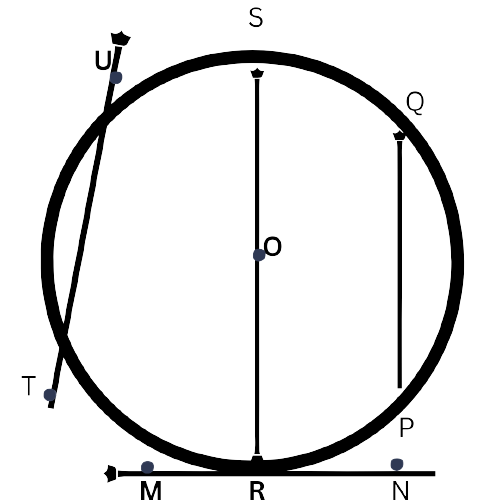
9. Match the images with the diameter of the circle:

10. What is the diameter of the circle?
11. Identify the centre of the given circle:

Parts of circle
12. Match the images with the chord of the circle:
13. What is the radius of a circle?
14. Identify the tangent of the circle:

Parts of circle
15. What is a secant to the circle?
Answers:
1.
AC is the radius of the circle.
2.
A tangent is a line that touches the closed curve at exactly one point.
3.
VW is the diameter of the circle.
4.
5.
The chord is a line segment connecting two points on the closed curve.
6.
The angle between the radius and the tangent of a circle is 90 degrees. Denise’s result is 90 degrees.
7.
RS is the secant of the circle.
8.
The diameter of a circle divides it into two balanced halves.
9.
10.
The diameter is a line segment connecting two points on a circle through the centre.
11.
The centre of the given circle is E.
12.
13.
The radius is the distance between any point on the circle and the centre.
14.
GF is the tangent to the circle.
15.
A secant is a line cutting a circle at two distinct points.
Importance of Parts of a Circle Worksheet
To understand the concepts of the parts of a circle, students will need the right practice ground to follow. This is where the worksheet designed by the experts will be very useful. The problems included in this worksheet focus on the concepts of parts of a circle. They can only be solved when the fundamental principles of a circle and its parts are clear.
Benefits of Solving Label Parts of a Circle Worksheet
Students will learn to identify the different significant parts of a circle first. This step will create a proper foundation to proceed and learn advanced concepts of circles.
By learning the different parts of a circle, they will be able to correlate the features and help create a foundation to learn the theorems later.
Resolve doubts related to this topic from the given solution. You can download and solve the worksheet on your own when you have the solutions in your hand.
Download Parts of a Circle PDF Worksheet
Get the free PDF version of this worksheet and make your practice sessions to learn parts of a circle more productive. Find interesting questions in this worksheet to solve and clarify your concepts related to this topic well. Focus on how the answers are formulated and develop your answering skills to score well in the exams.

FAQs on Parts Of A Circle Worksheets For Practice And Revision
1. What are the parts of a circle?
The parts of a circle include the center, radius, diameter, circumference, chord, arc, sector, and segment.
- Center: The fixed point in the middle of the circle.
- Radius: A line from the center to the circle.
- Diameter: A line through the center connecting two points on the circle.
- Circumference: The boundary or perimeter of the circle.
- Chord: A line joining any two points on the circle.
- Arc: A part of the circumference.
- Sector: A region formed by two radii and an arc.
- Segment: A region between a chord and an arc.
2. What is the difference between radius and diameter?
The diameter is twice the length of the radius.
- Radius (r): Distance from the center to the circle.
- Diameter (d): Distance across the circle through the center.
- Formula: d = 2r or r = d/2.
3. What is the formula for the circumference of a circle?
The circumference of a circle is calculated using C = 2πr or C = πd.
- r = radius
- d = diameter
- π ≈ 3.14 or 22/7
4. What is an arc in a circle?
An arc is a portion of the circumference of a circle between two points.
- Minor arc: Smaller arc between two points.
- Major arc: Larger arc between the same points.
- Semicircle: Arc measuring 180°.
5. What is a sector of a circle?
A sector is a region bounded by two radii and the included arc.
- It looks like a “slice” of pizza.
- Area formula: (θ/360) × πr², where θ is the central angle.
6. What is the difference between a chord and a diameter?
A diameter is a special type of chord that passes through the center of the circle.
- Chord: Any line segment joining two points on the circle.
- Diameter: The longest chord in a circle.
7. How do you find the area of a circle?
The area of a circle is calculated using the formula A = πr².
- Step 1: Measure the radius.
- Step 2: Square the radius.
- Step 3: Multiply by π (≈ 3.14).
8. What is a segment in a circle?
A segment is the region between a chord and its corresponding arc.
- Minor segment: Smaller region.
- Major segment: Larger region.
9. What is the center of a circle?
The center of a circle is the fixed point that is equidistant from all points on the circle.
- All radii start from the center.
- It determines the size of the circle.
10. Why are parts of a circle worksheets important for learning geometry?
Parts of a circle worksheets help students understand definitions, formulas, and relationships between circle components.
- They reinforce terms like radius, diameter, and chord.
- They provide practice with formulas such as C = 2πr and A = πr².
- They improve problem-solving skills in geometry.
