









What is Numeration Definition Types and Solved Examples
We use a set of digits known as numerals to represent numbers. A few examples of numbers are 1234 2314 56111. Numeration is the process of expressing numbers in words. A number system is described as a logical writing system that uses digits or symbols to represent numbers. In this article, we will discuss numbers and numeration in detail.
Number and Numeration
An arithmetic value used to indicate an amount is called a number. A number is a mathematical concept that is used for counting, measuring and labelling. Thus, Mathematics is built on numbers. Numeration is the process of expressing numbers in words. A number system is described as a logical writing system that uses digits or symbols to represent numbers.
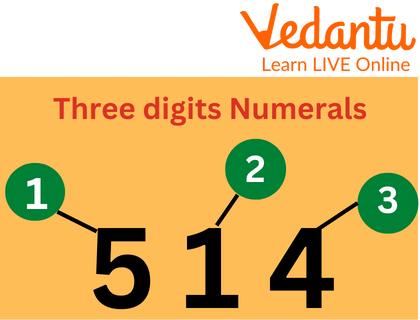
Examples of Numerals
What is Numeration?
Numbers are represented by symbols or groupings of symbols called numerals. Expressing a number in words is called numeration. Numeration systems are organised ways or processes for counting to figure out how many total units are in a collection.
Three functions of numerical systems are identification, ordering and counting. When determining who crosses the finish line first, second or third in a race, for instance, numerical systems can also be used to identify a person's or unit's position in a series.
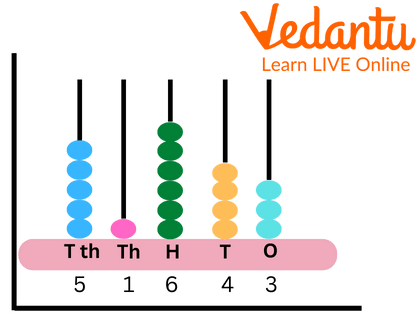
Numeration with Abacus
Difference between Number and Numeral
A number is a measurement or count that, in our minds, is essentially an idea. Numbers are expressed using numerals like "4" or "four" in writing or conversation. However, we might also touch the ground four times or hold up four fingers. These all serve as alternative expressions for the same number.
A numeral is a name or symbol that represents a certain number. Examples are the numerals 3, 49 and twelve. Therefore, the numeral is how we write the number.
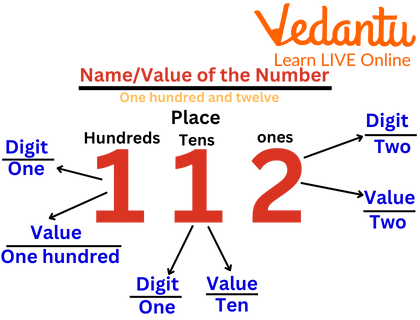
Value of a Number
Solved Examples
Example 1: Which number will be produced by adding one to :
(i) 9
(ii) 99
Ans: (i) We will get 10 if 1 is added to 9.
(ii) If 1 is added to 99, we will get 100.
Example 2: Write the following in descending order:
(i) 308, 312, 306, 318
(ii) 513, 515, 510, 525
Ans: As we know that information is considered to be in descending order if it is arranged from highest to lowest.
(i) 318, 312, 308, 306
(ii) 525, 515, 513, 510
Example 3: Write the numbers that are both bigger and less than the specified number:
(i) More than 539 but less than 544
(ii) Less than 999 but more than 994
Ans: (i) A number which is more than 539 and less than 544 is 541.
(ii) A number which is less than 999 and more than 994 is 996.
Conclusion
The technique of representing a number in digits or figures is known as notation. Numeration is the process of representing numbers in words. We have learned about numbers and numeration in detail in this article. We have also provided some solved examples to understand the topics better.
FAQs on Numeration and Place Value System Explained
1. What is numeration in mathematics?
Numeration is the system of writing and expressing numbers using digits or symbols according to specific rules. It helps us read, write, and represent numbers correctly in different number systems.
- It includes understanding place value and face value.
- It explains how digits combine to form numbers.
- Common systems include the Indian numeration system and the International numeration system.
2. What is the place value of a digit in numeration?
The place value of a digit is the value it gets because of its position in a number. In the number 5,482:
- Place value of 5 = 5000
- Place value of 4 = 400
- Place value of 8 = 80
- Place value of 2 = 2
3. What is the face value of a digit?
The face value of a digit is the digit itself, regardless of its position in the number. For example, in 7,356:
- Face value of 7 = 7
- Face value of 3 = 3
- Face value of 5 = 5
- Face value of 6 = 6
4. What is the difference between place value and face value?
The difference is that place value depends on position, while face value is the digit itself. For example, in 4,321:
- Face value of 4 = 4
- Place value of 4 = 4000
5. What is the Indian numeration system?
The Indian numeration system is a method of writing numbers using place values like ones, tens, hundreds, thousands, lakhs, and crores. Commas are placed as follows:
- First comma after three digits from the right
- Then every two digits
6. What is the International numeration system?
The International numeration system groups digits in sets of three from the right and uses terms like thousand, million, and billion. Commas are placed every three digits.
- Example: 7,543,218
- Read as: Seven million five hundred forty-three thousand two hundred eighteen
7. How do you write a number in expanded form?
A number is written in expanded form by expressing it as the sum of its place values. Steps:
- Identify each digit’s place value.
- Multiply the digit by its place value.
- Add the results.
8. How do you read large numbers correctly?
Large numbers are read by separating them into periods such as ones, thousands, millions, or lakhs. Steps:
- Place commas correctly (Indian or International system).
- Read from left to right period by period.
- Add the place value name after each group.
9. What is the standard form of a number in numeration?
The standard form of a number is writing it in its usual digit form without expansion. For example:
- Expanded form: 2000 + 500 + 40 + 3
- Standard form: 2543
10. Why is understanding numeration important?
Understanding numeration is important because it forms the foundation of arithmetic and number sense. It helps students:
- Read and write numbers correctly
- Compare and order numbers
- Perform operations like addition and subtraction accurately
- Understand place value and number systems
