









How to check if a number is divisible by 12 using 3 and 4 rule with examples
Imagine 3 friends trying to share 10 biscuits. Each of them gets 3 biscuits, and there’s one biscuit left over. They are unsure what to do with it; would one person get an extra biscuit? That did not seem fair to everyone, who loved sharing everything equally.
If there were 9 biscuits, they would have divided the biscuits equally, and there would have been no confusion. Because 9 is divisible by 3. This means that 9 biscuits could have been divided into three equal parts without any extra biscuits left.
What is Divisibility Rule?
Divisibility rules are a set of general rules often used to determine whether or not a number is divisible by a particular number. Divisibility rules can help kids determine whether a number will be divisible by another.
Divisibility Rule of 12
The divisibility chart or rule of 12 is -
If the number is divisible by both 3 and 4, then the number is divisible by 12 exactly.
Example: 5844
Sum of the digits = 5 + 8 + 4 + 4 = 21 (multiple of 3)
Last two digits = 44 (divisible by 4)
The number 5844 is divisible by 4 and 3; hence, it is divisible by 12.
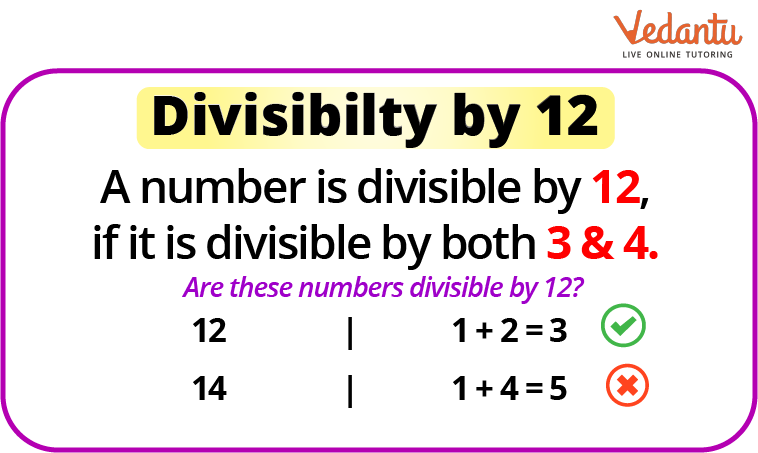
Divisibility by 12
Solved Worksheet
Following are the divisibility rule of 12 with examples -
Example 1: Check whether 840 is divisible by 12 or not.
Solution: We know that -
If the given number is divisible by both 3 and 4, then it is also divisible by 12.
1. First, check whether the given number is divisible by 3.
Sum of the digits :8 + 4 + 0 = 12 (multiple of 3)
2. Now, check whether the given number is divisible by 4.
In the given number 840, the number formed by the last two digits is 40, divisible by 4. So, the number 840 is divisible by 4.
Now, it is clear that the given number 840 is divisible by both 3 and 4.
Therefore, the number 840 is divisible by 12
Example 2: Check whether 9140 is divisible by 12 or not.
Solution: We know that -
If the given number is divisible by both 3 and 4, then it is also divisible by 12.
1. Firstly, check whether the given number is divisible by 3.
Sum of the digits : 9 + 1 + 4 + 0 = 14 (not a multiple of 3)
Because the number 9140 is not divisible by 3, the number 9140 is not divisible by 12.
Example 3: Check whether 2370 is divisible by 12 or not.
Solution: We know that -
If the given number is divisible by both 3 & 4, then it is also divisible by 12.
1. divisible by 12.
1. Firstly, check whether the given number is divisible by 3.
Sum of the digits: 2 + 3 + 7 + 0 = 12 (multiple of 3)
2. Now, check whether the given number is divisible by 4.
In the given number 2370, the number formed by the last two digits is 70, which is not divisible by 4.
So, the number 2370 is not divisible by 4.
Therefore, the number 2370 is not divisible by 12.
Conclusion
In this article, we have learned about the divisibility rule for 12. For instance, a number divisible by 12 will also be divisible by 3 and 4. Many mathematical rules and properties are required or beneficial to understand when solving a Maths problem. Learning and comprehending these rules provides students with a foundation to solve problems and tackle more advanced mathematical concepts.
FAQs on Numbers Divisible By 12 and Divisibility Rule Explained
1. What are numbers divisible by 12?
Numbers divisible by 12 are those that can be divided by 12 exactly without leaving any remainder. In other words, when a number is divided by 12, the remainder is 0.
- Examples: 12, 24, 36, 48, 60
- These numbers are also called multiples of 12
- They follow the divisibility rules of both 3 and 4
2. What is the divisibility rule for 12?
A number is divisible by 12 if it is divisible by both 3 and 4. This means it must satisfy the divisibility rules of 3 and 4 at the same time.
- Divisible by 3: Sum of digits is divisible by 3
- Divisible by 4: Last two digits form a number divisible by 4
- If both conditions are true, the number is divisible by 12
3. How do you check if a number is divisible by 12?
To check divisibility by 12, verify that the number is divisible by both 3 and 4. Follow these steps:
- Step 1: Add all digits and check if the sum is divisible by 3
- Step 2: Look at the last two digits and check if they are divisible by 4
- Step 3: If both are true, the number is divisible by 12
4. Why must a number be divisible by both 3 and 4 to be divisible by 12?
A number must be divisible by both 3 and 4 because 12 is the product of these two numbers (12 = 3 × 4). Since 3 and 4 are co-prime (they share no common factors other than 1), a number divisible by both will be divisible by 12.
- 12 = 2 × 2 × 3
- It includes the prime factors of both 3 and 4
- Therefore, both conditions must be satisfied
5. What are the first 10 numbers divisible by 12?
The first 10 numbers divisible by 12 are the first 10 multiples of 12. These are obtained by multiplying 12 by whole numbers from 1 to 10.
- 12 × 1 = 12
- 12 × 2 = 24
- 12 × 3 = 36
- 12 × 4 = 48
- 12 × 5 = 60
- 12 × 6 = 72
- 12 × 7 = 84
- 12 × 8 = 96
- 12 × 9 = 108
- 12 × 10 = 120
6. What is the smallest number divisible by 12?
The smallest positive number divisible by 12 is 12 itself. Since 12 ÷ 12 = 1 with no remainder, it is the first positive multiple of 12.
- Multiples start as: 12, 24, 36...
- Zero is also divisible by 12 because 0 ÷ 12 = 0
7. Is 144 divisible by 12?
Yes, 144 is divisible by 12 because it satisfies the divisibility rules of both 3 and 4. Checking step by step:
- 1 + 4 + 4 = 9, and 9 is divisible by 3
- The last two digits, 44, are divisible by 4
- Therefore, 144 ÷ 12 = 12
8. What is the formula to find numbers divisible by 12?
Numbers divisible by 12 can be written using the formula 12n, where n is any integer. This represents all multiples of 12.
- If n = 1 → 12 × 1 = 12
- If n = 5 → 12 × 5 = 60
- If n = 10 → 12 × 10 = 120
9. What is the difference between numbers divisible by 6 and numbers divisible by 12?
The main difference is that numbers divisible by 12 must satisfy stricter conditions than numbers divisible by 6. Specifically:
- Divisible by 6 → must be divisible by 2 and 3
- Divisible by 12 → must be divisible by 3 and 4
- Every number divisible by 12 is also divisible by 6, but not every number divisible by 6 is divisible by 12
10. Can a negative number be divisible by 12?
Yes, a negative number is divisible by 12 if it leaves no remainder when divided by 12. Divisibility rules apply to both positive and negative integers.
- Example: −24 ÷ 12 = −2
- Since there is no remainder, −24 is divisible by 12
- All numbers of the form −12n are divisible by 12
