









What Is the Multiplicative Identity Property Definition Formula and Examples
Have you ever heard about the answer obtained when any number is multiplied by 1? When any number is multiplied by 1 the product is always the number itself. In the below-discussed article, children would gain knowledge about the steps involved in solving multiplication problems, which is considered one of the basic and most widely used mathematical and arithmetical operations. Generally, it is represented using the symbol '×' or '*' in between the two numbers. Now, let us start with our topic here:
What is Multiplication?
Multiplication is a process of calculating the product of two quantities or numbers by multiplying them together. '×' is used to depict the product of two quantities. The number multiplied by the multiplier is called the multiplicand and the number by which the multiplicand is multiplied is called the multiplier. It can also be stated as a way of adding a number repeatedly to acquire their product.
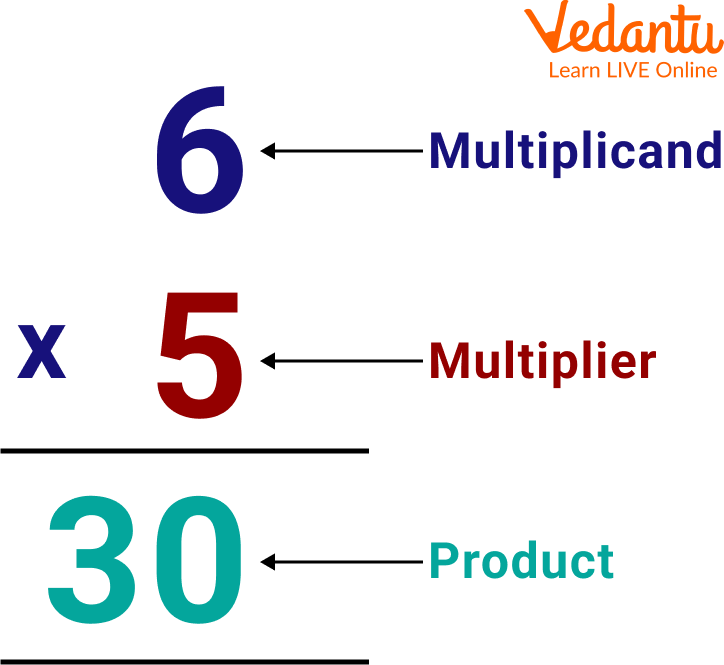
Showing Terms Used in the Multiplication of Two Numbers
Steps Involved in Solving Multiplication Queries
The steps required to follow in the multiplication of two numbers are given below:
Write the given multiplicand and multiplier in the column form by taking into consideration their place values
Then put the multiplication sign (×) preceding the multiplier
Start the multiplication from the right-hand side of the multiplier and move to the left side.
Count the number of digits in multiplier quantity and place the zeroes 1 less than the number of digits in the multiplier from the right side
Finally, add up all the products respective to each digit of the multiplier.

Multiplication of 8 and 5
Multiplicative Identity Property
Multiplicative identity property states that "Any number multiplied by 1 is the number itself". It means that when any number is multiplied by 1 the answer is always the number. It serves as a user identity in solving various problems. 1 is the identity of itself i.e. 1 × 1 = 1. It is also called the Identity Property of Multiplication because of the reason, here the identity of a number remains unaltered.
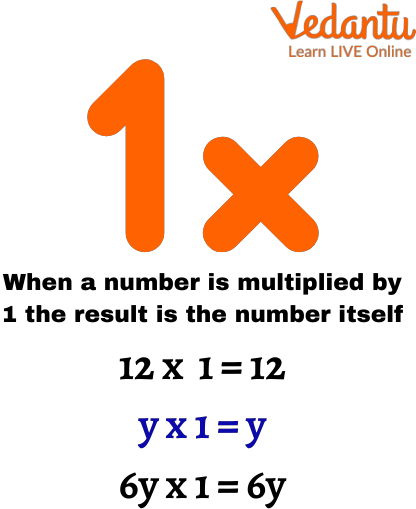
Showing Identity Property of Multiplication
Solved Examples
Q 1. 12 × 1
Ans: Steps to be followed to calculate the product using Multiplicative Identity
Align the given numbers in columns or rows to calculate the product
Multiplying 1 with the given number and noting the result
Thus, we can conclude that when any number is multiplied by 1 the answer is the number itself.

Showing Any Number Multiplied by 1
Q 2. 65 × 31
Ans: Steps to calculate the result of this statement are given below:
Write the given multiplier and multiplicand in columns format
Now, using multiplicative identity, any number multiplied by 1 is the number, for multiplying 65 and 1
Calculate the number of digits of the multiplier and put zeroes one less than the calculated number of digits
Further, multiplying the tens digit of the multiplier with the multiplicand
Adding the two obtained partial products i.e. 65 + 1950 = 2015
Hence, the required result of the multiplication of 65 × 31 is 2015.
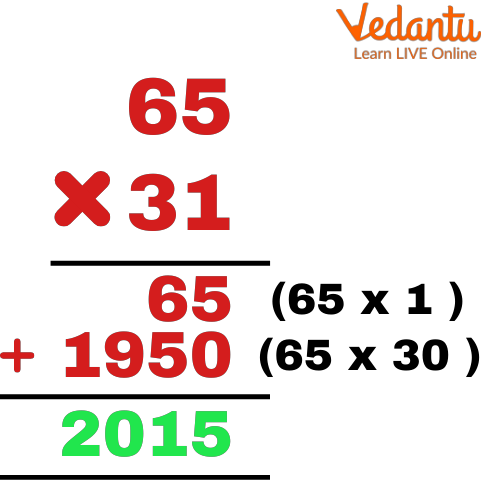
Showing the Multiplication of Two Digit Number Whose One Digit is 1
Practice Problems
Some practice problems based on the concept, any number multiplied by 1 is the number itself are given below. These should be solved by the children on their own for a better understanding of the concepts.
Q 1. 59 × 1
Ans: 59
Q 2. 84 × 1
Ans: 84
Q 3. 1 × 18
Ans: 18
Q 4. 34 × 1
Ans: 34
Q 5. 1 × 32
Ans: 32
Summary
To wrap up here with the topic of number multiplication. The main motive of this article is to impart knowledge of multiplication by covering every topic including, what is multiplication, the steps involved in solving mathematics problems, whether any number multiplied by 1 is the number, etc. It is formed using the solved examples and images which makes learning interesting and exciting. Hoping the writing helped you in capturing the concept of multiplication and you enjoyed reading it. Feel comfortable to ask about your problems.
FAQs on Multiplicative Identity Property in Mathematics
1. What is the multiplicative identity property?
The multiplicative identity property states that any number multiplied by 1 remains unchanged. In other words, for any number a, the rule is:
a × 1 = a
This property applies to integers, fractions, decimals, rational numbers, and real numbers. The number 1 is called the multiplicative identity because it does not change the value of a number when multiplied.
2. What is the multiplicative identity in mathematics?
The multiplicative identity in mathematics is the number 1. It is called the identity element for multiplication because:
- For any number a, a × 1 = a
- Multiplying by 1 does not change the value
3. Why is 1 called the multiplicative identity?
The number 1 is called the multiplicative identity because multiplying any number by 1 leaves it unchanged. The defining rule is:
a × 1 = a
For example:
- 7 × 1 = 7
- −3 × 1 = −3
- 4.5 × 1 = 4.5
4. What is an example of the multiplicative identity property?
An example of the multiplicative identity property is 9 × 1 = 9. Here’s a step-by-step illustration:
- Start with the number 9
- Multiply it by 1
- The result remains 9
5. Does the multiplicative identity property apply to fractions and decimals?
Yes, the multiplicative identity property applies to fractions and decimals because multiplying them by 1 keeps their value unchanged. For example:
- 3/5 × 1 = 3/5
- 0.75 × 1 = 0.75
6. What is the formula for the multiplicative identity property?
The formula for the multiplicative identity property is a × 1 = a for any number a. This formula means:
- a can be any real number
- 1 is the identity element
- The product equals the original number
7. What is the difference between additive identity and multiplicative identity?
The difference is that the additive identity is 0, while the multiplicative identity is 1. Specifically:
- Additive identity: a + 0 = a
- Multiplicative identity: a × 1 = a
8. Is zero a multiplicative identity?
No, 0 is not the multiplicative identity because multiplying a number by 0 changes its value to 0. The rule is:
- a × 0 = 0
9. Does the multiplicative identity property work with negative numbers?
Yes, the multiplicative identity property works with negative numbers because multiplying by 1 does not change the sign or value. For example:
- −8 × 1 = −8
- −1/4 × 1 = −1/4
10. How is the multiplicative identity property used in algebra?
The multiplicative identity property is used in algebra to simplify expressions and solve equations by multiplying terms by 1 without changing their value. Common uses include:
- Rewriting expressions, such as x = x × 1
- Introducing equivalent fractions (e.g., 3 = 3 × 1 = 3 × 2/2)
- Verifying algebraic properties in equations
