









What Is Number 8 Definition Properties and Counting Examples
The number 8 (eight) is represented by a number and numeral. It's the natural number that comes after 7 and before 9. It's an integer and a cardinal number, which means it's a number that can be counted. It's also classified as a real number, which distinguishes it from imaginary numbers.
Let us understand what the number 8 means and how it is used in various categories from this section.
What is 8 in Mathematics?
Eight is a composite number with the divisors 1, 2, and 4 as its appropriate divisors. Eight can be written as 23, totaling 23, which can be pronounced as two cubed. It has a sum of 7 aliquots. The aliquot sum of all powers of two is one less than their own.
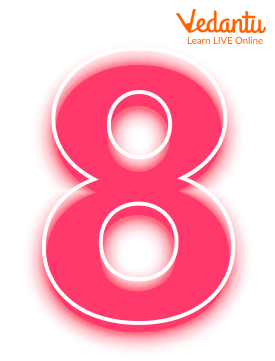
The Number 8
The octal number system, which is commonly used with computers, has an 8 as its basis. One digit in octal represents three bits. A byte, often known as an octet in modern computers, is a collection of eight bits.
The number 8 is a Fibonacci number, as it is made up of the numbers 3 and 5.
Under the second definition, where repeating prime elements are counted as often as they occur, 8 and 9 create a Ruth-Aaron pair.
An octagon is a polygon with eight sides. Octagonal numbers are figurate numbers that depict octagons (including eight). An octahedron is a polyhedron having eight faces.
Examples on 8
Let us look at a few descriptions that represent the number 8 in this section.
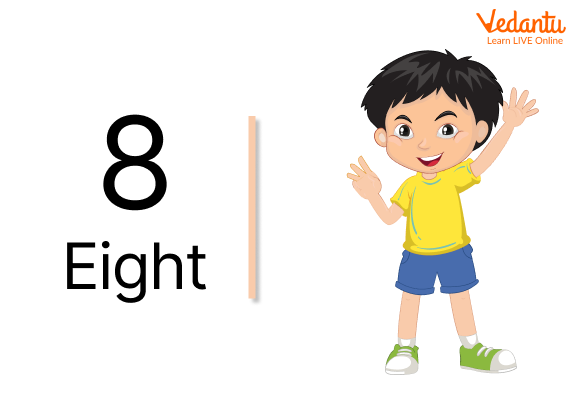
A little one showing his 8 fingers
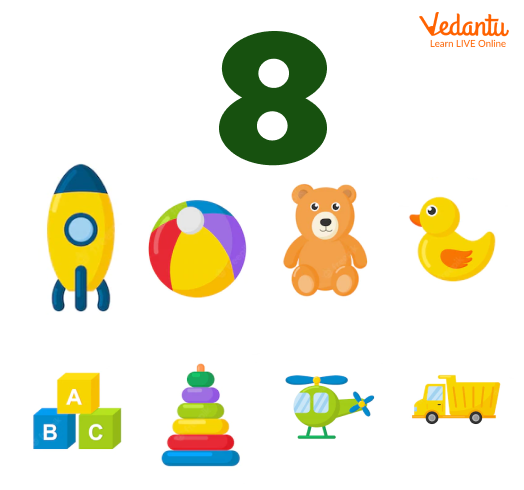
A set of 8 objects appeared at a place
Interesting Facts
Since 8 is a Fibonacci number, it can be found naturally all around the world. The number eight, the sixth in the Fibonacci sequence, is the only number in the sequence (apart from one) that is a perfect cube (23). The Fibonacci series continues with thirteen, while the previous number is five.
An octagon is a two-dimensional object with eight sides, while an octahedron is a three-dimensional shape with eight faces. They are named from the prefix ‘oct’, which is used to signify the number eight in numerous English terms, including octopus (which has eight arms).
A popular British confection is designed to be consumed in the evening, specifically after 8 p.m. The minty heart of Nestlé's After Eight Mint Chocolate Thins (or just After Eight) is covered with chocolate. Every year, more than a billion After Eights are sold around the world.
Conclusion
Most of the children are much interested to represent the single digit using their fingers. And the number 8 is one of them. When parents or teacher asked children to show something that represents the number 8, they can immediately point their 8 fingers. That’s a good way of immediately responding and we can come to know that they have understood the topic. This is one of the good ways to teach children about the importance and working with the numbers.
FAQs on Understanding the Number 8 in Mathematics
1. What is the number 8 in Maths?
The number 8 is a natural number that comes after 7 and before 9. In Mathematics, 8 is an even number because it is divisible by 2. It belongs to counting numbers, whole numbers, and integers. In symbols, it is written as 8, and in words, it is written as eight.
2. Is 8 an even or odd number?
The number 8 is an even number because it is exactly divisible by 2. When we divide 8 by 2, we get:
- 8 ÷ 2 = 4
3. What are the factors of 8?
The factors of 8 are numbers that divide 8 exactly without leaving a remainder. The factors are:
- 1
- 2
- 4
- 8
4. What are the multiples of 8?
The multiples of 8 are numbers obtained by multiplying 8 by whole numbers. Some common multiples are:
- 8 × 1 = 8
- 8 × 2 = 16
- 8 × 3 = 24
- 8 × 4 = 32
- 8 × 5 = 40
5. Is 8 a prime or composite number?
The number 8 is a composite number because it has more than two factors. A prime number has exactly two factors (1 and itself), but 8 has four factors: 1, 2, 4, and 8. Therefore, it is not prime.
6. What is the square and cube of 8?
The square of 8 is 64 and the cube of 8 is 512.
- Square: 8 × 8 = 64
- Cube: 8 × 8 × 8 = 512
7. How do you write 8 in Roman numerals?
The number 8 in Roman numerals is VIII. It is formed by adding:
- V (5)
- I (1)
- I (1)
- I (1)
8. What is 8 in expanded form?
The expanded form of 8 is simply 8 ones. Since 8 is a single-digit number, it can be written as:
- 8 = 8 × 1
9. What is the place value of 8?
The place value of 8 depends on its position in a number. For example:
- In 8, the place value is 8 ones.
- In 80, the place value is 80 (8 tens).
- In 800, the place value is 800 (8 hundreds).
10. Can you give a simple addition and subtraction example using 8?
Yes, simple operations with 8 include addition and subtraction like 5 + 3 = 8 and 10 − 2 = 8. Example steps:
- Addition: Count 3 more after 5 to reach 8.
- Subtraction: Take away 2 from 10 to get 8.
