









How to Find the Missing Digits with Step by Step Methods and Examples
Do you know what missing digits actually are? Missing digits are the digits that are missed within the given series of numbers with similar variations among them. You have to find the number that is missing. The simple method of finding these missing digits is by identifying the similar changes in the numbers and filling the digits in the given series.
Now you must be curious about how to find the missing digits. But after reading this article and solving some practice questions, you will be able to comprehend the topic of missing digits in addition, subtraction, and multiplication.
Find the Missing Digits in Addition
To find the missing digits in addition, follow the steps in the given example:
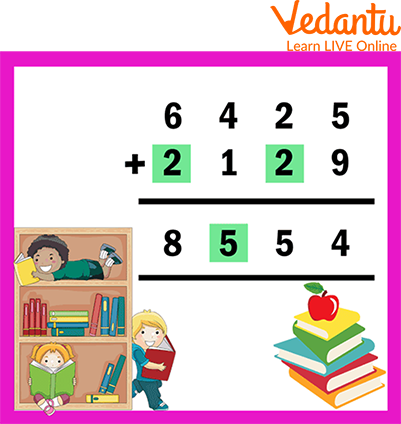
Example for Addition
Step 1: Add the ONES: 5 + 9 = 14
Step 2: Regroup as 1 Tens and 4 Ones
Step 3: Add the TENS: 2 + 1 carry over = 3
Step 4: Write 2 in the box to make 3 + 2 = 5
Step 5: Add the HUNDREDS: 4 + 1 = 5
Step 6: Add the THOUSANDS: 6 + 2 = 8
Step 7: Write 2 in the box. This is how the missing number will be filled.
Find the Missing Digits in Subtraction
To find the missing digits in subtraction, follow the steps in the given example:
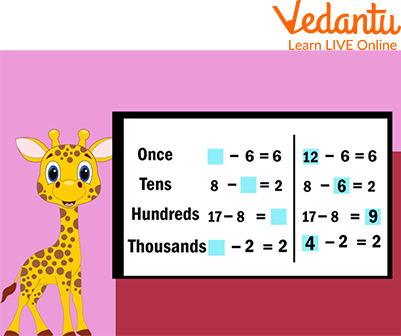
Missing Digits in Subtraction
Here we can see that we have one missing digit from which 6 have been subtracted to get the result as 6. So, if we subtract 6 from the 12, we get 6. Hence, the missing digit for once is 12. i.e. 12 - 6 = 6.
For tens, here we can see that we have one missing digit. We have 8, and if we subtract 8 from a missing digit, we will get the result as 2. So, if we subtract 6 from 8, we will get the result as 2. i.e. 8 - 6 = 2
For hundreds, here we can see that we have one missing digit. We have 17 and 8, and if we subtract 17 from 8, we will get the result as 9. So, the missing digit will become 9. i.e. 17 - 8 = 9
For thousands, here we can see that we have one missing digit from which 2 have been subtracted to get the result as 2. So, if we subtract 2 from the 4, the result we get is 2. Hence, the missing digit for once is 4. i.e. 4 - 2 = 2.
Find the Missing Number in Multiplication
To find the missing digits in multiplication, follow the steps in the given example:

Example for Multiplication
Step 1: First of all check where the missing place is, here we can see that we have the missing place in the result.
Step 2: Multiply $4 \times 6$ and we get 24. So, 4 will be at ones place, and now we have 2 in carry.
Step 3: Now, we will multiply, $6 \times 3$ and we get 18. As we have 2 carry also, so we will add 2 in it. It will become 20.
Step 4: Hence, the missing digit is 2.
Notice the Pattern and Find the Missing Digits
Select 2 or 3 terms in the text in which a rule will be applied to find the missing number. For example: If you have five numbers in a series then pick the first three numbers to check if any rule is to be applied.
While choosing the number to check the rule, select the number which is easy to operate. These include terms like factors of 2, 3, 5, or 10. Check the series with some common rules such as the sum of the terms, squares, cube, or other.
To find the missing digits in a pattern, follow the steps in the given example:
Find the Missing Numbers 1, 2, 6, 24
The given sequence has 4 terms. We will check which rule is applied by picking the first 3 terms. The second number in the sequence is 2 and the first number is 1, which means 1 is either added or 2 is multiplied to obtain the second term.
The third term is 6 which we get from 2 by multiplying it with 3. So, now we have 1 x 1, 1 x 2, 2 x 3, and 6 x 4. Thus, we have identified the pattern and accordingly, the last term will be 24 x 5= 120.
Hence, the missing number is 120.
Solved Examples
Q1. Find the missing digit marked with a yellow box.
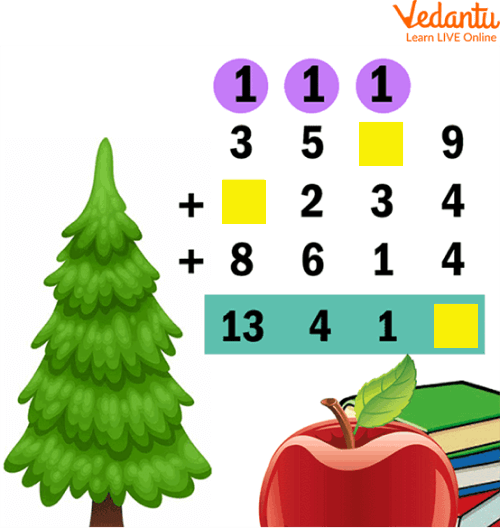
Missing Digits in Addition
Ans:
Steps:
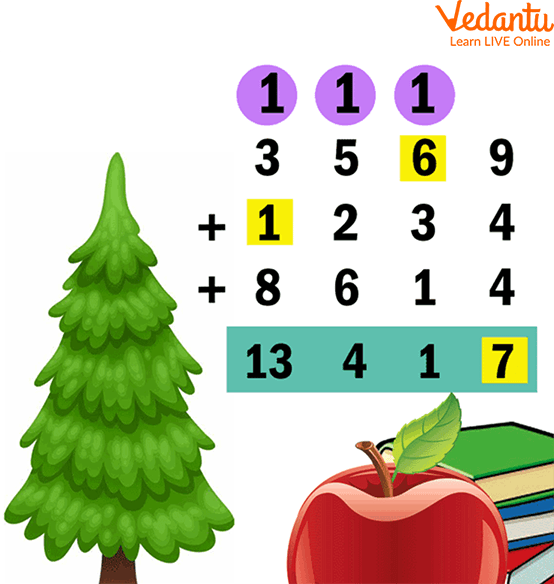
I: Add the one place that is 9 + 4 + 4 = 17. Put 7 in the box and carry 1 to the tens.
II: Add tens place leaving the box so that 1 + 3 + 1 = 5. If 5 + 6 = 11, then we get 1 in tens place. put 6 in the box and carry 1 to the hundreds.
III: Add the hundreds place including the carried 1 so that 1 + 5 + 2 + 6 = 14. Now we get 4 in the hundreds place and now, carry 1 to the thousands.
IV: Add thousands leaving the box so that 1 + 3 + 8 = 12. 12 + 1 = 13. Put 1 in the box.
Missing Digits in Addition
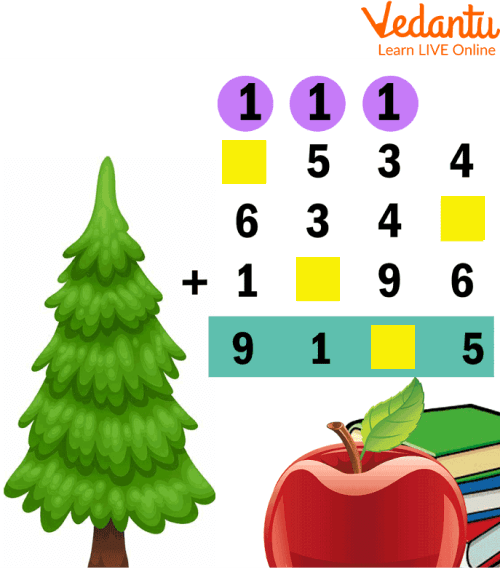
Q2. Find the missing digit marked with a yellow box.
Missing Digits in Addition
Ans:
Steps:
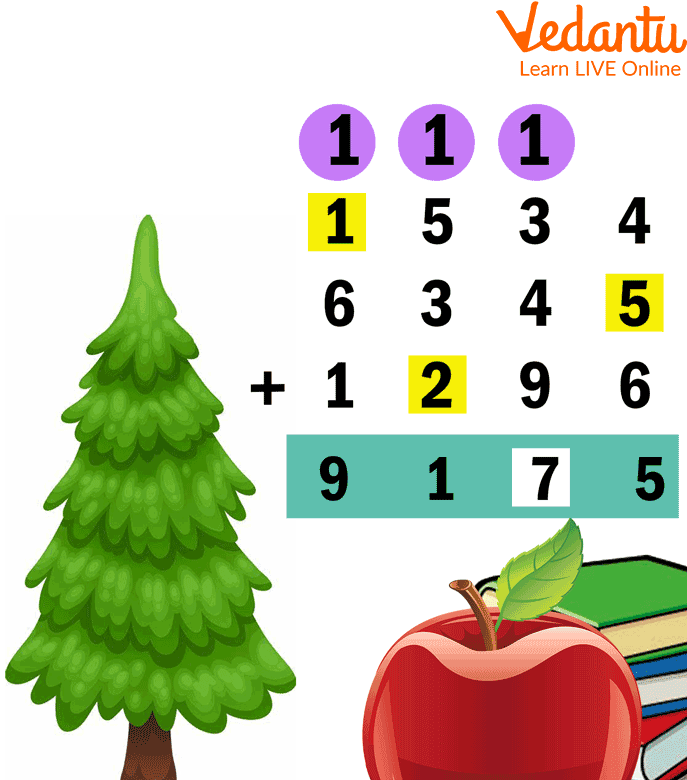
I: Add ones leaving the box. 4 + 6 = 10 and 10 + 5 = 15, therefore we get 5 in the ones place. Write 5 in the box and carry 1 to the tens place.
II: Add tens place. 1 + 3 + 4 + 9 = 17. Write 7 in the tens place and carry 1 to the hundreds place.
III: Add the hundreds place leaving the box. 1 + 5 +3 = 9. 9 + 2 = 11, then we get 1 in the hundreds place. Write 2 in the box. Carry 1 to the thousands place.
IV: Add thousands place leaving the box. 1 + 6 + 1 = 8; 8 + 1 = 9. Write 1 in the box.
Missing Digits in Addition
Practice Questions
Find the Missing Digits in Addition:
I. Fill □ by the correct digit.

Fill in the Box
Ans:

Fill in the Box
Find the Missing Digits in Subtraction
II. Fill □ by the correct digit.

Fill in the Box
Ans:

Fill in the Box
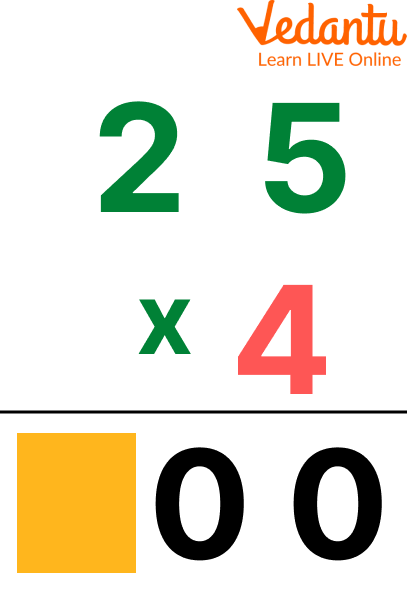
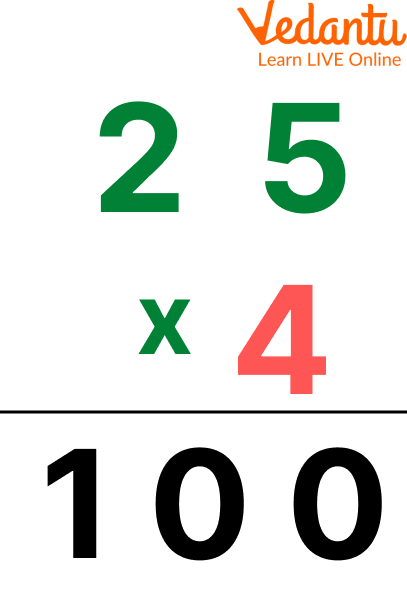
Find the Missing Digits in Multiplication:
Fill in the Box
Ans:
Fill in the box
Summary
Missing numbers are the numbers that have been missed in a given series of a number or digits with similar differences among them. The method of filling in these missing numbers is stated as finding similar changes or rules between those numbers and filling the missing terms in the specific series and places. You can also find the missing digits by identifying the pattern of the sequence. Keep practising and solving the missing digits worksheets and you will be able to solve such questions easily.
FAQs on Find The Missing Digits in Maths Problems
1. What does “find the missing digits” mean in maths?
“Find the missing digits” means determining unknown numbers in a mathematical expression so that the equation or calculation becomes correct. In these problems, one or more digits are replaced with blanks or symbols, and you must:
- Use the rules of addition, subtraction, multiplication, or division
- Apply place value concepts (ones, tens, hundreds, etc.)
- Check that the completed equation is mathematically correct
These questions help improve number sense and understanding of arithmetic operations.
2. How do you find a missing digit in addition?
To find a missing digit in addition, use column addition and work from right to left while considering carrying. Follow these steps:
- Start from the ones place
- Check if there is any carry over
- Solve for the missing digit so the column total matches
Example: 4_ + 38 = 75. In the ones place, _ + 8 must end in 5. Since 7 + 8 = 15, the missing digit is 7 (carry 1 to the tens place).
3. How do you find a missing digit in subtraction?
To find a missing digit in subtraction, subtract column by column and consider borrowing if needed. Steps include:
- Begin with the ones place
- Check if borrowing is required
- Adjust the next column if borrowing occurs
Example: 6_ − 25 = 37. In the ones place, _ − 5 must equal 7. Since borrowing is needed, 12 − 5 = 7, so the missing digit is 2.
4. How do you find a missing digit in multiplication?
To find a missing digit in multiplication, use multiplication rules and check place value alignment. Follow these steps:
- Multiply normally and leave the blank as a variable
- Compare the product with the given result
- Test possible digits from 0–9
Example: 3 × _ = 21. Since 3 × 7 = 21, the missing digit is 7.
5. How do you find a missing digit in division?
To find a missing digit in division, use the relationship between division and multiplication. Since Dividend ÷ Divisor = Quotient, you can multiply the divisor and quotient to find the missing value.
- Use Divisor × Quotient = Dividend
- Fill in the blank and verify
Example: _ ÷ 4 = 6. Multiply 6 × 4 = 24, so the missing digit is 24.
6. What is the role of place value in finding missing digits?
Place value helps determine the correct digit by identifying its position such as ones, tens, or hundreds. Each digit’s value depends on its position:
- Ones place = units
- Tens place = digit × 10
- Hundreds place = digit × 100
Understanding place value ensures the missing digit fits correctly into the arithmetic operation.
7. Can you give an example of a missing digit problem with two blanks?
A missing digit problem with two blanks requires solving step by step using column methods. Example: _5 + 4_ = 89.
- Ones place: 5 + _ must end in 9 → 5 + 4 = 9
- Tens place: _ + 4 = 8 → 4 + 4 = 8
So the missing digits are 4 and 4, making 45 + 44 = 89.
8. Why are missing digit questions important in maths?
Missing digit questions are important because they strengthen number sense and understanding of arithmetic operations. They help students:
- Improve mental maths skills
- Understand inverse operations
- Develop logical reasoning
These problems build a strong foundation for algebra and higher-level maths.
9. What are common mistakes when solving missing digit problems?
Common mistakes include ignoring carry or borrowing and misplacing digits according to place value. Typical errors are:
- Forgetting carry over in addition
- Not applying borrowing in subtraction
- Misaligning columns
- Not checking the final answer
Always recheck the completed equation to confirm it is correct.
10. How do you check your answer after finding the missing digit?
You check your answer by substituting the missing digit back into the original equation and verifying the calculation. Steps:
- Rewrite the full number with the found digit
- Perform the arithmetic operation again
- Confirm the result matches the given answer
If both sides are equal, the missing digit is correct.
