






Hindi Numbers 1 to 100 with Pronunciation and Spelling Chart
Counting from 1 to 100 in Hindi is one of the most important basics for students, language learners, and competitive exam aspirants. Hindi numbers are widely used in daily conversations, academic learning, banking, and government exams in India. Learning how to count 1 to 100 in Hindi improves numerical understanding, pronunciation skills, and overall language proficiency. This guide provides a complete and easy-to-understand table of Hindi numbers along with their English equivalents and correct spellings.
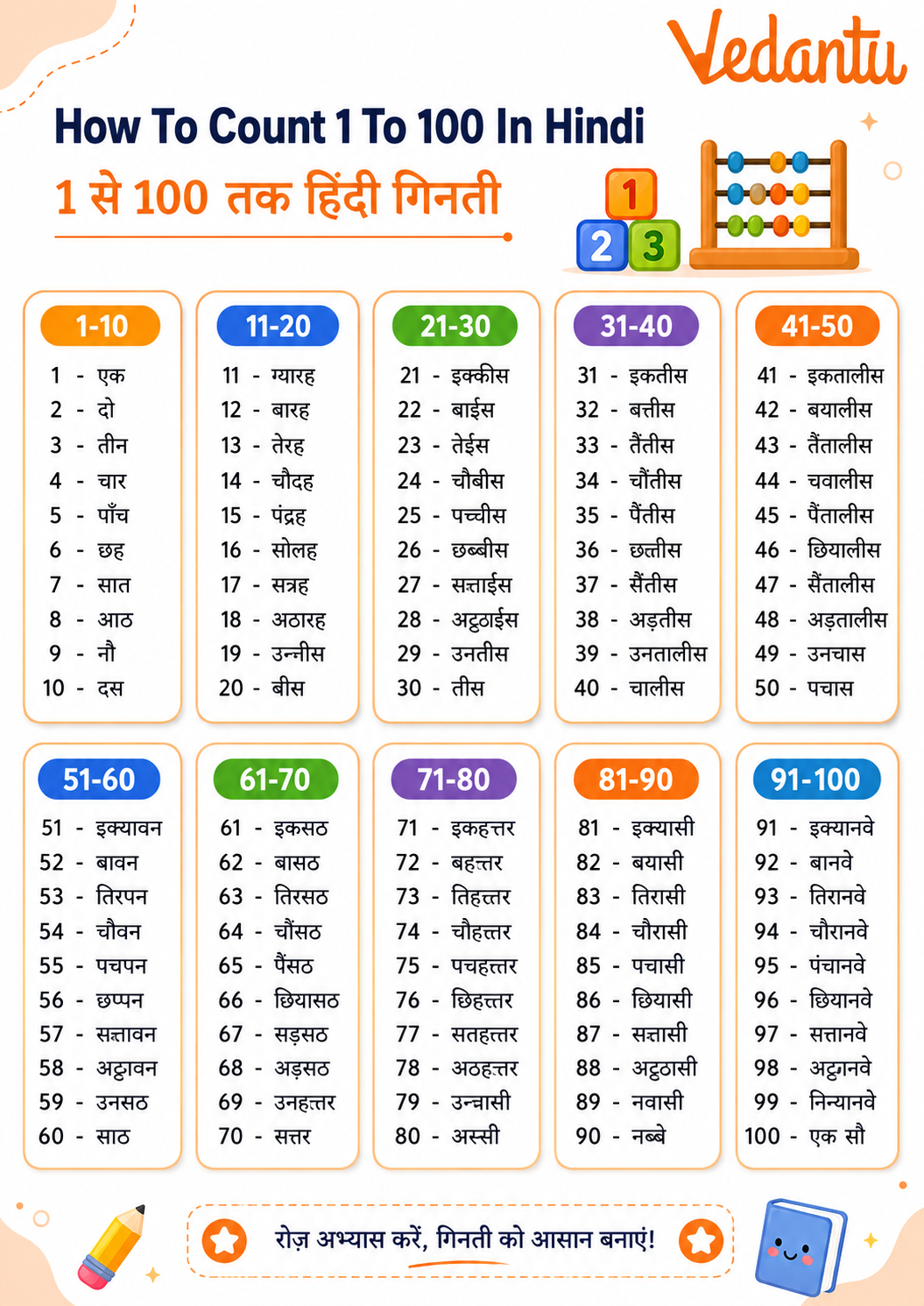
Importance of Learning Hindi Numbers 1 to 100
Hindi counting is essential for school students, competitive exam candidates, and anyone learning the Hindi language. Numbers are frequently used in mathematics, time, dates, money transactions, measurements, and general communication.
- Helps in understanding basic mathematics in Hindi medium schools
- Useful for competitive exams and general knowledge tests
- Improves spoken and written Hindi skills
- Essential for daily life communication in Hindi speaking regions
Counting 1 to 100 in Hindi
| Number | Hindi (Devanagari) | Pronunciation |
|---|---|---|
| 1 | एक | Ek |
| 2 | दो | Do |
| 3 | तीन | Teen |
| 4 | चार | Chaar |
| 5 | पांच | Paanch |
| 6 | छह | Chhah |
| 7 | सात | Saat |
| 8 | आठ | Aath |
| 9 | नौ | Nau |
| 10 | दस | Das |
| 11 | ग्यारह | Gyarah |
| 12 | बारह | Baarah |
| 13 | तेरह | Terah |
| 14 | चौदह | Chaudah |
| 15 | पंद्रह | Pandrah |
| 16 | सोलह | Solah |
| 17 | सत्रह | Satrah |
| 18 | अठारह | Atharah |
| 19 | उन्नीस | Unnees |
| 20 | बीस | Bees |
| 21 | इक्कीस | Ikkees |
| 22 | बाईस | Baais |
| 23 | तेईस | Teis |
| 24 | चौबीस | Chaubees |
| 25 | पच्चीस | Pachchees |
| 26 | छब्बीस | Chhabbees |
| 27 | सत्ताईस | Sattais |
| 28 | अट्ठाईस | Atthais |
| 29 | उनतीस | Untees |
| 30 | तीस | Tees |
| 31 | इकतीस | Ikatees |
| 32 | बत्तीस | Battees |
| 33 | तैंतीस | Taintees |
| 34 | चौंतीस | Chauntees |
| 35 | पैंतीस | Paintees |
| 36 | छत्तीस | Chhattis |
| 37 | सैंतीस | Saintees |
| 38 | अड़तीस | Adtees |
| 39 | उनतालीस | Untalees |
| 40 | चालीस | Chalees |
| 41 | इकतालीस | Iktalees |
| 42 | बयालीस | Bayalees |
| 43 | तैंतालीस | Taintalees |
| 44 | चवालीस | Chavalees |
| 45 | पैंतालीस | Paintalees |
| 46 | छियालीस | Chiyalees |
| 47 | सैंतालीस | Saitalees |
| 48 | अड़तालीस | Adtalees |
| 49 | उनचास | Unchaas |
| 50 | पचास | Pachaas |
| 51 | इक्यावन | Ikyavan |
| 52 | बावन | Bavan |
| 53 | तिरेपन | Tirpan |
| 54 | चौवन | Chauvan |
| 55 | पचपन | Pachpan |
| 56 | छप्पन | Chhappan |
| 57 | सत्तावन | Sattavan |
| 58 | अट्ठावन | Atthavan |
| 59 | उनसठ | Unsath |
| 60 | साठ | Saath |
| 61 | इकसठ | Iksath |
| 62 | बासठ | Basath |
| 63 | तिरेसठ | Tiresath |
| 64 | चौंसठ | Chaunsath |
| 65 | पैंसठ | Painsath |
| 66 | छियासठ | Chhiyasath |
| 67 | सड़सठ | Sadsath |
| 68 | अड़सठ | Adsath |
| 69 | उनहत्तर | Unhattar |
| 70 | सत्तर | Sattar |
| 71 | इकहत्तर | Ikhattar |
| 72 | बहत्तर | Bahattar |
| 73 | तिहत्तर | Tihattar |
| 74 | चौहत्तर | Chauhattar |
| 75 | पचहत्तर | Pachhattar |
| 76 | छिहत्तर | Chhihattar |
| 77 | सतहत्तर | Satahattar |
| 78 | अठहत्तर | Athahattar |
| 79 | उन्नासी | Unnasi |
| 80 | अस्सी | Assi |
| 81 | इक्यासी | Ikyasi |
| 82 | बयासी | Bayasi |
| 83 | तिरासी | Tirasi |
| 84 | चौरासी | Chaurasi |
| 85 | पचासी | Pachasi |
| 86 | छियासी | Chhiyasi |
| 87 | सत्तासी | Sattasi |
| 88 | अट्ठासी | Atthasi |
| 89 | नवासी | Navasi |
| 90 | नब्बे | Nabbe |
| 91 | इक्यानवे | Ikyanave |
| 92 | बानवे | Banave |
| 93 | तिरानवे | Tiranave |
| 94 | चौरानवे | Chauranave |
| 95 | पचानवे | Pachanave |
| 96 | छियानवे | Chhiyanave |
| 97 | सत्तानवे | Sattanave |
| 98 | अट्ठानवे | Atthanave |
| 99 | निन्यानवे | Ninyanave |
| 100 | सौ | Sau |
The table above provides complete counting from 1 to 100 in Hindi with correct spellings and pronunciations. Regular practice by reading aloud and writing the numbers can help in memorizing them effectively.
Tips to Learn Hindi Counting Easily
- Start by memorizing numbers from 1 to 20 as they form the base.
- Learn multiples of 10 such as 20, 30, 40, 50 and so on.
- Practice writing numbers daily in a notebook.
- Use flashcards to improve quick recall.
- Speak numbers in daily conversations for better retention.
Conclusion
Learning how to count 1 to 100 in Hindi is a fundamental skill for students and language learners. It strengthens basic mathematics, enhances communication, and builds confidence in using Hindi in daily life. With consistent practice and regular revision, anyone can master Hindi numbers easily. This complete guide serves as a reliable reference for accurate Hindi counting from 1 to 100.
FAQs on How to Count 1–100 in Hindi for Beginners
1. How to count 1 to 100 in Hindi easily?
Counting 1 to 100 in Hindi becomes easy when you learn numbers in small groups and practice daily.
• Start with 1–10 (Ek se Dus) as the foundation.
• Then learn 11–20, which have unique names like Gyarah, Barah, Terah.
• Memorize the tens: 10 (Dus), 20 (Bees), 30 (Tees), 40 (Chalis), 50 (Pachaas), 60 (Saath), 70 (Sattar), 80 (Assi), 90 (Nabbe), 100 (Sau).
• Practice speaking and writing Hindi numbers in words daily.
This method helps students, beginners, and competitive exam aspirants master Hindi counting 1–100 quickly.
2. What are Hindi numbers 1 to 10?
The Hindi numbers 1 to 10 are the basic building blocks of counting.
• 1 – Ek
• 2 – Do
• 3 – Teen
• 4 – Chaar
• 5 – Paanch
• 6 – Chhah
• 7 – Saat
• 8 – Aath
• 9 – Nau
• 10 – Dus
These are essential for learning Hindi counting for kids and beginners.
3. How do you write numbers 1 to 100 in Hindi words?
To write numbers 1 to 100 in Hindi words, combine basic numbers with tens correctly.
• Learn spellings like Ek, Do, Teen, Bees, Tees.
• Understand patterns after each ten (e.g., 21 – Ikkees, 31 – Iktees).
• Memorize unique numbers between 11–19.
• Practice writing Hindi numbers in words and numerals regularly.
This improves spelling accuracy and helps in school exams and GK preparation.
4. Why are Hindi numbers from 11 to 20 different?
The Hindi numbers 11 to 20 are unique because they do not follow a simple addition pattern like English.
• 11 – Gyarah
• 12 – Barah
• 13 – Terah
• 14 – Chaudah
• 15 – Pandra
• 16 – Solah
• 17 – Satrah
• 18 – Attharah
• 19 – Unnees
• 20 – Bees
Because of historical language development, these must be memorized separately when learning Hindi counting 1–100.
5. What are the multiples of 10 in Hindi up to 100?
The multiples of 10 in Hindi form the base structure for counting up to 100.
• 10 – Dus
• 20 – Bees
• 30 – Tees
• 40 – Chalis
• 50 – Pachaas
• 60 – Saath
• 70 – Sattar
• 80 – Assi
• 90 – Nabbe
• 100 – Sau
Knowing these helps in forming numbers like 45 (Paintalis) and 78 (Athhattar).
6. How can students memorize Hindi counting quickly?
Students can memorize Hindi counting 1 to 100 faster by using repetition and grouping techniques.
• Practice daily recitation of Hindi numbers.
• Write numbers in a notebook for better retention.
• Use charts and flashcards for visual learning.
• Learn patterns after each ten (21–29, 31–39, etc.).
• Take small quizzes for revision.
These methods are helpful for school exams and general knowledge (GK) improvement.
7. What is the importance of learning Hindi numbers 1 to 100?
Learning Hindi numbers 1 to 100 is important for communication, academics, and competitive exams.
• Helps in daily conversations and transactions.
• Required for school curriculum and language studies.
• Useful in government exams and GK tests.
• Builds a strong base for advanced Hindi learning.
It strengthens both numerical skills and language proficiency.
8. How are Hindi numbers different from English numbers?
The main difference between Hindi and English numbers lies in pronunciation and formation patterns.
• English follows a regular pattern (Twenty-One, Thirty-Two).
• Hindi has unique forms like Ikkees (21), Battis (32).
• Numbers 11–19 in Hindi are irregular.
• Hindi uses Devanagari script for writing (१, २, ३).
Understanding these differences improves bilingual counting skills.
9. How do you pronounce Hindi numbers correctly?
Correct pronunciation of Hindi numbers requires listening and repeated speaking practice.
• Focus on sounds like “dh” in Chaudah and “tt” in Attharah.
• Listen to native speakers or audio lessons.
• Break difficult words into syllables.
• Practice aloud daily for fluency.
This helps learners speak Hindi counting 1–100 confidently.
10. What is 100 called in Hindi?
The number 100 in Hindi is called Sau.
• Written in Devanagari as १००.
• Used in daily counting and mathematics.
• Forms the base for larger numbers like 200 (Do Sau) and 500 (Paanch Sau).
Knowing Sau completes the sequence of counting from 1 to 100 in Hindi.
