







What Are Sentence Starters Definition Types and How to Use Them with Examples
Sentence starters are essential tools that help to begin sentences effectively, making your writing more engaging and varied. Whether you're writing essays, narratives, or speeches, using different sentence starters can enhance the flow and readability of your text. Understanding how to use them correctly can greatly improve your writing skills and keep your readers interested.
 Table of Content
What is a Sentence Starter?
Sentence starters are words or phrases used at the beginning of a sentence to introduce an idea, provide a transition, or set the tone. They are particularly useful in ensuring that sentences flow logically and are not monotonous.
Examples
In contrast, the data suggests otherwise.
Furthermore, this study reveals new insights.
Surprisingly, the results were different than expected.
First of all, we must consider the following points.
Where to Use a Sentence Starter?
Introductions: Begin new ideas or sections with sentence starters to set the stage.
Transitions: Use them to smoothly move from one idea or paragraph to the next.
Emphasis: Highlight important points or add emphasis to key statements.
Varied Structure: Add variety to sentence structure to keep writing engaging.
How to Use a Sentence Starter?
Choose starters that indicate the direction or purpose of the sentence.
Ensure the starter fits the tone and style of your writing.
Use different starters to avoid repetitive patterns.
Use starters to connect related ideas and maintain a logical flow.
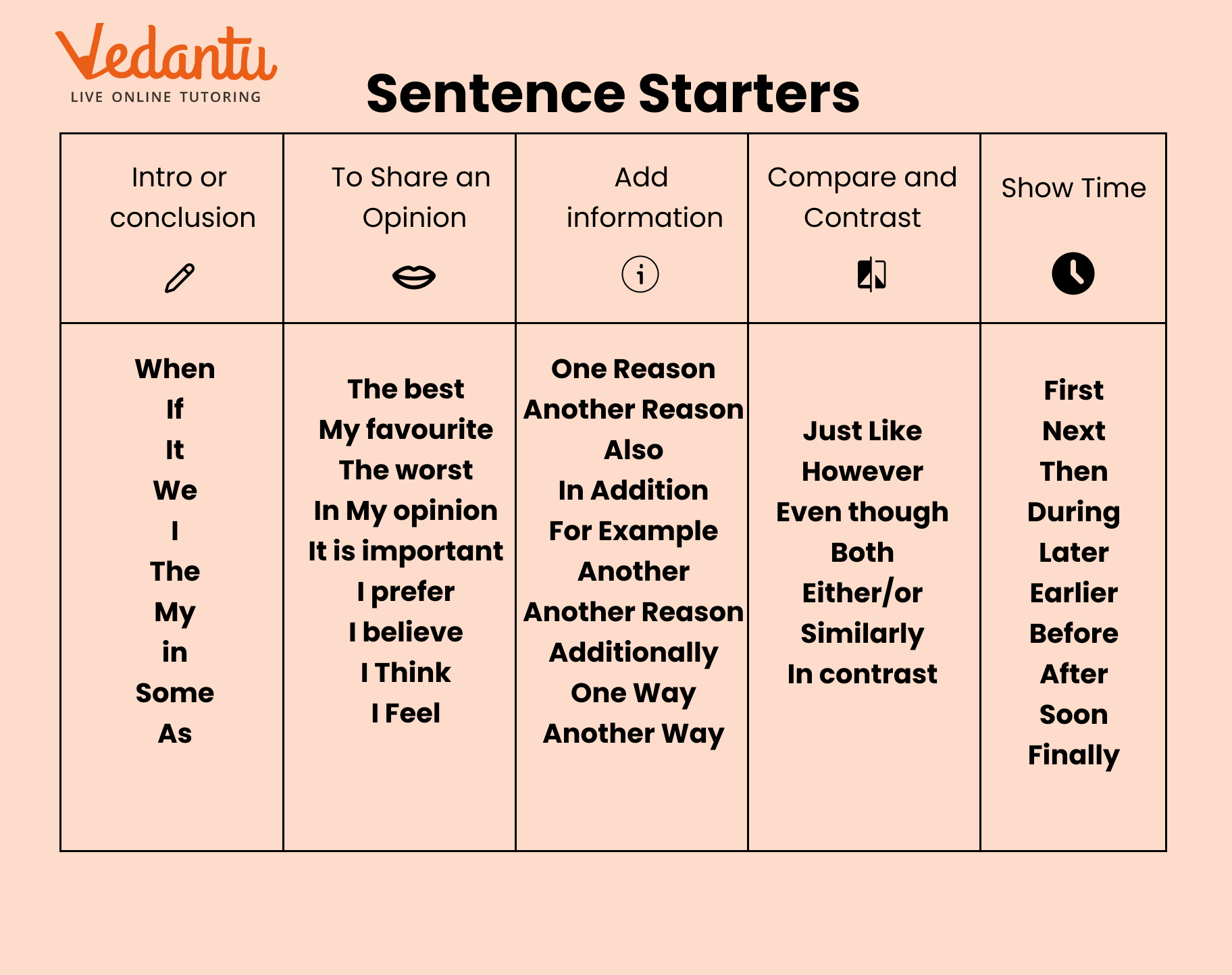
Commonly Used Sentence Starters
The below table provides the best understanding and correct use of sentence starter:
Common Confusions about Sentence Starters
Sentence Starters vs. Conjunctions: While both can be used to connect ideas, sentence starters are more versatile and can add emphasis, whereas conjunctions like "and," "but," and "or" merely link clauses.
Sentence Starters vs. Topic Sentences: Topic sentences introduce the main idea of a paragraph, while sentence starters can be used in various parts of a paragraph to introduce, transition, or emphasize ideas.
Exercise for Sentence Starters
Exercise 1: Complete the Sentences
Fill in the blanks with the appropriate sentence starters from the list below. Each sentence starter should fit the context of the sentence.
Sentence Starters List:
In contrast,
For example,
Ultimately,
Furthermore,
As a result,
________, the data shows a significant increase in sales during the last quarter.
The new policy aims to reduce waste. ________, it encourages recycling in all departments.
The two companies have different approaches. ________, Company A focuses on innovation, while Company B prioritizes cost efficiency.
The project faced several challenges. ________, the team managed to meet the deadline.
The experiment was carefully designed. ________, the results were not as expected.
Exercise 2: Match the Sentence Starter to its Purpose
Match the following sentence starters with their correct purpose.
Answer Key
Exercise 1:
Furthermore, the data shows a significant increase in sales during the last quarter.
The new policy aims to reduce waste. As a result, it encourages recycling in all departments.
The two companies have different approaches. In contrast, Company A focuses on innovation, while Company B prioritizes cost efficiency.
The project faced several challenges. Ultimately, the team managed to meet the deadline.
The experiment was carefully designed. However, the results were not as expected.
Exercise 2:
In conclusion, - d) Concluding a thought
On the other hand, - b) Contrasting ideas
For example, - c) Providing an example
Moreover, - a) Adding information
As a result, - e) Showing cause and effect
Test Your Understanding of the Topic by Completing the Following Tasks
1. Which of the following is a sentence starter used to introduce an idea?
a) Furthermore,
b) In contrast,
c) To begin with,
d) As a result,
2. Which sentence starter would you use to add more information?
a) In conclusion,
b) Moreover,
c) However,
d) Therefore,
3. Which of the following sentence starters is best for showing contrast?
a) For example,
b) On the other hand,
c) Similarly,
d) To sum up,
4. Which sentence starter would be most appropriate for concluding a paragraph?
a) Indeed,
b) To clarify,
c) Ultimately,
d) For instance,
5. Which sentence starter is used to show cause and effect?
a) Likewise,
b) In my opinion,
c) Therefore,
d) Undoubtedly,
Check the Answers with Explanation
Correct Answer: c) To begin with,
Explanation: This sentence starter is commonly used to introduce an idea or topic.
Correct Answer: b) Moreover,
Explanation: Moreover is used to add more information or details.
Correct Answer: b) On the other hand,
Explanation: This phrase is used to show contrast between two ideas.
Correct Answer: c) Ultimately,
Explanation: Ultimately is used to conclude or summarize a discussion.
Correct Answer: c) Therefore,
Explanation: Therefore is used to show a cause-and-effect relationship.
Takeaways from the Topic “Sentence Starters”
Understanding Sentence Starters: Grasp the importance of varied sentence starters in making writing more engaging.
Enhancing Writing: Practice using different sentence starters to improve the flow and readability of your text.
Practical Application: Applying sentence starters correctly can enhance both academic and creative writing.
FAQs on Sentence Starters Meaning and Examples in English Grammar
1. What are sentence starters in English?
Sentence starters are words or phrases used at the beginning of a sentence to introduce an idea, transition, or emphasis. They help improve clarity and flow in writing and speaking.
- They can show time: First, Later
- They can show contrast: However, On the other hand
- They can introduce examples: For example, For instance
2. Why are sentence starters important in writing?
Sentence starters are important because they improve coherence, flow, and clarity in writing. They guide the reader through ideas logically.
- They connect paragraphs and sentences smoothly.
- They prevent repetitive sentence structures.
- They signal purpose, such as contrast, addition, or conclusion.
3. What are some examples of sentence starters?
Common sentence starters include transition words, introductory phrases, and dependent clauses. These help structure ideas clearly.
- Addition: Additionally, Moreover
- Contrast: However, Although
- Cause and effect: Therefore, As a result
- Time: After that, Meanwhile
4. How do you use sentence starters correctly?
You use sentence starters correctly by placing them at the beginning of a sentence and following correct punctuation and grammar rules.
- Use a comma after introductory words like However, or For example,
- Ensure the sentence remains complete and logical.
- Avoid overusing the same starter repeatedly.
5. What is the difference between sentence starters and transition words?
The main difference is that sentence starters begin a sentence, while transition words connect ideas within or between sentences. Many transition words can also function as sentence starters.
- Sentence starter: In conclusion, the experiment was successful.
- Transition within a sentence: The experiment was successful; however, improvements are needed.
6. Can you start a sentence with “and” or “but”?
Yes, you can start a sentence with And or But in modern English, especially in informal or creative writing. Traditional grammar discouraged it, but it is now widely accepted.
- And adds emphasis or continuation.
- But introduces contrast.
7. What are good sentence starters for essays?
Good sentence starters for essays are formal transition phrases that organize arguments clearly. They help structure introductions, body paragraphs, and conclusions.
- Introduction: To begin with, In this essay
- Body: Furthermore, On the contrary
- Conclusion: In conclusion, To sum up
8. What are sentence starters for storytelling?
Sentence starters for storytelling are phrases that create setting, action, or suspense at the beginning of a sentence. They help engage the reader.
- Time-based: One day, Suddenly
- Setting-based: In the middle of the forest,
- Action-based: Without warning,
9. What are common mistakes when using sentence starters?
Common mistakes include overusing the same starter, incorrect punctuation, and sentence fragments. These errors reduce clarity and professionalism.
- Repeating words like Firstly in every paragraph.
- Forgetting a comma after introductory phrases.
- Writing incomplete clauses after starters like Although.
10. How can sentence starters improve vocabulary and fluency?
Sentence starters improve vocabulary and fluency by encouraging the use of varied transition words and complex sentence structures. They help learners avoid repetitive patterns.
- They introduce new linking words like Consequently or In contrast.
- They promote complex sentences with clauses.
- They enhance logical flow in speaking and writing.
