









What is Economics?
Economics is the economic problem or study of economic problems arising from the fact that resources are scarce relative to our needs and that scarce resources have other uses. It focuses on rationally managing scarce resources in ways that maximise economic benefits at both micro and macro levels. One of the major limitations of economics is that it assumes economic agents are rational and that only economic equilibrium exists. Economics is divided into two parts:
Microeconomics
Macroeconomics.
Below is a brief explanation of micro and macro concepts in Economics.
Microeconomics
Microeconomics is the study of economics at the individual, group, or firm level. This is considered to be basic economics. Microeconomics may be defined as that branch of economic analysis which studies the economic behaviour of the individual unit, maybe a person, a particular household, or a particular firm. This is a study of specific entities rather than all entities combined. Microeconomics is also known as the theory of prices and values, the theory of households, firms, and industries. Most production and welfare theories are microeconomics in nature. A key role of microeconomics is to study how firms can maximise their production and capacity so that they can lower prices and compete in their industry.
Microeconomics
Limitations of Microeconomics
The main limitations of microeconomics are as follows:
Microeconomic studies assume that other values are constant, which is not realistic. All factors are subject to change and are not constant.
One of the important limitations of Microeconomics is that it assumes full employment. In other words, all resources are fully used in the production process, but this is only an illusion and not true.
Adopting a laissez-faire policy is unrealistic in the real world, where we see government interference in economic activity.
Knowledge of the economy as a whole is very important for people as it encompasses all economic factors. But microeconomics only focuses on a small part of the economy as a whole.
The scope of microeconomics is limited and narrow. It does not include income theory, inflation, monetary policy, etc., which are very important for economic analysis.
Macroeconomics
Macroeconomics may be defined as that branch of economic analysis which studies the behaviour of not one particular unit but all the units combined. Macroeconomics is a study in aggregates. Macroeconomics studies the links between different countries in terms of how the policies of one country affect others. Within that framework, an analysis of the successes and failures of government strategies is presented.
Limitations of Macroeconomics
The limitations of macroeconomics are as follows:
Macroeconomics deals with aggregates, which refer to individual totals. However, overall results may differ from individual behaviour.
It does not study the different effects of the aggregate on different sectors of the economy.
It ignores the contribution of Individual units.
If each data unit is different, it becomes difficult to judge.
The aggregate tendency may not affect all sectors equally.
Aggregate values cannot be used when individual items need to be considered separately.
Business Economics
Business economics is the application of microeconomics focused on subjects of great importance and interest. Business Economics deals with the organisation and allocation of a company's scarce resources to achieve desired goals. Thus, it combines the fundamentals of economics and business. The primary concern of business economics is with the company, the environment in which the company is located, and the business decision a company must make. Business Economics seeks to examine and analyse how and why a company behaves. It looks at the impact of actions, the policies of the companies that act, and the economy as a whole.
Limitations of Business Economics/Managerial Economics
The limitations of managerial economics are listed below:
Business economics focuses on business analysis based on financial and costing data. The reliability of this data, therefore, depends on the accuracy of the financial accounting information.
This analysis is based on historical information. But things change when new systems are introduced, and conclusions cannot be predicted from this previous information. Management controls are subject to the personal preferences of individual managers, which may influence to some extent, the final decisions of managers.
It is a costly process as the company usually needs a certain number of managers to keep it functioning properly.
The science of business management is relatively new and not fully developed. So, it can be ambiguous in certain scenarios.
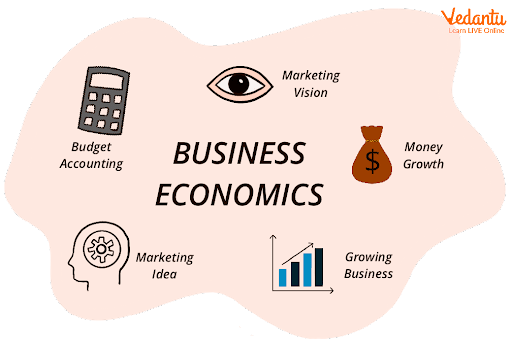
Business Economics
Case Study
“Economics is the study of choice under the conditions of scarcity.” Explain the statement concerning scarcity.
Ans: Scarcity is the basis of an essential problem in Economics. Even free natural resources when there is a cost to acquire or consume them, or when consumer demand for previously unnecessary resources increases due to changing tastes or newly discovered uses. Without scarcity, there would have been neither economic problems nor choice problems. Without a shortage of resources, the concept of infinite needs does not exist. If resources are not limited and desires are no longer unlimited, there would no longer be a question of choice. The question of choice ceases to exist. Therefore, there should be no economic problems and no economics.
Summary
Economics is derived from the Greek word ‘oikonomia’, which can be divided into two parts: ‘Oikos’ means house and ‘nomos’ means management, so together, they mean the management of household finances. The subject of Economics revolves around the central question of the rational use of resources. At the micro level, it rationalises limited resources so that individuals can maximise their satisfaction as consumers and profits as producers, and at the macro level, economies can maximise social welfare along with rapid economic growth.
FAQs on Limitations of Economics: Challenges and Criticisms
1. What are the limitations of economic thought?
Economic thought provides frameworks to analyze and predict human behavior in markets, but it has several key limitations. One main issue is that many economic models assume people act rationally and have full information, which often does not match real-world behavior. Furthermore, economic thought can struggle to include social and ethical factors, focusing mainly on efficiency and growth.
Because societies are complex, simplifying assumptions may exclude key variables like emotions, culture, and power dynamics. These limitations mean that while economic theory is valuable, it cannot fully capture the diversity or unpredictability of real-world economies. Understanding these constraints helps create more responsible and realistic policies.
2. What are the 4 problems of economics?
Economics studies how societies allocate limited resources, and faces four fundamental problems. These address both scarcity and resource optimization through key questions:
- What to produce: Deciding which goods and services should be made with finite resources.
- How to produce: Choosing the most efficient methods or technologies for production.
- For whom to produce: Determining how goods and services are distributed among individuals.
- How to achieve economic growth: Finding ways to improve productivity and quality of life.
3. What are economic limits?
Economic limits refer to the boundaries that restrict production, consumption, or resource use in a society. These can be caused by factors such as scarcity of resources, environmental constraints, legal regulations, and limited technological ability. Since resources like land, labor, and capital are always finite, economies must make choices about how best to use them. Recognizing these limits helps policy makers and businesses set realistic goals. In summary, economic limits are unavoidable barriers that force individuals and societies to prioritize their wants and manage trade-offs carefully.
4. What are the disadvantages of economics?
Economics offers powerful tools, but relies on certain assumptions that can be problematic. Disadvantages include its tendency to oversimplify complex situations or ignore social and environmental factors. For instance, economic models often focus on measurable outcomes like GDP, neglecting well-being or ecological effects. As a result, exclusive dependence on economics can lead to policies that overlook inequality or sustainability. To be truly effective, economics must be paired with insights from other fields to ensure comprehensive solutions.
5. How does the assumption of rationality limit economics?
Many economic models assume that people always make logical decisions aimed at maximizing their benefit, known as the 'rational actor' model. However, in reality, individuals are influenced by emotions, habits, and misinformation, leading to irrational choices. This limits the predictive power of economic theory, making it less accurate for real-life scenarios. By not accounting for behavioral factors, economics sometimes fails to explain phenomena like market bubbles or sudden changes in consumer trends. Recognizing behavioral economics is essential for more realistic insights.
6. Why can't economics predict the future with certainty?
Economics cannot predict the future with certainty because it deals with complex systems involving millions of unpredictable choices. Factors like political decisions, technological changes, and global events introduce extra uncertainty. Economic models rely on assumptions that may not hold over time or under unexpected conditions. As a result, while economics can identify trends and probabilities, it cannot offer precise forecasts. This inherent uncertainty highlights the need for flexible planning and continuous adjustments in economic policy.
7. How do social and ethical factors limit the application of economics?
Economics often emphasizes efficiency and resource allocation, but it may overlook social values, traditions, or ethical concerns. Policies that are economically optimal may conflict with fairness, culture, or justice in society. Additionally, some economic solutions might violate ethical norms or rights, such as environmental protection or labor standards. This means decision-makers must balance economic recommendations with broader social and moral responsibilities for well-rounded outcomes.
8. In what ways do external shocks reveal the limitations of economics?
External shocks refer to sudden events like natural disasters, pandemics, or financial crises that affect economies. These shocks expose the limits of economic forecasting and models, as such events are hard to predict and often fall outside standard assumptions. When unexpected shocks occur, existing economic tools may be insufficient to provide immediate solutions. This highlights the importance of adaptability and the need to consider factors beyond standard economic analysis in policy and crisis management.
