






Mensuration Class 8 important questions with answers PDF download
Very Short Answer Question 1 Mark
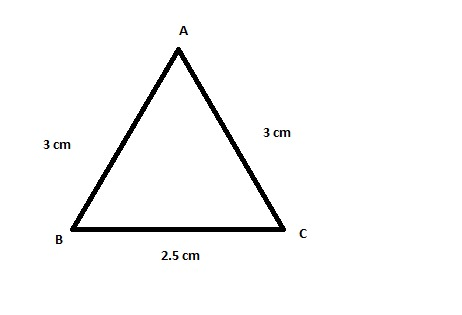
1. Find the perimeter of the given figure
(a) ${\text{11cm}}$
(b) ${\text{8}}{\text{.5cm}}$
(c) ${\text{13cm}}$
(d) ${\text{9}}{\text{.5cm}}$
Ans: Perimeter of the given figure = ${\text{3cm + 3cm + 2}}{\text{.5cm = 8}}{\text{.5cm}}$
Therefore, the correct option is (b)
2. Area of a trapezium = Half of the sum of the length of parallel sides × _____?
Ans: Perpendicular distance between them.
3. The area of a parallelogram whose base is ${\text{9cm}}$and altitude is ${\text{6cm}}$
(a) ${\text{45c}}{{\text{m}}^{\text{2}}}$
(b) ${\text{54c}}{{\text{m}}^2}$
(c) ${\text{48c}}{{\text{m}}^{\text{2}}}$
(d) ${\text{84c}}{{\text{m}}^2}$
Ans: Area of parallelogram = base × altitude
= ${\text{9}}\;{\text{cm } \times 6}\;{\text{cm = 54}}\;{\text{c}}{{\text{m}}^{\text{2}}}$
Therefore, correct option is (b)
4. The volume of a cube whose edge is ${\text{6a}}$ is
(a) ${\text{25}}{{\text{a}}^{\text{3}}}$
(b) ${\text{216}}{{\text{a}}^3}$
(c) ${\text{125}}{{\text{a}}^{\text{3}}}$
(d) None of these
Ans: Volume of cube = ${\text{6}}{{\text{a}}^{\text{3}}}\;{\text{ = }}\;{\text{216}}{{\text{a}}^{\text{3}}}$
Therefore, the correct option is (c)
5. The sum of the areas of all six faces of a cuboid is the _____ of the cuboid.
(a) Volume
(b) Surface area
(c) Area
(d) Curved surface area
Ans: Sum of the areas of all six faces of cuboid is the surface area of cuboid which is given by ${\text{2(l b + b h + h l)}}$
Therefore, the correct option is (b)
6. The area of a. Rhombus is $240\mathrm{~cm}^{2}$ and one of the diagonals is $16 \mathrm{~cm}$ Then other diagonal is
(a) ${\text{25cm}}$
(b) ${\text{30cm}}$
(c) ${\text{18cm}}$
(d) ${\text{35cm}}$
Ans: Area of Rhombus= ${\text{240c}}{{\text{m}}^{\text{2}}}\;{\text{ = }}\;\dfrac{{\text{1}}}{{\text{2}}}{\text{(}}{{\text{d}}_{\text{1}}}{ \times }{{\text{d}}_{\text{2}}}{\text{)}}$
= ${\text{2} \times 240}\;{\text{c}}{{\text{m}}^{\text{2}}}\;{\text{ = }}\;{\text{16}}\;{\text{cm} \times }{{\text{d}}_{\text{2}}}$
$ \Rightarrow $${{\text{d}}_{\text{2}}}{\text{ = }}\dfrac{{{\text{2}}\;{ \times }\;{\text{240}}\;{\text{c}}{{\text{m}}^{\text{2}}}}}{{{\text{16}}\;{\text{cm}}}}{\text{ = 30}}\;{\text{cm}}$
Therefore, correct option is (b)
7. The volume of water tank is ${\text{3}}\;{{\text{m}}^{\text{3}}}$. Its capacity in litres is
(a) ${\text{30}}$
(b) ${\text{300}}$
(c) ${\text{3000}}$
(d) None of these
Ans:
${\text{1}}{{\text{m}}^{\text{3}}}{\text{ = 1000}}\;{\text{litres}}$
V = ${\text{3}}{{\text{m}}^{\text{3}}}{\text{ = 3(1000) = 3000}}\;{\text{litres}}$
Therefore, correct option is (c)
Short Answer Questions 2 Mark
8. Find the area of a square, the length of diagonal is $2 \sqrt{2} m$
Ans: Area of Square = $\dfrac{{\text{1}}}{{\text{2}}}{{\text{d}}^{\text{2}}}\;\;\;\;\;\;\;\;\;\;\;\;\;(\therefore {\text{d = 2}}\sqrt {\text{2}} {\text{m}})$
where d = diagonal length
Area of Square = $\dfrac{{\text{1}}}{{\text{2}}}{{\text{(2}}\sqrt {\text{2}} \;{\text{m)}}^{\text{2}}}{\text{ = }}\dfrac{{\text{1}}}{{\text{2}}}\;{\times }\;{\text{4}}\;{ \times }\;{\text{2 }}{{\text{m}}^{\text{2}}}{\text{ = 4}}\;{{\text{m}}^{\text{2}}}$
9. If the parallel sides of a parallelogram are ${\text{2cm}}$apart and their sum is ${\text{12cm}}$ then find its area.
Ans:
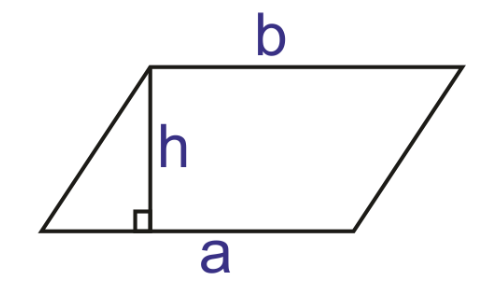
Opposite sides of a parallelogram are equal
∴ ${\text{a}}\;{\text{ + }}\;{\text{b}}\;{\text{ = }}\;{\text{12}}$
${\text{a}}\;{\text{ + }}\;{\text{a = 12}}$
${\text{2a = 12}}$
${\text{a = 6}}$
Area of parallelogram = ${\text{a}}\;{ \times }\;{\text{h = 6}}\;{ \times }\;{\text{2 = 12}}\;{\text{c}}{{\text{m}}^{\text{2}}}$
10. The length, breadth and height of a cuboid are ${\text{20cm}}$, ${\text{15cm}}$ and ${\text{10cm}}$ respectively. Find its total surface area.
Ans:
${\text{L = 20cm , B = 15cm , H = 10cm}}$
Surface area of cuboid = ${\text{2(lb}}\;{\text{ + }}\;{\text{bh}}\;{\text{ + }}\;{\text{hl)}}$
= ${{2(20 \times 15 + 15 \times 10 + 10 \times 20)c}}{{\text{m}}^{\text{2}}}$
= ${\text{2(300}}\;{\text{ + }}\;{\text{150}}\;{\text{ + }}\;{\text{200)}}\;{\text{c}}{{\text{m}}^{\text{2}}}$
= ${\text{2(650)}}\;{\text{c}}{{\text{m}}^{\text{2}}}{\text{ = 1300}}\;{\text{c}}{{\text{m}}^{\text{2}}}$
11. Volume of Cube is ${\text{8000c}}{{\text{m}}^{\text{3}}}$. Find its surface area.
Ans:
V= ${\text{8000}}\;{\text{c}}{{\text{m}}^{\text{3}}}$
${{\text{l}}^{\text{3}}}{\text{ = 8000}}\;{\text{c}}{{\text{m}}^{\text{3}}}$
$ \Rightarrow \;{\text{l = }}\sqrt[{\text{3}}]{{{\text{8000 c}}{{\text{m}}^{\text{3}}}{\text{ }}}}\;$
${\text{l}}\;{\text{ = }}\;{\text{20}}\;{\text{cm}}$
Surface Area of Cube = ${\text{6}}{{\text{l}}^{\text{2}}}$
= ${\text{6(20cm}}{{\text{)}}^{\text{2}}}{\text{ = 2400c}}{{\text{m}}^{\text{2}}}$
12. Find the ratio of the areas of two circles whose radii is ${\text{7cm}}$ and ${\text{14cm}}$.
Ans:
${{\text{r}}_{\text{1}}}{\text{ = 7cm}}$
$ \Rightarrow $ ${{\text{A}}_{\text{1}}}{\text{ = }}\;\pi {{\text{(7)}}^{\text{2}}}{\text{ = 49}}\;\pi $
${{\text{r}}_2}{\text{ = 14cm}}$
$ \Rightarrow $${{\text{A}}_2}{\text{ = }}\pi \;{{\text{(14)}}^{\text{2}}}{\text{ = 196}}\;\pi $
${{\text{A}}_{\text{1}}}{\text{:}}{{\text{A}}_{\text{2}}}{\text{ = 49}}\pi \,{\text{:}}\;{\text{196}}\pi $
${{\text{A}}_{\text{1}}}{\text{:}}{{\text{A}}_{\text{2}}}{\text{ = 7:28}}$
13. Find the diameter of the circle whose circumference is ${\text{230m}}$.
Ans: Circumference = ${\text{230m}}$
${\text{2}}\pi {\text{r = 230}}\,{\text{m}}$
${\text{r = }}\dfrac{{{\text{230}}}}{{{\text{2}}\pi }}{\text{ = }}\dfrac{{{{230 \times 7}}}}{{{{2 \times 22}}}}{\text{ = 36}}{\text{.6}}\;{\text{m}}$
${\text{d}}\;{\text{ = }}\;{\text{2r}}\;{\text{ = }}\;{\text{2}}\;{{ \times }}\;{\text{36}}{\text{.6}}\;{\text{m}}\;{\text{ = }}\;{\text{73}}{\text{.18}}\;{\text{cm}}$
Question (14 – 18) 3 Mark
14. Find the area of the figure if the upper portion is a semicircle
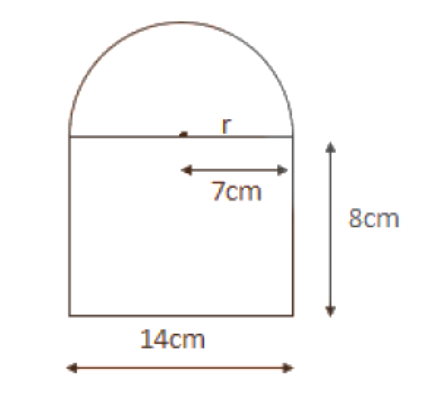
Ans: Total area = Area of semicircle + Area of Rectangle
Area of semicircle = $\dfrac{{\text{1}}}{{\text{2}}}\pi \;{{\text{r}}^{\text{2}}}$
With ${\text{r = }}\dfrac{{\text{1}}}{{\text{2}}}{\text{(length}}\;{\text{of}}\;{\text{rectangle)}}\;{\text{ = }}\dfrac{{\text{1}}}{{\text{2}}}{{ \times 14 = 7}}$
Area of semicircle = $\dfrac{{\text{1}}}{{\text{2}}}{{ \times }}\dfrac{{{\text{22}}}}{{\text{7}}}{{ \times 7 \times 7 = 77}}\;{\text{c}}{{\text{m}}^{\text{2}}}$
Area of rectangle = length × breadth
= ${\text{14}}\;{{ \times }}\;{\text{8 = 112}}\;{\text{c}}{{\text{m}}^{\text{2}}}$
Total area = ${\text{(77}}\;{\text{ + }}\;{\text{112)}}\;{\text{c}}{{\text{m}}^{\text{2}}}{\text{ = 189}}\;{\text{c}}{{\text{m}}^{\text{2}}}$
15. A goat is tied to one corner of a square field of side ${\text{8m}}$by a rope ${\text{3m}}$ long. Find the area it can graze? Also find the area the goat cannot graze.
Ans:
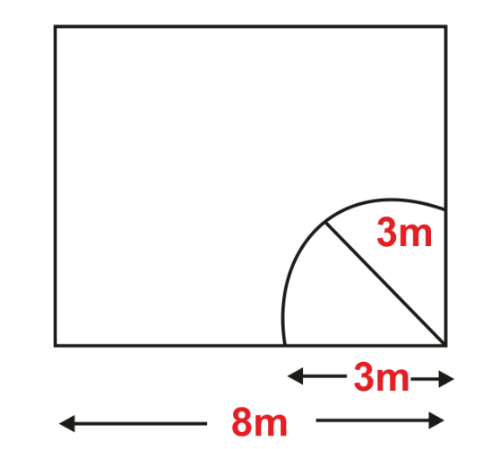
Length of side of a square = ${\text{8}}\;{\text{m}}$
Area of square = ${{\text{(8}}\;{\text{m)}}^{\text{2}}}{\text{ = 64}}\;{{\text{m}}^{\text{2}}}$
Length of rope = ${\text{3m}}$ = ${\text{r}}$ (radius of circle)
As the goat is tied to a corner of square plot it can only graze $\dfrac{{\text{1}}}{{\text{4}}}{\text{th}}$ of circle of radius equal to length of rope inside the plot.
Area covered (or grazed) by goat = $\dfrac{{\pi \;{{\text{r}}^{\text{2}}}}}{{\text{4}}}$
= $\dfrac{{{\text{22}}}}{{\text{7}}}{ \times }\dfrac{{{{{\text{(3)}}}^{\text{2}}}}}{{\text{4}}}{\text{ = }}\dfrac{{{22 \times 9}}}{{{\text{28}}}}$
= ${\text{7}}{\text{.07}}\;{{\text{m}}^{\text{2}}}$
Area the goat cannot graze = Area of square – Area grazed by goat
= ${\text{64}}\;{\text{ - }}\;{\text{7}}{\text{.07 = 56}}{\text{.93}}\;{{\text{m}}^{\text{2}}}$
16. If ${\text{x}}$ units are added to the length of the radius of a circle, what is the number of units by which the circumference of the circle is increased?
Ans: Let the radius of the circle be ‘${\text{r}}$’ units
The circumference of the circle will be ${\text{2}}\pi \;{\text{r}}$ units
If the radius is increased by ‘${\text{x}}$’ units, the new radius will be ${\text{(r + x)}}$ units.
New circumference will be ${\text{2}}\pi \;{\text{(r}}\;{\text{ + }}\;{\text{x) = 2}}\pi \;{\text{r}}\;{\text{ + }}\;{\text{2}}\pi {\text{x}}$
Circumference increased by ${\text{2}}\pi \;{\text{x}}$ units.
17. Find the area of the shaded portion if diameter of circle is ${\text{16cm}}$ and ABCD is a square.
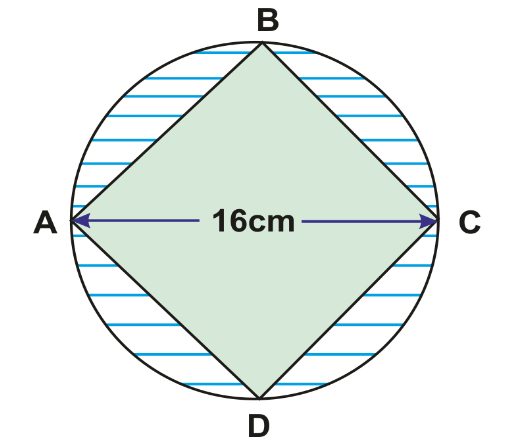
Ans: Area of shaded portion = (Area of circle with radius =${\text{8cm}}$) – (Area of square with diagonal length = ${\text{16cm}}$)
= $\pi \;{{\text{r}}^{\text{2}}}{\text{ - }}\dfrac{{\text{1}}}{{\text{2}}}{{\text{d}}^{\text{2}}}$
= $\dfrac{{22}}{7} \times {(8)^2} - \dfrac{1}{2}{(16)^2}$
= $\dfrac{{22 \times 64}}{7} - 128$
= ${\text{201}}{\text{.1}}\;{\text{ - }}\;{\text{128}}\;{\text{ = }}\;{\text{73}}{\text{.1}}\;{\text{c}}{{\text{m}}^{\text{2}}}$
18. How many ${\text{c}}{{\text{m}}^{\text{3}}}$ of juice can be poured in a cuboidal can whose dimensions are $\text{15cm} \times \text{10cm} \times \text{25cm}$. How many cubical packs of ${\text{25c}}{{\text{m}}^{\text{3}}}$ volume can be made?
Ans: Volume of cuboid = Length $\times$ Breadth $\times$ Height
= ${\text{15}}\;{\text{cm}}\;{ \times }\;{\text{10}}\;{\text{cm}}\;{\times}\;{\text{25}}\;{\text{cm}}$
Volume of juice in cuboidal can = ${\text{3750}}\;{\text{c}}{{\text{m}}^{\text{3}}}$
Each volume of cubical packet = ${\text{25}}\;{\text{c}}{{\text{m}}^{\text{3}}}$
Number of such cubical packets made from the volume of juice in cuboidal can
${\text{n = }}\dfrac{{{\text{volume}}\;{\text{of}}\;{\text{juice}}\;{\text{in}}\;{\text{cuboidal}}\;{\text{can}}}}{{{\text{each}}\;{\text{cubical}}\;{\text{pack}}\;{\text{volume}}}}$
${\text{n = }}\dfrac{{{\text{3750}}\;{\text{c}}{{\text{m}}^{\text{3}}}}}{{{\text{25}}\;{\text{c}}{{\text{m}}^{\text{3}}}}}$
${\text{n = 150}}$ packets
Question (19 – 25) 5 Mark
19. A rectangular piece of paper${\text{66}}\;{\text{cm}}$long and${\text{10}}\;{\text{cm}}$broad is rolled along the length to form a cylinder. What is the radius of the base and calculate volume of cylinder?
Ans:
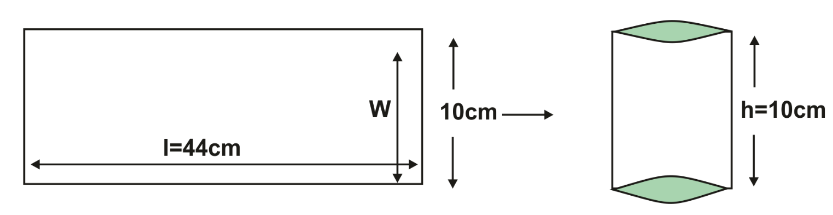
When the rectangular piece is rolled in the form of a cylinder then the length became the circumference of the base of cylinder
C = ${\text{66}}$,
${\text{2}}\pi \;{\text{r = 66}}$
$\pi \;{\text{r = }}\dfrac{{{\text{66}}}}{{\text{2}}}{\text{ = 33}}$
${\text{r = }}\dfrac{{{\text{33}}\;{{ \times }}\;{\text{7}}}}{{{\text{22}}}}{\text{ = 10}}{\text{.5}}\;{\text{cm}}$
Volume of Cylinder with radius = ${\text{10}}{\text{.5cm}}$ ang height = ${\text{10cm}}$
${\text{V = }}\pi \;{{\text{r}}^{\text{2}}}{\text{h = }}\;\dfrac{{{\text{22}}}}{{\text{7}}}\;{{ \times }}\;{{\text{(10}}{\text{.5)}}^{\text{2}}}{{ \times }}\;{\text{10}}$
= ${\text{3465}}\;{\text{c}}{{\text{m}}^{\text{3}}}$
20. ABCD has area equal to ${\text{28}}$. BC is parallel to AD. BA is perpendicular to AD. If BC is ${\text{6}}$ and AD is ${\text{8}}$, then what is CD?
Ans: The shape of the given figure is a trapezium
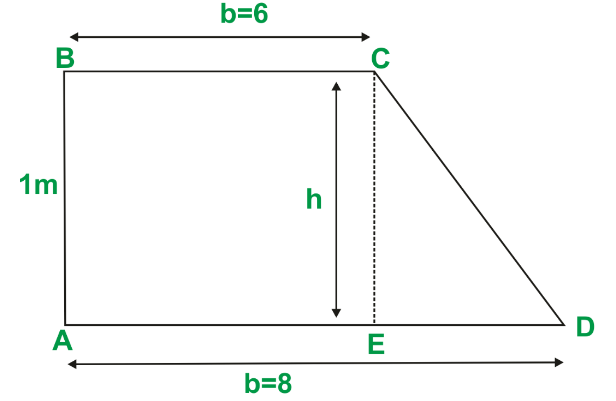
Area of Trapezium = $\dfrac{1}{2}\text{(sum of parallel sides)} \times \text{height}$
Given area of ABCD = ${\text{28}}$, BC = ${\text{6}}$, AD = $8$, CD = ?
${\text{28 = A = }}\dfrac{{\text{1}}}{{\text{2}}}{\text{(6}}\;{\text{ + }}\;{\text{8)}}\;{\text{h}}$
${\text{h = }}\dfrac{{{\text{28}}\;{{ \times }}\;{\text{2}}}}{{{\text{14}}}}{\text{ = 4}}\;{\text{units}}$
To find CD: let DE perpendicular to AD (construction done)
In triangle CED,
ED = AD – AE
ED = ${\text{8 - 6}}$
ED = ${\text{2}}$
${\text{C}}{{\text{D}}^{\text{2}}}{\text{ = C}}{{\text{E}}^{\text{2}}}{\text{ + E}}{{\text{D}}^{\text{2}}}$
${\text{C}}{{\text{D}}^{\text{2}}}{\text{ = }}\;{{\text{(4)}}^{\text{2}}}{\text{ + }}\;{{\text{(2)}}^{\text{2}}}{\text{ = 16}}\;{\text{ + }}\;{\text{4}}\;{\text{ = }}\;{\text{20}}$
${\text{CD = }}\sqrt {{\text{20}}} \;{\text{ = }}\;{\text{2}}\sqrt {\text{5}} $
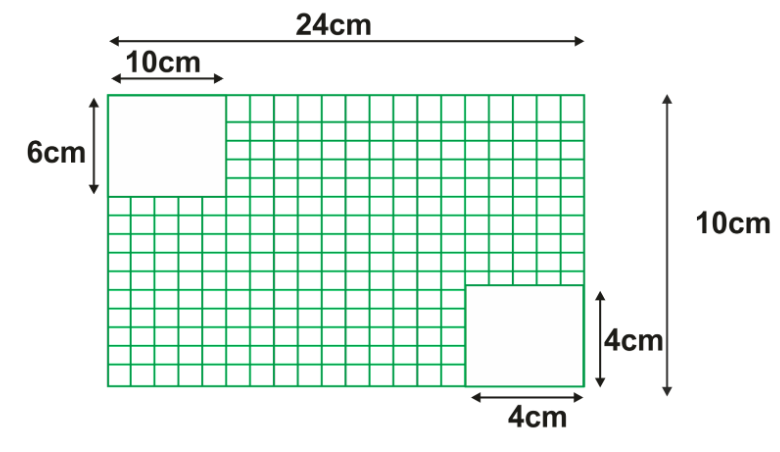
21. From the adjoining figure find the area of shaded portion
Ans: From the figure,
Area of shaded portion = [Area of rectangle with ${\text{l = 24}}$, ${\text{b = 10}}$] – [Area of rectangle with ${\text{b = 6}}$, ${\text{l = 10}}$+ Area of square with side = ${\text{4}}$]
Area of big rectangle = ${\text{l}}\;{{ \times }}\;{\text{b}}$
= ${\text{24}}\;{{ \times }}\;{\text{10}}\;{\text{ = 240}}\;{\text{c}}{{\text{m}}^{\text{2}}}$
Area of small rectangle = ${\text{l}}\;{{ \times }}\;{\text{b}}$
= ${\text{6}}\;{{ \times }}\;{\text{10 }}\;{\text{ = }}\;{\text{60}}\;{\text{c}}{{\text{m}}^{\text{2}}}$
Area of squares = ${\text{4}}\;{{ \times }}\;{\text{4}}\;{\text{ = }}\;{\text{16}}\;{\text{c}}{{\text{m}}^{\text{2}}}$
Therefore, Area of shaded portion = ${\text{240}}\;{\text{ - }}\;{\text{(60}}\;{\text{ + }}\;{\text{16)}}$
= ${\text{240}}\;{\text{ - }}\;{\text{76 = 164}}\;{\text{c}}{{\text{m}}^{\text{2}}}$
22. A flooring tile has a shape of a parallelogram whose base is ${\text{28cm}}$ and the corresponding height is ${\text{20cm}}$. How many such tiles are required to cover a floor of area ${\text{2800}}{{\text{m}}^{\text{2}}}$.
Ans: Given, Base = ${\text{28cm}}$ , height = ${\text{20cm}}$
Area of floor = ${\text{2800}}\;{{\text{m}}^{\text{2}}}$
= ${\text{2800}}\;\;{{ \times }}\;{\text{1}}{{\text{0}}^{\text{4}}}\;{\text{c}}{{\text{m}}^{\text{2}}}\;{\text{ = }}\;\;{\text{28}}\;{{ \times }}\;{\text{1}}{{\text{0}}^{\text{6}}}\;{\text{c}}{{\text{m}}^{\text{2}}}$
Area of each parallelogram tile = base × height
= ${\text{28}}\;{{ \times }}\;{\text{20 = 560}}\;{\text{c}}{{\text{m}}^{\text{2}}}$
Number of tiles required = $\dfrac{{{\text{Area}}\;{\text{of}}\;{\text{floor}}}}{{{\text{Area}}\;{\text{of}}\;{\text{tiles}}}}{\text{ = }}\dfrac{{{\text{28} \times 1}{{\text{0}}^{\text{6}}}}}{{{\text{560}}}}$ = $\dfrac{{{\text{1}}{{\text{0}}^{\text{5}}}}}{{\text{2}}}{\text{ = }}\dfrac{{{\text{100000}}}}{{\text{2}}}{\text{ = 50000}}$
23. Rain water which falls on a flat rectangular surface of length ${\text{6m}}$ and breadth ${\text{4m}}$ is transferred into a cylindrical vessel of internal radius ${\text{20cm}}$. What will be the height of water in the cylindrical vessel if the rain fall is ${\text{1cm}}$ (Take $\pi \;{\text{ = }}\;{\text{3}}{\text{.14}}$)
Ans:
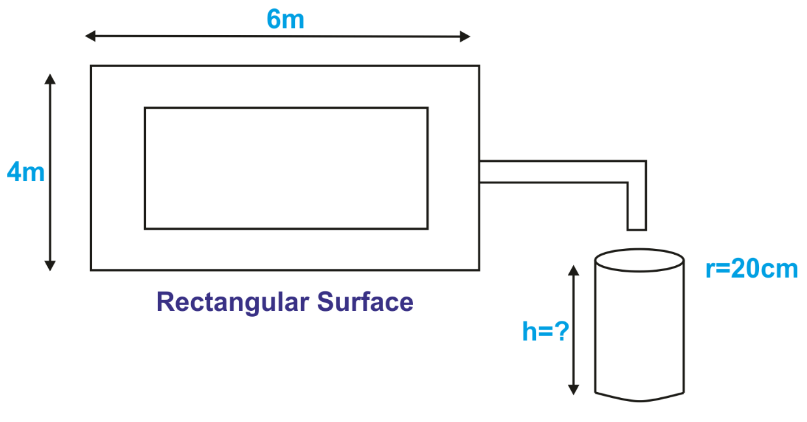
Since the water in the rectangular surface is transferred to the cylindrical vessel.
Length of surface = ${\text{6}}\;{\text{m = 600}}\;{\text{cm}}$
Breadth of surface = ${\text{4}}\;{\text{m = 400}}\;{\text{cm}}$
Height of water level = ${\text{1}}\;{\text{cm}}$
Volume of water on the surface = ${\text{l}}\;{{ \times }}\;{\text{b}}\;{{ \times }}\;{\text{h}}$
$\begin{align} & =\text{600}\ \times \ \text{400}\ \times \ \text{1} \\ & =\text{240000}\ \text{c}{{\text{m}}^{\text{3}}} \\ \end{align}$
Let ‘${\text{h}}$’ be the height of the cylindrical vessel, ${\text{r = 20}}\;{\text{cm}}$ (radius of cylindrical vessel)
Volume of cylindrical vessel = $\pi \;{{\text{r}}^{\text{2}}}{\text{h}}$
= $\;\pi {{\text{(20)}}^{\text{2}}}\;{{ \times }}\;{\text{h}}$
Volume of water on surface = Volume of water in cylindrical vessel
${\text{24000 = }}\pi {{\text{(20)}}^{\text{2}}}{{ \times h}}$
${\text{h = }}\dfrac{{{\text{24000}}}}{{\pi \;{{ \times }}\;{\text{20}}\;{{ \times }}\;{\text{20}}}}{\text{ = 191}}{\text{.08}}\;{\text{cm}}$
24. If each edge of a cube is doubled
(a) how many times will its surface area increases
(b) how many times will its volume increases
Ans:
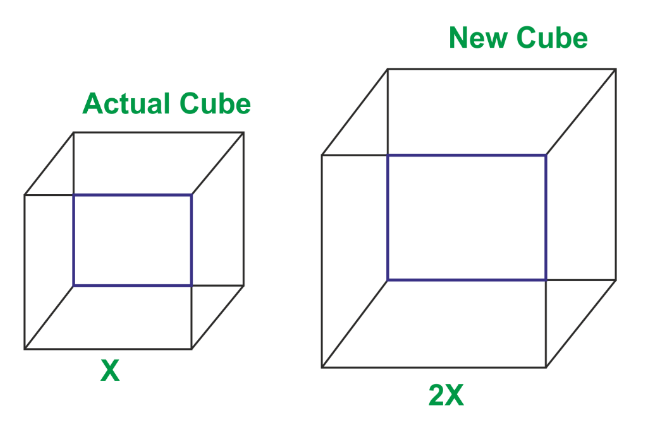
For side of ‘x’ units, surface area ${{\text{s}}_{\text{1}}}\;{\text{ = }}\;{\text{6}}{{\text{x}}^{\text{2}}}$
When side of cube is doubled (${\text{2x}}$ units)
Surface area ${{\text{s}}_{\text{2}}}{\text{ = }}\;{\text{6(2x}}{{\text{)}}^{\text{2}}}$
${{\text{s}}_{\text{2}}}{\text{ = }}\;{\text{6}}\;{{ \times }}\;{\text{4(x}}{{\text{)}}^{\text{2}}}\;{\text{ = }}\;\;{\text{4(6}}{{\text{x}}^{\text{2}}}{\text{)}}\;{\text{ = }}\;{\text{4}}{{\text{s}}_{\text{1}}}$
Surface area increases by ${\text{4}}$ times.
Volume for edge of ‘${\text{x}}$’ units ${{\text{v}}_{\text{1}}}\;{\text{ = }}\;{{\text{x}}^{\text{3}}}$
Volume of cube when edge is doubled ${\text{(2x)}}$, ${{\text{v}}_{\text{2}}}\;{\text{ = }}\;{{\text{(2x)}}^{\text{3}}}$
${{\text{v}}_{\text{2}}}{\text{ = }}\;\;{\text{8(x}}{{\text{)}}^{\text{3}}}\;{\text{ = }}\;{\text{8}}{{\text{v}}_{\text{1}}}$
Therefore, volume increases by 8 times.
25. A box with measures ${\text{80cm} \times \text{48cm} \times \text{24cm}}$ is to be covered with a tarpaulin cloth how many metres of tarpaulin cloth of width ${\text{96cm}}$ is required to cover ${\text{50}}$ such boxes?
Ans: The box with ${\text{l}}\;{\text{ = }}\;{\text{80}}\;{\text{cm,}}\;{\text{b}}\;{\text{ = }}\;{\text{48}}\;{\text{cm,}}\;{\text{h}}\;{\text{ = }}\;{\text{24}}\;{\text{cm}}$
Total surface area = ${\text{2(lb}}\;{\text{ + }}\;{\text{bh}}\;{\text{ + }}\;{\text{hl)}}$
= ${\text{2[(80}}\; \times \;48)\;{\text{ + }}\;{\text{(48}}\; \times \;{\text{24)}}\;{\text{ + }}\;{\text{(80}}\; \times \;{\text{24)]}}$
= ${\text{2[3840}}\;{\text{ + }}\;{\text{1152}}\;{\text{ + }}\;{\text{1920]}}$
= ${\text{2[6912] = 13824}}\;{\text{c}}{{\text{m}}^{\text{2}}}$
Length of cloth required = ${\text{(}}\dfrac{{{\text{Area}}\;{\text{of}}\;{\text{box}}}}{{{\text{breadth}}}}{\text{)}}\;{{ \times }}\;{\text{50}}$
= ${\text{(}}\dfrac{{13824}}{{96}}{\text{)}}\;{{ \times }}\;{\text{50 = 144}}\; \times \;{\text{50}}$
= ${\text{7200}}\;{\text{cm = 72}}\;{\text{m}}$
Important Formulas Related to CBSE Class 8 Maths Chapter 9 Mensuration
Benefits of Using Important Questions of Class 8 Maths for Mensuration
1. Expertly Curated Material: Vedantu's Class 8 Maths Mensuration Important Questions PDF is curated by top-notch math professors for a solid understanding of foundational concepts.
2. Comprehensive Coverage for Chapter 9: The important questions for Mensuration in Chapter 9 encompass all essential topics, presented in an understandable manner.
3. Concept Clarity: Solving these questions helps reinforce your understanding of formulas and techniques, building a strong foundation in the topic.
4. Step-by-Step Solutions: The PDF typically provides detailed solutions, helping you learn the correct approach and rectify mistakes effectively.
5. Portable and Convenient: Being a digital resource, the PDF is easy to access on-the-go, enabling consistent practice anytime, anywhere.
Conclusion
The CBSE Class 8 Maths Chapter 9 on Mensuration focuses on calculating the perimeter, area, and volume of different shapes and figures. It helps students understand real-world applications like measuring land, constructing objects, and finding capacities. By practising important questions, students can strengthen their problem-solving skills, improve accuracy, and prepare effectively for exams. The chapter covers 2D shapes (like rectangles, triangles, and circles) and 3D objects (like cubes, cuboids, and cylinders). With consistent practice and a clear understanding of formulas, students can build confidence in tackling questions and apply these concepts in practical situations.
Related Study Materials for CBSE Class 8 Maths Chapter 9
CBSE Class 8 Maths Chapter-wise Important Questions
Other Important Related Links for CBSE Class 8 Maths

FAQs on Important Questions For Class 8 Maths Chapter 9 Mensuration - 2025-26 Free PDF Download (Sign-in Required)
1. What are some Higher Order Thinking Skills (HOTS) questions that could be asked from Chapter 9, Mensuration, in the CBSE Class 8 exams for 2025-26?
For the 2025-26 exams, HOTS questions in Mensuration often involve multi-step problems or real-world applications. Expect important questions such as:
- Finding the cost of painting the walls and ceiling of a room, which requires calculating the area of four walls and a rectangle.
- Calculating the number of smaller cubes that can be cut from a larger cuboid, involving a comparison of their volumes.
- Problems involving a road roller, where you must find the area covered in a certain number of revolutions by calculating its curved surface area.
- Comparing the surface areas of two different solids (e.g., a cube and a cuboid) that have the same volume to determine which requires more material.
2. What is the typical mark distribution for important questions from Mensuration in the Class 8 Maths exam?
In the Class 8 Maths exam, questions from Mensuration typically range from short answer (2 marks) to long answer (4-5 marks). A likely breakdown is:
- 2-mark questions: These usually test direct formula application, like finding the area of a trapezium or the volume of a cube given its side.
- 3-mark questions: These may require calculating the total surface area of a cylinder or a cuboid, involving a couple of steps.
- 4 or 5-mark questions: These are often application-based (HOTS), such as problems on finding the capacity of a tank, calculating the area of a complex polygon, or real-life scenarios.
3. What type of important questions can be expected on the area of a trapezium and a general quadrilateral?
For the 2025-26 session, important questions on quadrilaterals focus on applying formulas correctly. For a trapezium, expect questions where you are given the height and the lengths of the two parallel sides to find the area. A more challenging question might provide the area and ask you to find a missing side or height. For a general quadrilateral, a common important question involves being given the length of a diagonal and the lengths of the perpendiculars dropped on it from the opposite vertices to calculate the total area.
4. If a cube and a cuboid have the same volume, which one is likely to have a larger total surface area and why is this concept important?
For any given volume, the cube will always have the minimum surface area compared to any cuboid. This concept is a crucial application of Mensuration in real life. For instance, in manufacturing and packaging, companies aim to use the least amount of material to create a box that can hold a specific volume. Understanding this principle helps in designing cost-effective and resource-efficient products, making it an important concept for application-based questions.
5. What is the most common mistake students make when asked to find the surface area of a cylinder?
The most common mistake is confusing the Total Surface Area (TSA) with the Curved Surface Area (CSA). It is important to read the question carefully.
- Use the formula for CSA (2πrh) when the question asks for the area of the curved part only, like finding the area of a label on a can or the surface of a pipe.
- Use the formula for TSA (2πr(h+r)) when the question asks for the total area of a closed cylinder, including its top and bottom circular bases, like a closed storage tank. Misinterpreting this can lead to incorrect answers in 3-mark and 5-mark questions.
6. How is the area of an irregular polygon, like a pentagon, typically calculated in an exam?
As per the Class 8 syllabus, the area of an irregular polygon is found by dividing it into familiar shapes. This is a frequently asked long-answer question. The standard method is to split the polygon into several triangles and trapeziums using diagonals or perpendiculars. You then calculate the area of each smaller shape individually and add them all up to find the total area of the polygon.
7. Why is understanding the difference between volume and capacity crucial for solving important word problems from Mensuration?
Understanding the distinction between volume and capacity is vital for applying the correct formulas in word problems.
- Volume is the 3D space an object occupies (e.g., the metal of a tank), measured in cubic units like m³.
- Capacity is the quantity a hollow object can hold (e.g., water inside the tank), measured in units like litres.
8. A road roller makes 750 complete revolutions to level a road. If its diameter is 84 cm and length is 1 m, what is the area of the road? How is this solved?
This is a classic important question. To solve it, follow these steps:
- First, find the radius from the diameter (r = 84/2 = 42 cm). Ensure units are consistent by converting the length to cm (h = 1 m = 100 cm).
- Next, calculate the Curved Surface Area (CSA) of the roller using the formula 2πrh. This gives the area covered in one revolution.
- CSA = 2 × (22/7) × 42 × 100 = 26,400 cm².
- Finally, multiply the CSA by the number of revolutions to get the total area of the road: 26,400 cm² × 750 = 19,800,000 cm².
- For full marks, convert this to a more standard unit like square metres: 19,800,000 / 10,000 = 1980 m².
