








An Overview of Class 11 Biology Study Of Distribution Of Stomata In The Upper And Lower Surface Of Leaves Experiment
We are well aware of the indispensable role of plants in the carbon cycle in the biosphere. During respiration, plants take in carbon dioxide and release oxygen, hence are valuable in maintaining the oxygen-carbon balance of life. To do this, plants “inhale” carbon dioxide and “exhale” oxygen. This gaseous exchange occurs through microscopic pores present on the epidermis of the leaves. These pores are the stomata, the breathing apparatus of the plants. Carry out this simple experiment to understand the anatomy and role of stomata in detail.
Table of Contents
Aim
Apparatus required
Theory
Procedure
Observations
Result
Aim
To study the distribution of stomata on the upper and lower surfaces of leaves
Apparatus Required
Leaves from 4 o'clock plant (Mirabilis jalapa), distilled water, safranin solution, glycerine, forceps, dropper, blade, glass slide, coverslip, compound microscope, needle and brush, compound microscope
Theory
Stomata are the breathing apparatus of the leaves of a plant. This implies that the stomata are the media for exchanging gases, namely, carbon dioxide and oxygen.
The stomata are present on the epidermis of a leaf among the epidermal cells.
The stomatal apparatus comprises the pore where the gaseous exchange occurs, guard cells and subsidiary cells. The guard cells regulate the opening and closing of the stomatal pore.
The stomata are also involved in the exchange of water vapour during transpiration.
Stomatal distribution on the leaf surface is often used to identify monocots and dicots.
Generally, monocots have an equal number of stomata on the leaves' adaxial (dorsal) and abaxial (ventral) surface. Such leaves are also known as isobilateral leaves
In the case of dicots, the stomata are predominantly present on the underside (ventral surface) of the leaves
To calculate the stomatal index of a leaf, the following formula is used
\[{\rm{stomatal index = }}\dfrac{{{\rm{no}}{\rm{. of stomatal cells }}}}{{{\rm{no}}{\rm{. of stomatal cells + no}}{\rm{. of epidermal cells }}}} \times 100\]
Procedure
Set two watch glasses with a small amount of distilled water in each of them
Take a freshly plucked leaf from the 4 o’clock plant
Cut the leaf obliquely, such that you can easily remove the peel of the upper side and the underside of the leaf
On one of the watch glasses, place the peel of the upper side of the leaf
On the other watch glass, place the peel of the underside of the leaf
Next, add a few drops of safranin onto the peels in each of the watch glass
Now set two glass slides, one for each side of the leaf peels
Transfer the leaf peel from each watch glass onto its respective glass slide. Use the brush for this step
Next, cut a small piece of the leaf peel on each glass slide.
Add one drop of glycerine onto the piece of leaf peel on each of the glass slide
Cover the specimen on each of the glass slides with a cover slip. Use a needle to do this
Now, observe the glass slides using a compound microscope. Count the number of stomata on both sides of the leaf peels and note down your observation
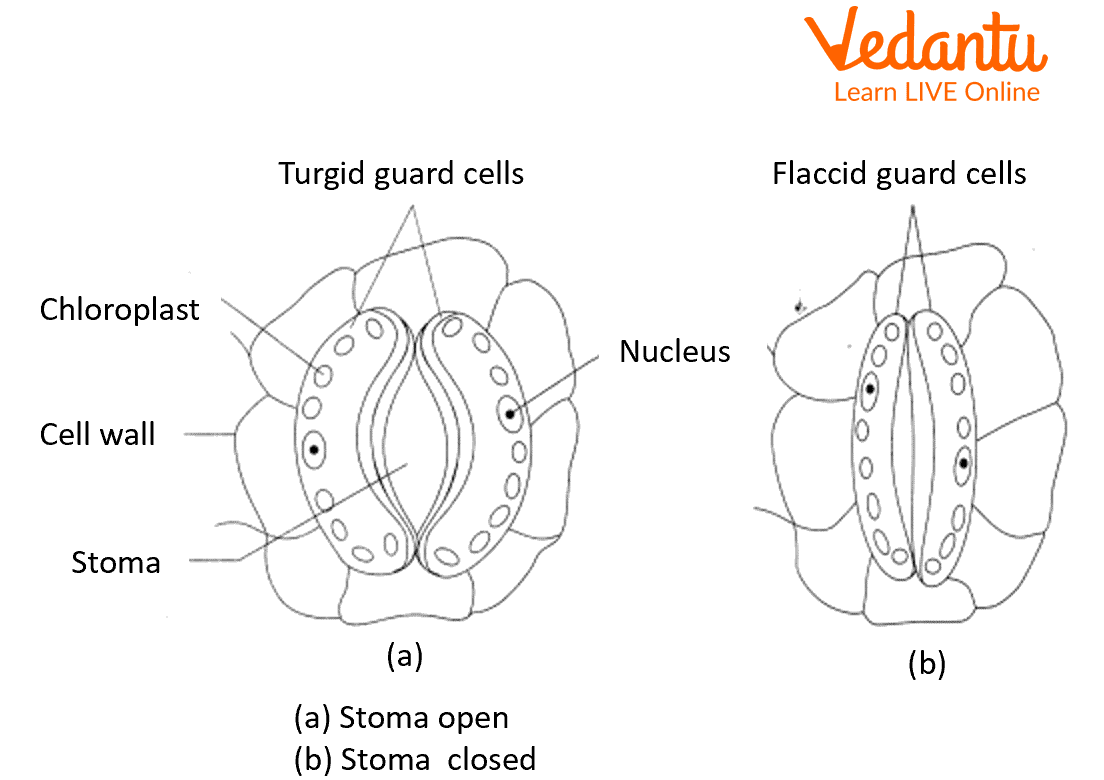
Anatomy of the stomata on the surface of leaves
Observations and Calculations
The peel of the underside of the 4 o’clock leaf bears a greater number of stomata as compared to the peel of the upper side of the leaf
Number of epidermal cells in the microscopic field _________
Number of stomatal cells in microscopic field ___________
Stomatal index
\[{\rm{stomatal index = }}\dfrac{{{\rm{no}}{\rm{. of stomatal cells }}}}{{{\rm{no}}{\rm{. of stomatal cells + no}}{\rm{. of epidermal cells }}}} \times 100\]
Results
The upper side of the leaf bears a lesser number of stomata than the underside of the leaf
Precautions
Be careful while transferring the leaf peels from the watch glasses onto the glass slides- the peels must not overlap with themselves
Care must be taken while handling the razor blade
Do not keep the peel out in the open for long, as the section may dry
The coverslip must be placed gently with the help of a needle to avoid air bubbles
Lab Manual Questions
1. What is the stomatal index?
Ans. The stomatal index is the ratio of the number of stomatal cells to the total number of stomata and the epidermal cells on the surface of a leaf
2. What regulates the opening and closing of the stomatal pore?
Ans. The guard cells are present on both sides of the stomatal pore. They regulate the opening and closing of the stomata by either becoming turgid by taking in water or becoming flaccid when water is lost by these cells, respectively.
3. Why are stomata absent in the roots?
Ans. Roots are the underground part of a plant that is not exposed to sunlight. Moreover, root cells acquire oxygen sufficiently via diffusion and do not require stomata.
4. What are isobilateral leaves?
Ans: Isobilateral leaves are leaves wherein both the abaxial and adaxial surfaces are similar, i.e. mesophyll is not differentiated into palisade and spongy tissues. They are generally vertically oriented, and hence both surfaces are equally exposed to the sun.
Viva Questions
1. What do you know about the stomatal distribution of the leaves of aquatic plants?
Ans. The aquatic plants are often either fully or partially submerged or floating in the water. In the case of floating or partially submerged plants, the stomata are only present on the upper surface of the leaves, while in the case of fully submerged plants, stomata are absent altogether.
2. What is the difference between the leaves of monocots and dicots?
Ans. The leaves of monocots have parallel venation and are described as isobilateral, owing to the equal number of stomata on both leaf surfaces. On the other hand, the dicot leaf has reticulate venation and is termed dorsiventral. The upper surface of the dicot leaf has a lower number of stomata than the ventral surface.
3. What do you understand by the term stomatal index?
Ans. The stomatal index is the ratio of the stomatal cells to the total number of epidermal and stomatal cells on the surface of a leaf. This ratio helps determine the stomatal distribution on the surface of the leaf.
4. What is the difference between the leaves of an aquatic plant and a terrestrial plant?
Ans. The leaves of terrestrial plants have an abundance of stomata on their leaves. The stomata are found on both the upper and lower leaf surfaces. However, aquatic plants have fewer stomata, and the stomatal pores are situated on the upper surface of the leaf instead.
5. What is the difference between the guard cells of the monocots and dicots?
Ans. The guard cells of the dicots are kidney-shaped, while those of the monocots have a dumb-bell-shaped appearance.
6. How do you think the stomatal opening and closing are regulated?
Ans. The stomatal opening and closing depending on the guard cells' turgidity. The stomatal pore opens when guard cells take in water and become turgid. However, when the guard cells lose water, they become flaccid, causing the pore to close.
7. What are paracytic stomata?
Ans. Paracytic refers to those stomata in which the subsidiary cells are present and situated parallel to the long axis of the two guard cells, i.e., those stomata which possess a pair of lateral subsidiary cells. Anomocytic stomata lack subsidiary cells altogether.
8. In the case of cactus, the leaves are reduced to spines. Where do the stomata occur on such plants?
Ans. In such plants where the leaves are reduced to spines, the stomata are found on the surface of the stems, which also perform photosynthesis.
9. Give functions of Stomata.
Ans: The main function of stomata is an exchange of carbon dioxide, oxygen and water vapour from the plant.
10. How are stomata in isobilateral leaves?
Ans: Stomata on dorsal and ventral epidermises are distributed equally in an isobilateral leaf.
Practical Based Questions
In the case of monocots
More stomata are present on the ventral surface
More stomata are present on the dorsal surface
An equal number of stomata are present on both surfaces
Stomata are present only on the dorsal surface
Ans. C) Equal number of stomata are present on both surfaces
Which of the following plants bear more stomata on their ventral surface?
Petunia
Water lily
Grass
Orchid
Ans. A) Petunia
In the case of aquatic plants,
Stomata are present only on the upper leaf surface
Stomata are present on the petals
Stomata are absent; breathing occurs through general surface
Stomata are present as seen in terrestrial plants
Ans. A) Stomata are present only on the upper leaf surface
The stomatal pore opens when
Guard cells become flaccid
Guard cells become turgid
Guard cells plasmolyse
Subsidiary cells become turgid
Ans. B) Guard cells become turgid
Sunken stomata are observed in
Aquatic plants
Desert plants
Mesophytes
Terrestrial plants
Ans. B) Desert plants
Dumb-bell shaped guard cells are found in the leaves of
Maize
Petunia
4 o’clock plant
Sunflower
Ans. A) Maize
The stomata occur in the
Epidermal tissue
Vascular tissue
Parenchyma
Sclerenchyma
Ans. A) Epidermal tissue
The dye used to visualise the cells in this experiment is
Safranin
Methylene blue
Glycerine
Phenolphthalein
Ans. A) Safranin
9. The shape of the cells in an anomocytic stomata is ____which are similar to____
irregular, epidermal cells
epidermal cells, irregular
circular, palisade cells
narrow, subsidiary cells
Ans: irregular, epidermal cells
10. Which of the following does not have a stomata?
Mangifera indica
Magnolia champaca
Psidium guajava
Stylites andicola
Ans: Stylites andicola
Conclusion
From the above article, we understand that the epidermis of the leaves of the dicot-4 o’clock plant has a greater number of stomata on the ventral surface of the leaf than the dorsal surface. To prevent excessive water loss from stomata, this difference in the number of stomata between two surfaces is seen.


FAQs on Class 11 Biology Study Of Distribution Of Stomata In The Upper And Lower Surface Of Leaves Experiment
1. What are the key steps to prepare a temporary mount of a leaf peel to study the distribution of stomata as per the CBSE Class 11 practical syllabus (2025-26)?
Preparing a temporary mount is a frequently asked question based on the practical. The essential steps are as follows:
- Pluck a fresh leaf and fold it to tear it from the lower side to get a transparent peel.
- Using a brush, place the peel in a watch glass containing water.
- Add a few drops of safranin stain to the watch glass and leave for 2-3 minutes.
- Transfer the stained peel to another watch glass with water to remove excess stain.
- Place a drop of glycerine on a clean glass slide and carefully place the peel over it.
- Gently lower a coverslip with the help of a needle to avoid air bubbles.
- The slide is now ready for observation under the microscope.
2. For a 3-mark question, explain why most terrestrial dicot plants have significantly more stomata on the lower leaf surface than the upper surface.
This is a critical concept for exams. The distribution of stomata is an adaptation to balance gas exchange and water loss.
- The upper (adaxial) surface of a leaf is directly exposed to sunlight and heat, which increases the rate of transpiration.
- Having fewer or no stomata on the upper surface helps to minimise water loss through evaporation, a crucial survival mechanism.
- The lower (abaxial) surface is shaded and cooler. Placing most stomata here allows for efficient gas exchange (CO₂ intake and O₂ release) for photosynthesis while protecting the pores from direct solar radiation, thus conserving water.
3. What are the expected observations when comparing the stomatal distribution on the upper (adaxial) and lower (abaxial) surfaces of a typical dicot leaf?
When observing a dicot leaf peel under a microscope for this experiment, you are expected to record the following:
- Lower Epidermis: A large number of stomata are visible, scattered among irregular-shaped epidermal cells. Each stoma consists of two bean-shaped guard cells surrounding a stomatal pore.
- Upper Epidermis: Very few or no stomata are present. The epidermal cells are compactly arranged.
- Conclusion: The number of stomata is significantly higher on the abaxial (lower) surface compared to the adaxial (upper) surface in a dorsiventral (dicot) leaf.
4. List two essential precautions a student must take while preparing a leaf peel for the stomata experiment to get a clear microscopic view. Why are these precautions important?
To score well on practical-based questions, mentioning precautions is key. Two important precautions are:
- Take a thin and transparent peel: A thick peel will not allow sufficient light to pass through, making the cells and stomata difficult to observe under the microscope.
- Avoid air bubbles when mounting: Air bubbles trapped under the coverslip can obstruct the view of the stomata and be mistaken for cell structures. The coverslip should be lowered slowly at an angle to prevent their formation.
5. How do sunken stomata in xerophytes like Nerium represent a significant adaptation for survival? What would you observe differently in such a leaf?
This is a Higher Order Thinking Skills (HOTS) question. Sunken stomata are a key xerophytic adaptation. They are located in deep pits or depressions on the leaf surface. This arrangement creates a small pocket of humid air that is not affected by external dry winds. This layer of high humidity right outside the stomatal pore reduces the water potential gradient between the inside of the leaf and the outside air, significantly decreasing the rate of transpiration and conserving water in arid conditions.
6. Compare the stomatal distribution and structure you would expect in a dicot leaf versus a monocot leaf. What does this difference imply physiologically?
Comparing monocots and dicots is an important distinction:
- Dicot Leaf (Dorsiventral): Stomata are more numerous on the lower surface. The guard cells are typically kidney-shaped. This structure is adapted for a horizontal leaf orientation to the sun.
- Monocot Leaf (Isobilateral): Stomata are distributed almost equally on both upper and lower surfaces. The guard cells are characteristically dumbbell-shaped.
Physiologically, this implies that monocot leaves (like grass) are oriented vertically and receive sunlight on both sides, hence the equal distribution for gas exchange. Dicots protect their primary gas exchange surface from direct sun.
7. Why is simply counting the number of stomata per unit area (stomatal density) sometimes insufficient for a precise comparison between different leaves?
Simply counting stomata can be misleading because the size of the epidermal cells can vary with leaf age or environmental conditions. A leaf with smaller epidermal cells might show a higher stomatal density even if the ratio of stomata to epidermal cells is the same as another leaf. For a more accurate, standardized measure, scientists use the stomatal index, which is the percentage of stomata relative to the total number of epidermal cells in a given area. This provides a more stable value for physiological and taxonomic comparisons.
