



Key Benefits of Personalized Tutoring for Cambridge Learners
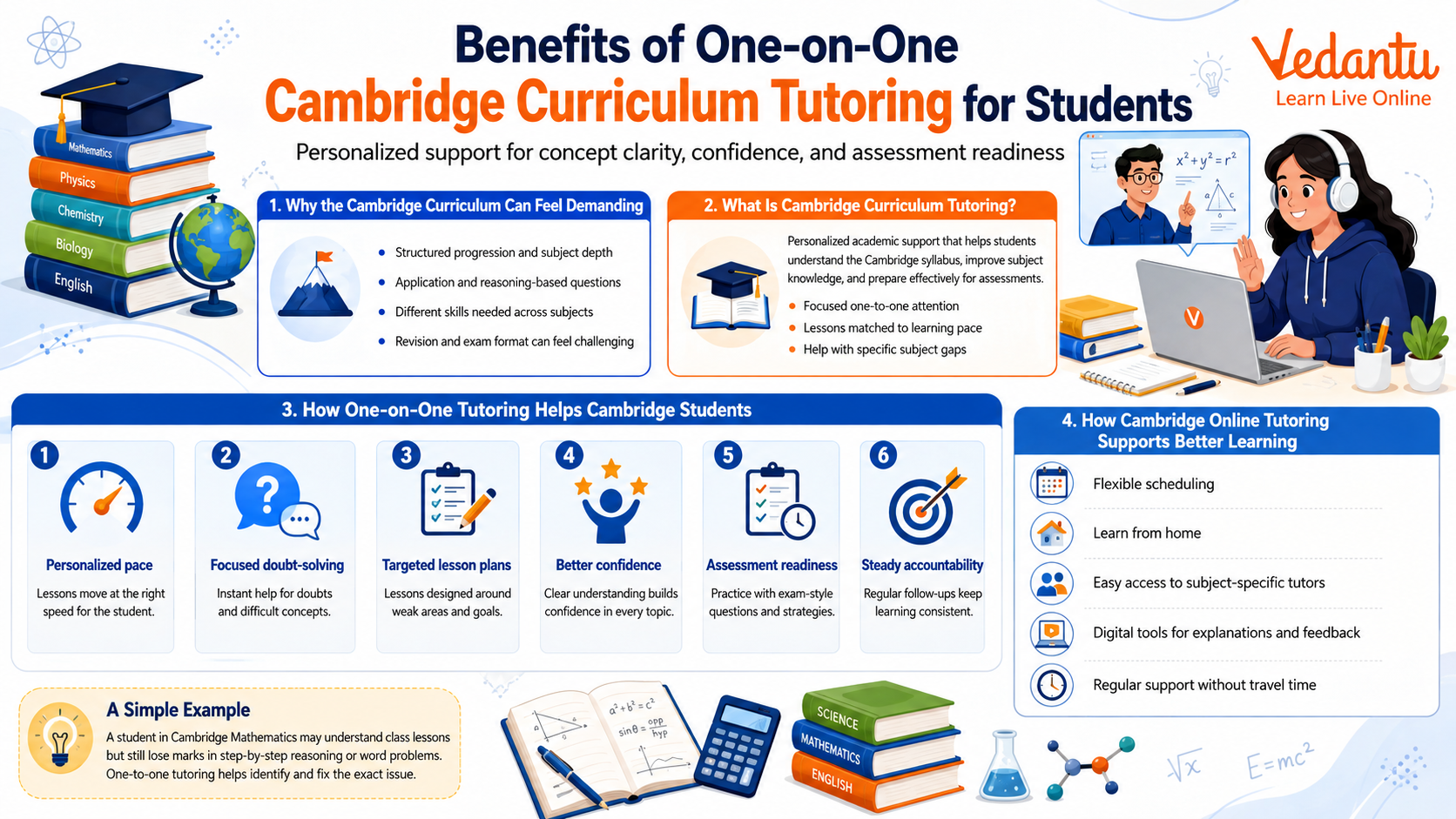
Personalized tutoring helps Cambridge students master difficult concepts by identifying exactly where understanding breaks down, adjusting explanations and providing practice that targets those gaps. It can also strengthen the reasoning, writing and independent problem-solving needed in assessments. The important choice is not simply between individual and group lessons: it is whether the support matches the student’s Cambridge programme, subject syllabus and current needs. Effective tutoring should gradually make the learner less dependent on help.
Check Our IB Online Tuition Classes Choose Your IB Home Tutoring for Success
What Cambridge Curriculum Mastery Actually Means
Mastery means more than completing chapters or recognising familiar questions. A student should be able to explain an idea, use it in a different situation and communicate an answer clearly without repeated prompts. Cambridge learning involves subject knowledge alongside skills such as interpreting information, analysing evidence and constructing reasoned responses.
Support must also change with the programme. Cambridge Primary and Lower Secondary learners may need stronger foundations and guided exploration. Students taking Cambridge IGCSE, O Level or International AS & A Level need teaching aligned with their particular subject syllabus and assessment requirements, alongside deeper conceptual understanding.
- Start with the correct syllabus: For qualification courses, use the subject syllabus code and the syllabus applicable to the examination year, rather than a textbook title alone.
- Identify the required skills: Where assessment objectives are specified, connect practice to the knowledge, application, analysis or evaluation they require.
- Respect subject differences: English as a First Language and English as a Second Language, for example, should not receive identical lesson plans.
- Account for the assessment route: Where applicable, tutoring should reflect the student’s tier, component choices and school arrangements.
How Personalized Tutoring Turns Learning Gaps into Progress
Diagnosing the Cause, Not Just Correcting the Answer
Two students can make the same mistake for different reasons. One may misunderstand a concept; another may know it but misread the question. A useful tutor asks the student to explain their thinking, examines schoolwork and uses a short diagnostic task before deciding what to teach.
For example, a student who writes 3(x + 2) = 3x + 2 needs help with the distributive property, not simply more complicated algebra. After explaining why 3(x + 2) = 3x + 6, the tutor can introduce brackets containing negative terms and later revisit the skill within equations. This checks whether the understanding transfers beyond the original example.
Adjusting Pace While Maintaining Challenge
Personalization does not mean making every task easier. It means spending longer on a missing prerequisite and moving ahead when the student demonstrates secure understanding. A confident learner might need unfamiliar applications or competing interpretations rather than another explanation of familiar content.
The tutor should gradually reduce support: model one example, solve another together, then ask the student to work independently. If every question is completed with hints, a productive-looking lesson can hide a continuing learning gap.
Making Feedback Specific Enough to Use
“Revise this topic” gives a student little direction. More useful feedback identifies the missing step: “Your conclusion states the trend, but it does not use data from the graph.” The student can then rewrite the response and apply the same skill to a different graph.
A private setting may also make some learners more comfortable asking questions. Confidence becomes meaningful when it leads to attempts, corrections and independent success—not merely agreement with the tutor’s explanation.
We are Now Available in 47 Cities. Visit Your Nearest Centre📍
What Subject-Specific Cambridge Support Looks Like
| Subject Area | Learning Difficulty | Targeted Tutoring Response | Evidence of Progress |
|---|---|---|---|
| Mathematics | Can follow examples but struggles to select a method. | Mix question types and ask the student to justify the first step. | Chooses and applies a method without hints. |
| Sciences | Recalls facts but struggles with unfamiliar data. | Connect concepts to graphs, experimental results and evidence-based explanations. | Explains a new result using relevant scientific ideas. |
| English | Understands a text but gives vague or unsupported responses. | Practise selecting evidence and explaining its effect, according to the syllabus. | Produces a focused response to an unseen passage. |
| Humanities and essay-based subjects | Lists information instead of developing an argument. | Build claims with supporting evidence and practise weighing explanations. | Reaches a justified conclusion that answers the question. |
In science, discussion of experimental design can support practical understanding, but online explanations cannot replace required hands-on laboratory work. Tutoring should complement the school’s practical teaching and assessment arrangements. For a subject-focused perspective, Vedantu’s resource on personalized tuition for IGCSE Biology students is relevant to families considering targeted Biology support.
Connecting Understanding with Cambridge Exam Preparation
Exam preparation works best when it reveals what still needs teaching. Repeatedly completing papers without analysing mistakes can reinforce the same errors. A tutor can turn each practice task into a clear next step while keeping the current syllabus and assessment objectives in view.
- Attempt a suitable question independently. Begin with topic practice; introduce timed sections once the underlying methods are reasonably secure.
- Identify the command word. “Describe” generally asks for relevant characteristics or observations, while “explain” requires reasons or relationships. Use the subject syllabus guidance for precise expectations.
- Review the response against the mark scheme. Examine missing reasoning, evidence, units or relevant detail rather than memorising model wording.
- Classify the error. Record whether it came from a knowledge gap, misinterpretation, an incorrect method, weak expression or time pressure.
- Repair and retest. Relearn the specific point, attempt a related question and return to it after a gap to check retention.
Past papers and examiner reports can support this process, but older questions should be checked against the current syllabus. Vedantu’s discussion of one-on-one tuition for Cambridge IGCSE exam preparation offers further reading for families whose main concern is moving from subject understanding to assessment performance.
A Practical Tutoring and Independent Study Routine
A manageable routine is more useful than filling every available hour with tuition. The following is an illustrative weekly cycle for one subject; adjust it to the student’s age, school workload and learning needs.
- Before the lesson: Bring one recent piece of schoolwork and attempt a short task without help. Mark the point where the difficulty begins.
- During the lesson: Review an earlier skill, address one priority gap and work towards an independent attempt at a new question.
- Between lessons: Complete two short practice blocks. Use the first for the corrected skill and the second for mixed questions that include older topics.
- At the next lesson: Start with a brief recall or application task before reviewing notes. This shows what has been retained.
- After several weeks: Compare similar tasks for accuracy, quality of explanation and number of hints needed. Adjust the next learning goal accordingly.
Parents should look beyond attendance and completed worksheets. A stronger sign of progress is a student who can explain an error, correct it and solve a related problem later. If improvement is limited, revisit the diagnosis, practice workload and teaching approach rather than automatically adding more sessions.
One-on-One Tutoring, Group Classes and Self-Study
No format is best for every Cambridge learner. Individual tutoring offers scope for targeted adaptation, while group learning provides peer discussion and self-study develops independence. The actual benefit depends on teaching quality, syllabus alignment and what the student does between lessons.
| Learning Option | Main Strength | Limitation to Consider | Useful When |
|---|---|---|---|
| One-on-one tutoring | Allows detailed diagnosis and individual feedback. | Over-helping can create dependence unless support is reduced gradually. | Specific gaps persist or advanced work needs close feedback. |
| Group classes | Offer shared discussion and exposure to other students’ approaches. | Individual feedback time and pace vary with group size and teaching design. | The learner benefits from a shared routine and peer interaction. |
| Recorded lessons and self-study resources | Allow repetition and study at a chosen time. | Resources alone cannot diagnose the student’s individual mistakes. | The learner can organise practice and recognise when help is needed. |
Online tutoring removes travel and can support shared written work through digital tools, where available. However, it needs a reliable connection, readable working and active participation. In-person lessons may suit students who concentrate better away from a screen; neither setting guarantees better learning by itself.
Using Vedantu Resources to Make a Better-Informed Choice
Vedantu’s resource on personalized one-on-one online tuition for IGCSE students provides a relevant starting point for considering individual support. Use it alongside recent schoolwork to identify the problem you want tuition to address: missing foundations, difficulty applying knowledge or a need for more detailed feedback.
Such reading supports planning and selection; unlike a taught lesson, it does not assess your child’s work or provide individual correction. Before enrolling with Vedantu, confirm current Cambridge-specific availability for the exact programme, subject and syllabus, together with the lesson format, feedback arrangements and fees.
For any tutor or provider, ask how an initial assessment will shape the lessons and how independent progress will be measured. A useful plan should name a concrete learning goal, explain the practice required between sessions and show when that goal will be reviewed.
Summary
Personalized tutoring helps Cambridge students by diagnosing learning gaps, adapting instruction and linking feedback to independent practice. Its value lies in stronger understanding and the ability to tackle unfamiliar tasks—not simply more lesson time. Begin with the correct syllabus and one measurable learning goal, then review progress through work completed without hints. Vedantu’s Cambridge and IGCSE tutoring resources can support this decision, while any course choice should match the learner’s exact academic needs.
FAQs on How Personalized Tutoring Helps Students Master the Cambridge Curriculum
1. How does personalized tutoring support students in mastering the Cambridge curriculum?
Personalized tutoring provides tailored support and guidance, helping students master complex concepts in the Cambridge curriculum more effectively.
- Individual learning plans that address unique strengths and challenges
- One-on-one attention to clarify doubts quickly
- Regular assessments to track progress and adjust teaching strategies
- Flexible scheduling for better time management with the Cambridge syllabus
2. What advantages do students gain from one-on-one Cambridge curriculum tutoring?
One-on-one tutoring fosters a highly focused learning atmosphere, enabling deeper understanding.
- Personalized feedback on assignments and tests
- Targeted support for exam preparation and revision
- Confidence building through encouragement and positive reinforcement
- Flexible pacing to match individual learning speeds
3. How is progress tracked in personalized Cambridge tutoring sessions?
Progress is tracked using structured assessments and regular feedback.
- Periodic mock tests modelled after Cambridge exam patterns
- Detailed performance reports highlighting strengths and areas for improvement
- Continuous goal setting to achieve curriculum benchmarks
4. Can personalized tutoring help with all Cambridge subjects?
Yes, personalized tutoring supports a wide range of Cambridge subjects including Mathematics, Sciences, English, and Humanities.
- Subject-specific strategies tailored to each syllabus component
- Exam-oriented practice for every subject
- Expert tutors specialized in Cambridge curricula
5. What skills do students develop with Cambridge curriculum tutors?
Students build both academic and personal skills through personalized tutoring.
- Critical thinking and analytical skills
- Time management for efficient exam preparation
- Self-study and revision techniques
- Effective communication of complex ideas
6. How is lesson content customized for individual learners?
Lesson content is tailored based on student assessments and learning preferences.
- Diagnostic tests to establish current knowledge levels
- Adaptive lesson plans that focus on weak areas
- Resource recommendations aligned with Cambridge syllabus needs
7. In what ways do tutors help with Cambridge exam preparation?
Personalized tutors offer comprehensive Cambridge exam support.
- Practice with past papers and sample questions
- Revision strategies specific to Cambridge assessments
- Time management tips for each exam section
- Exam techniques such as answer structuring and key terminology usage
8. How are parents involved throughout the personalized tutoring process?
Parents remain informed and involved to support student success.
- Regular progress updates from tutors
- Feedback sessions to discuss goals and achievements
- Collaborative planning to reinforce learning at home
9. What differentiates personalized Cambridge tutoring from group classes?
Personalized tutoring offers individualized attention and tailored learning, unlike group classes.
- Flexible lesson pace and content depth
- Immediate doubt resolution
- Focused exam preparation and revision
- Adaptive teaching methods suited to individual learners
10. How can students start with personalized Cambridge curriculum tutoring?
Getting started is simple—just follow these steps:
- Contact a reputed tutoring platform offering Cambridge curriculum support
- Schedule a diagnostic assessment to identify strengths and learning needs
- Choose preferred subjects and timing
- Begin personalized sessions tailored to individual goals
11. What teaching resources are used in personalized Cambridge tutoring?
Tutors use a variety of high-quality learning materials for effective support.
- Official Cambridge textbooks and recommended guides
- Interactive online platforms for digital learning
- Custom worksheets and practice papers
- Visual aids like diagrams and charts for conceptual clarity
12. How does personalized tutoring ensure alignment with the latest Cambridge curriculum?
Personalized tutoring stays updated with all Cambridge curricular changes.
- Access to updated syllabus and assessment criteria
- Regular tutor training on new requirements
- Timely curriculum adjustments reflected in lesson plans



