



Key Benefits of One-on-One IGCSE Biology Tuition for Exam Mastery
IGCSE Biology can feel manageable during lessons but much harder when an exam asks you to explain an unfamiliar experiment. Personalized tuition helps by identifying where understanding breaks down, adapting explanations and giving feedback on the student’s own answers. Its value is not simply extra teaching time: it is practice that changes as the learner improves. For students and parents, the important decision is whether the support addresses a specific learning need rather than merely repeating school lessons.
Find the IGCSE Online Tuition Here! Get Your Perfect IGCSE Home Tutor
What Makes IGCSE Biology Tuition Truly Personalized?
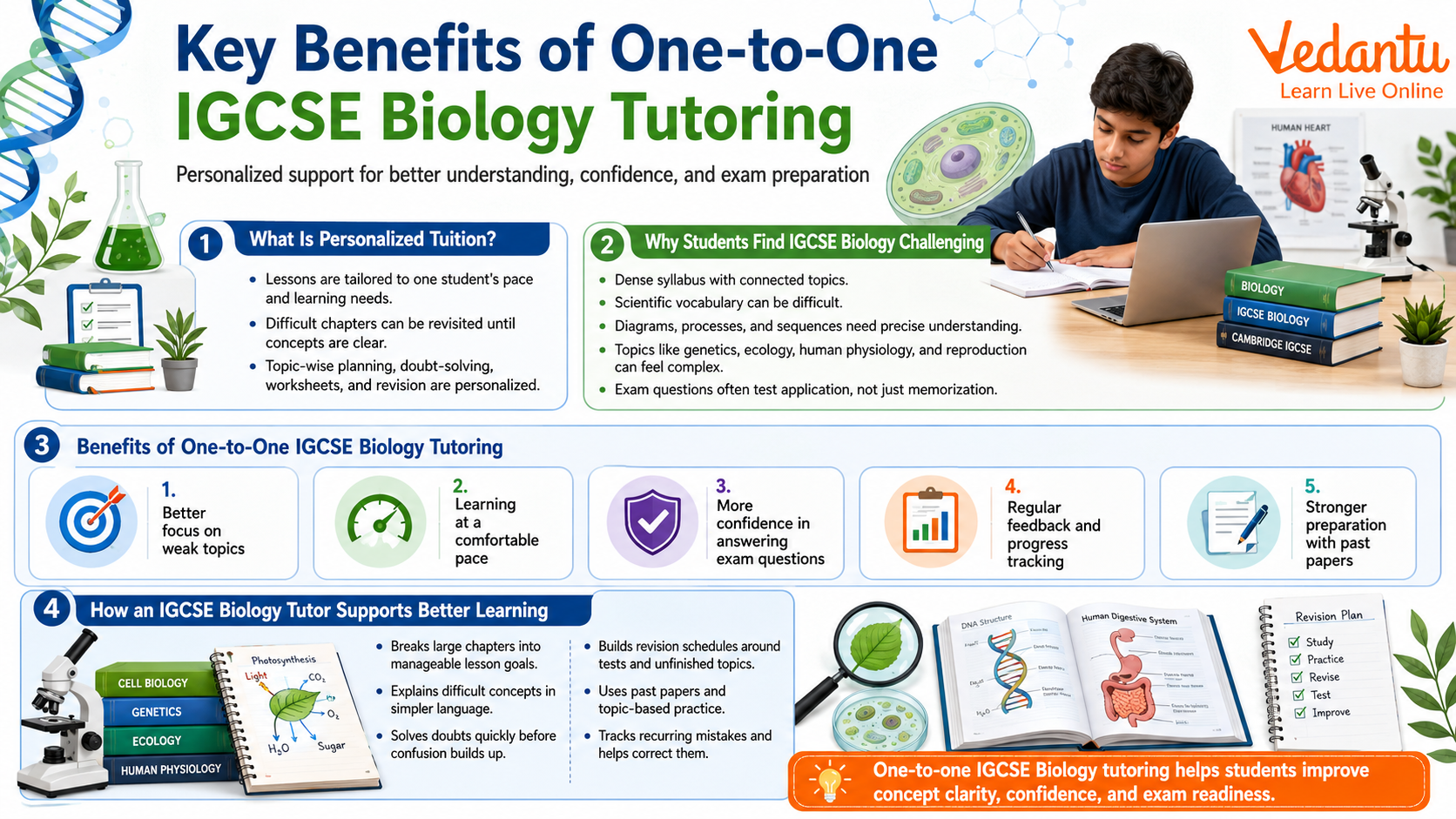
Personalized tuition adjusts the lesson content, pace and feedback to the learner’s current understanding. One-to-one teaching creates room for this, but individual attention alone is not enough. A tutor still needs to diagnose difficulties, set clear goals and check whether the student can apply the learning independently.
The starting point should be the student’s examination board, syllabus code, examination year and assessment route. For Cambridge IGCSE Biology, teaching should match the applicable Core or Extended content and practical assessment route. The school’s current syllabus information should guide these choices, rather than a tutor’s generic Biology chapter list.
- Before teaching: Review a recent test and ask the student to explain a few answers aloud.
- During teaching: Change the explanation or task when a misconception appears, rather than continuing through prepared slides.
- After teaching: Set independent questions and use the results to decide what happens next.
Why Biology Students Need More Than Memorisation
Biology combines factual knowledge with scientific explanation, diagrams, calculations and experimental reasoning. A student might remember the definition of diffusion but struggle to explain gas exchange in an unfamiliar organism. Another may understand inheritance yet lose marks because their genetic diagram is incomplete.
These difficulties need different responses. Relearning a whole chapter will not necessarily help someone whose main problem is interpreting a graph. Personalized support becomes useful when it separates knowledge gaps from difficulties with application, scientific language or answering under time pressure.
How Targeted Teaching Builds Stronger Biological Understanding
It Identifies the Reason Behind a Wrong Answer
Consider a question about potato tissue gaining mass in water. An incorrect answer could reflect confusion about osmosis, difficulty interpreting percentage change or an inability to connect the result to cell structure. Asking the student to talk through the question reveals which explanation and practice they actually need.
A useful diagnostic task combines a definition, a labelled diagram and an application question on the same concept. This shows whether the student can recall information, represent it visually and use it in a new situation. The tutor can then focus on the missing step instead of assuming that every error means poor recall.
It Replaces Vague Explanations with Scientific Reasoning
Students often recognise a process without being able to explain it precisely. For osmosis, a tutor can move from a diagram to the statement that water moves through a partially permeable membrane from higher water potential to lower water potential. The student then uses this idea to explain why tissue gains or loses water.
A similar approach helps with enzymes. Saying that an enzyme “dies” at high temperature is inaccurate; a stronger explanation connects denaturation with a change in the active site’s shape, so the substrate no longer fits. Asking the learner to rebuild the explanation in their own words tests understanding better than copying a model answer.
It Connects Topics and Adjusts the Level of Challenge
Biological processes are linked. Understanding exchange surfaces helps students explain absorption in the small intestine and gas exchange in the lungs, while understanding respiration supports explanations of active transport. A tutor can revisit the underlying principle when a later topic exposes a gap.
Students who need foundational support may begin with diagrams and short explanations. Those who already understand the content can move to unfamiliar data and questions requiring several linked ideas. Personalization should increase independence and challenge over time, not keep the learner dependent on hints.
Discover Our Classes With A Guided Centre Tour Near You📍
How Personalized Tuition Improves Exam Practice
Past papers are most useful when the student investigates lost marks rather than simply records a score. A tutor can distinguish an inaccurate fact from an incomplete explanation, a misread command word or a calculation error. Each calls for a different correction.
- Attempt independently: Complete a question without notes or prompting so the result reflects current understanding.
- Identify the error: Label it as a knowledge gap, application problem, practical-skills issue, calculation error or missed instruction.
- Repair the reasoning: Explain why the original response was insufficient, using the relevant mark scheme and examiner guidance where available.
- Answer a different question: Apply the corrected idea in a new context rather than memorising the original answer.
- Retest later: Check whether the improvement remains after a gap of several days.
Command words deserve explicit practice. “Describe” usually asks what happens or what the data show; “explain” asks for the biological reasons. For a graph question, a student may need to identify a trend and quote relevant values, while an explanation requires the mechanism behind that trend. Precise scientific meaning matters more than copying stock phrases.
Practical Skills Need Their Own Attention
Practical questions test more than remembering an experiment. Students need to identify variables, plan measurements, interpret results and judge whether conclusions are justified. Personalized tuition can reveal whether the difficulty lies in experimental design, handling data or explaining limitations.
- Variables: Identify what is changed, what is measured and which conditions must stay constant.
- Measurement: Choose suitable equipment, units, intervals and a workable method.
- Reliability: Explain how repeats and appropriate averaging help assess variation in results.
- Data: Practise graph scales, axis labels, calculations and conclusions supported by evidence.
- Evaluation: Suggest a specific improvement and explain which weakness it addresses.
For example, when investigating how light intensity affects photosynthesis, students should consider how temperature could influence the results. A video or online discussion can support planning and interpretation, but it does not replace supervised hands-on laboratory experience or practical assessment requirements.
A Manageable Weekly Learning Cycle
Tuition works best when lessons connect with short periods of independent work. The following is an illustrative cycle for one priority topic, not a fixed requirement. Adjust it around schoolwork, the size of the learning gap and time remaining before assessments.
- Before the lesson, 15–20 minutes: Attempt a few questions and mark anything that feels uncertain.
- During the lesson: Resolve the main misconception, practise with guidance and finish with an independent question.
- Within two days, 20–30 minutes: Retrieve key ideas from memory, redraw a relevant diagram and attempt fresh questions.
- At the end of the week, 20–30 minutes: Complete a short mixed quiz containing both the new topic and earlier material.
- Before the next lesson: Update an error log and identify the one or two issues still needing help.
Measure progress through fewer repeated errors, clearer explanations and successful answers without prompts. A higher score on the same worksheet may reflect memory of the answers; improvement on a fresh question is stronger evidence that learning has transferred.
Personalized Tuition Compared with Other Learning Options
No format is automatically best for every student. A learner who understands lessons but needs occasional clarification may manage with school support and self-study. Persistent misconceptions or difficulty applying knowledge may justify more individual feedback. Actual teaching quality and arrangements vary by provider.
| Learning Option | Potential Strength | Main Consideration | When It May Suit |
|---|---|---|---|
| Personalized one-to-one tuition | Teaching can respond directly to individual errors. | Value depends on diagnosis, feedback and independent practice. | Recurring misconceptions or specific exam-skill gaps. |
| Group tuition | Shared discussion and a regular study structure. | Pace and individual feedback depend on the group and teacher. | Students whose needs broadly match the group’s level. |
| Recorded-only lessons | Explanations can be paused and replayed. | Recordings alone cannot diagnose the learner’s mistakes. | Revisiting familiar concepts at a convenient time. |
| Self-study with school support | Builds independence using existing lessons and resources. | Unnoticed misconceptions may need teacher feedback. | Students who can plan revision and identify when to ask for help. |
Online one-to-one tuition can remove commuting and allow discussion of shared diagrams and answers, where those tools are used. Its effectiveness still depends on active participation, reliable connectivity and meaningful feedback. In-person tuition may suit learners who engage better face to face; neither delivery mode guarantees better grades.
Exploring Vedantu Support for IGCSE Biology
Families considering Vedantu can use its IGCSE Tutor Services page as a starting point for an enquiry about Biology support. Share the student’s syllabus details, a recent marked test and the main learning difficulty. Confirm current subject availability, teaching format, feedback arrangements and fees before choosing an option.
When comparing a Vedantu option with a local tutor or group class, use the same practical test: how would the teacher address the student’s actual mistakes? A learner struggling with experimental questions needs support with variables and evidence, while one struggling with recall needs a structured retrieval routine. A course label alone does not show whether those needs will be met.
For families following the Cambridge syllabus, Vedantu’s reading on 1-on-1 Tuition for Cambridge IGCSE Exams provides further context for considering individual support. Use it alongside a discussion of the learner’s Biology goals, rather than assuming every tuition option includes the same features.
Summary
Personalized tuition can help IGCSE Biology students succeed by finding specific gaps, strengthening scientific explanations and turning mistakes into targeted practice. The strongest sign of progress is independent success on unfamiliar questions, not simply more completed worksheets. Start with a recent test and clear learning goals, then choose support that addresses those needs. Vedantu’s IGCSE tutor enquiry page and Cambridge-focused reading offer useful starting points for exploring an appropriate option, with current arrangements confirmed before enrolment.
FAQs on How Personalized Tuition Supports IGCSE Biology Student Success
1. How does personalized tuition benefit IGCSE Biology students?
Personalized tuition offers targeted support to IGCSE Biology students by addressing their specific learning needs. Key benefits include:
- Customized lesson plans focused on individual strengths and weaknesses
- Flexible pacing to allow thorough understanding of challenging topics
- Immediate feedback to clarify doubts instantly
- Increased motivation and confidence through tailored strategies
- Exam-focused practice that aligns with IGCSE assessment criteria
2. What topics are typically challenging in IGCSE Biology and how can tuition help?
Common challenging topics in IGCSE Biology include genetics, cell biology, and ecological relationships. Personalized tuition can help by:
- Breaking down complex concepts into simple explanations
- Providing additional practice questions for high-difficulty areas
- Using visual aids and diagrams to enhance understanding
- Focusing revision sessions on weak points identified through regular assessments
3. How is IGCSE Biology tuition structured to follow the latest exam syllabus?
Expert tutors align all lessons with the current IGCSE Biology syllabus by:
- Covering each topic as per the official exam outline
- Incorporating recent syllabus updates and changes
- Focusing on key terminology, concepts, and laboratory techniques
- Regularly practising past-year and predicted exam questions
4. Are there interactive learning methods used in personalized IGCSE Biology tuition?
Yes, interactive methods enhance understanding and engagement. These include:
- Live quizzes for instant recall and retention
- Visual aids like diagrams and animations
- Group discussions for collaborative problem-solving
- Practical experiment simulations to apply theoretical knowledge
5. How does Vedantu ensure progress tracking for IGCSE Biology students?
Progress is closely monitored through:
- Regular assessments and mock exams
- Personalized feedback after each session
- Performance analytics to identify and address learning gaps
- Parent-teacher updates for transparent communication
6. Can personalized tuition help improve scores in IGCSE Biology practical exams?
Personalized tuition effectively prepares students for practical exams by:
- Demonstrating key laboratory techniques
- Guiding through experimental procedures
- Providing practice with specimen analysis and data interpretation
- Offering exam-specific tips for maximizing practical marks
7. What resources are provided for IGCSE Biology revision during personalized tutoring?
Students receive a variety of resources such as:
- Summary notes for all syllabus units
- Practice worksheets with exam-style questions
- Concept maps and revision flashcards
- Video lessons for difficult topics
8. How does one-on-one Biology tuition differ from classroom teaching?
One-on-one tuition provides focused attention that is often not possible in a classroom, including:
- Individualized learning speed
- Immediate resolution of doubts
- Tailored teaching strategies for unique learning preferences
- Flexible scheduling to fit revision around other commitments
9. What qualifications do Vedantu’s IGCSE Biology tutors have?
Vedantu’s IGCSE Biology tutors are:
- Certified educators with subject specialization
- Experienced in teaching IGCSE curriculum and exam techniques
- Trained in delivering interactive and customized online lessons
- Regularly updated on syllabus changes and best teaching practices
10. How can I enroll for personalized IGCSE Biology tuition at Vedantu?
Enrolling is simple and student-friendly:
- Visit Vedantu’s website and select IGCSE Biology
- Fill in your details and academic requirements
- Schedule a free demo session with an expert tutor
- Choose your preferred learning plan and start personalized classes
11. Does personalized tuition cover IGCSE Biology for Exam Year 2024-25?
Yes, personalized tuition is fully updated for IGCSE Biology Exam Year 2024-25, ensuring all content and resources reflect the latest syllabus and assessment patterns.
12. What advantages does Vedantu offer over traditional IGCSE tuition?
Vedantu provides several advantages compared to conventional tuition:
- Live one-on-one online sessions for direct interaction
- Access to digital study materials and recorded lessons
- Personalized progress monitoring tools
- Expert guidance tailored to IGCSE Biology success



