




Easy Fable Passages with Questions for Grade 1 Reading Practice
Story 1: The Thirsty Crow
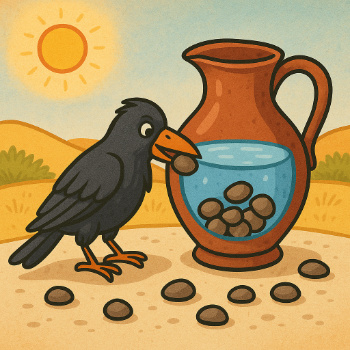
On a hot day, a thirsty crow found a pitcher with very little water at the bottom. He could not reach it. He saw some small stones nearby. He got an idea! He picked up the stones one by one and dropped them into the pitcher. The water level rose up. The clever crow drank the water and flew away happily.
1. What was the crow's problem?
(a) He was hungry
(b) He was thirsty
(c) He was lost
2. Fill in the blank: The crow dropped ______ into the pitcher to raise the water level.
____________________
3. Write 'True' or 'False' for the sentence below.
The crow used a straw to drink the water.
____________________
4. Why was the crow clever?
_________________________________________________________________
5. Underline the correct word in the sentence.
The crow flew away (sadly / happily).
Story 2: The Hare and the Tortoise
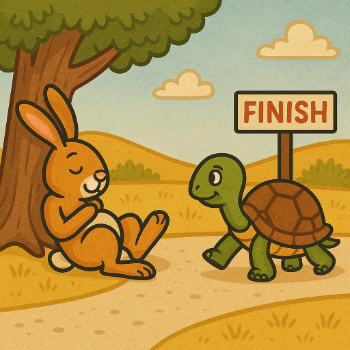
A speedy hare made fun of a slow tortoise. The tortoise challenged the hare to a race. The hare ran very fast and was soon far ahead. Thinking he had plenty of time, he decided to take a nap under a tree. The tortoise walked slowly but steadily. He passed the sleeping hare and reached the finish line first. Slow and steady wins the race.
6. Who challenged the hare to a race?
(a) A fox
(b) A lion
(c) A tortoise
7. Was the hare slow? (Yes / No)
____________________
8. Tick the correct statement.
[ ] The tortoise took a nap.
[ ] The hare won the race.
[ ] The tortoise won the race.
9. Rearrange the actions in the correct order (1, 2, 3).
[ ] The hare took a nap.
[ ] The tortoise won the race.
[ ] The hare and tortoise started a race.
10. Complete the sentence from the story.
Slow and steady ______ the race.
Story 3: The Ant and the Grasshopper
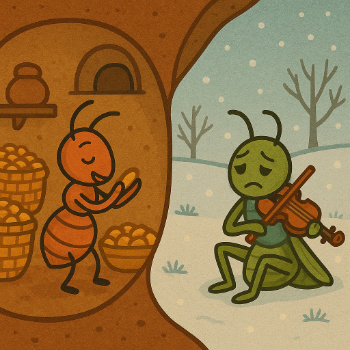
All summer, an ant worked hard to collect food for winter. A grasshopper just sang and played his fiddle. He laughed at the ant for working so hard. When winter came, the grasshopper had no food and was very hungry. The ant had plenty to eat in her warm home. It is wise to prepare for the days of need.
11. What did the ant do all summer?
_________________________________________________________________
12. Match the character to what they did in winter.
13. Circle the correct word in the sentence.
The ( ant / grasshopper ) had no food in the winter.
14. Why is it important to work hard?
(a) So you can play all the time.
(b) So you can be prepared for the future.
(c) So you can laugh at others.
15. Jumbled Words: Unscramble the name of the insect who worked hard.
T N A
____________________
Answer Key
1. (b) He was thirsty
2. stones
3. False
4. He found a way to get the water by using stones.
5. The crow flew away (happily).
6. (c) A tortoise
7. No
8. [✓] The tortoise won the race.
9. [2] The hare took a nap. [3] The tortoise won the race. [1] The hare and tortoise started a race.
10. wins
11. The ant worked hard to collect food for winter.
12. 1-B, 2-A
13. The (grasshopper) had no food in the winter.
14. (b) So you can be prepared for the future.
15. ANT
How This Worksheet Helps You Learn?
Class 1 Reading Comprehension Stories Kids Fables worksheet is designed to help young learners master early literacy in a fun and structured way. These printable comprehension stories for Grade 1 combine simple fable stories, child-friendly questions, and engaging illustrations to build vocabulary and logical thinking. Each worksheet offers easy practice for reading comprehension skills, allowing first graders to develop confidence through curriculum-aligned tasks.
Using this reading comprehension worksheet at home or school supports children in understanding short fable passages, identifying main ideas, and recognizing stories’ morals. The included PDF is print-friendly and crafted with large, clear fonts—ensuring comfortable practice for all students. Practicing regularly with this resource helps reinforce key English reading skills and supports parent-child learning routines.
Usage Tips for Parents and Teachers
- Read each fable story aloud together before allowing your child to attempt the questions independently.
- Use the worksheet as a quick after-school or weekend activity to reinforce classroom learning.
- Preview the PDF on your mobile before printing to ensure the pages are student-friendly and clear.
- Encourage kids to retell or draw their favorite part of each story for added comprehension practice.
Explore Related Worksheets
- Class 1 English Marigold Worksheets
- Kids Learning English Comprehension Worksheets
- Class 1 English Marigold Chapter 1 Worksheets
- Class 1 English Worksheet Collection
- Kids Fable Stories Worksheet
What You Learned
This worksheet page provides free, downloadable PDF practice sheets focused on class 1 reading comprehension using stories and fables. By working through simple stories and targeted questions, students gain experience in reading, answering “who,” “what,” and “where” questions, and understanding the moral of each story. The printable worksheets are ideal for home or school use, helping Grade 1 children develop essential English reading comprehension skills in a supportive, engaging format.
FAQs on Fun Reading Comprehension Stories and Fables for Class 1 Kids
1. What is a fable for grade 1?
A fable for Grade 1 is a very short story that is easy for young children to read and understand, often featuring talking animals as main characters. The primary purpose of a fable is to teach a simple lesson, also known as the moral of the story, in an engaging and memorable way.
2. What are good comprehension exercises for class 1?
Good comprehension exercises for Class 1 are designed to be simple, fun, and effective at checking a child's understanding. These typically include:
- Answering direct questions like 'who', 'what', and 'where' about the story.
- Multiple-choice questions (MCQs) to test recall of key facts.
- Fill-in-the-blank sentences using words from the story.
- Activities that involve matching pictures to sentences.
- Identifying the moral of the story from a few choices.
3. What is reading comprehension for 1st grade?
Reading comprehension for 1st grade is the basic ability to understand the meaning of a simple text, story, or passage after reading it. For a first-grader, this means being able to:
- Identify the main idea of a short story.
- Recall important characters and the setting.
- Understand the sequence of events (what happened first, next, and last).
- Answer simple questions about the text.
4. How do you teach fables to kids using these worksheets?
You can effectively teach fables to kids by making the learning process interactive with our printable fable worksheets. A great approach is to:
- Read the short fable story aloud with your child.
- Talk about the animal characters and what they do.
- Encourage your child to try answering the comprehension questions.
- Use the included answer key to check their work together.
- Discuss the moral of the story and what it teaches us.
5. Do these Class 1 fable worksheets include answers?
Yes, all our Class 1 reading comprehension stories kids fables worksheets include a complete answer key. This makes it easy for parents and teachers to check a child's work, provide feedback, and confirm their understanding of the story and its moral.
6. Are these reading comprehension worksheets printable?
Yes, absolutely. These Grade 1 fables worksheets are provided as a free download PDF file, which is specifically designed for easy printing. You can print them for classroom use, after-school practice, or holiday learning activities.
7. What is an example of a fable story for kids?
A classic example of a fable story suitable for kids is 'The Lion and the Mouse.' This story features a mighty lion who spares a tiny mouse, and later, the mouse repays the kindness by freeing the lion from a hunter's net. The moral of the story is that even the small can help the strong, and kindness is never wasted.
8. What skills does my child build with these fable worksheets?
These reading comprehension exercises help a Class 1 student develop several fundamental skills. By completing these worksheets, your child will improve their:
- Reading and Comprehension: Understanding written text.
- Vocabulary: Learning new words from the context of a story.
- Recall and Memory: Remembering key details from the passage.
- Logical Thinking: Identifying the story's moral and understanding cause and effect.
- Attention to Detail: Finding answers within the text.
9. How can I use these worksheets at home with my child?
Using these free reading worksheets for Class 1 at home is very simple and beneficial for parent-child learning. You can:
- Choose a quiet time and download the printable PDF.
- Read the fable story together with your child to make it engaging.
- Let them attempt the questions and answers section on their own.
- Review their work together to reinforce learning and build confidence.
10. Are these worksheets suitable for 6-year-olds?
Yes, these worksheets are perfectly designed for 6 to 7-year-old children, which is the typical age for Grade 1. The content, including the short fable comprehension for grade 1, uses large, clear fonts, simple sentences, and engaging illustrations to meet the learning needs of this age group.
