




Comprehension Questions and Answers for Grade 1 Boat Parade Story
Read the Story
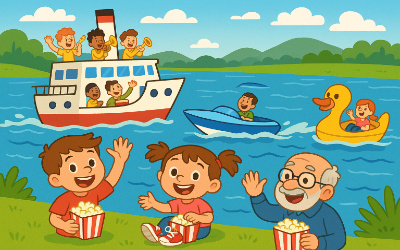
Sam and his grandpa went to the lake. There was a big boat parade today! Many boats were on the water. A big ferry boat had a band playing music. Small boats had colourful flags and bright balloons.
Sam saw a little paddle boat. It looked like a big yellow duck. Sam laughed. But his favorite boat was the blue speedboat. It went "vroom" and moved very fast across the water. Sam and his grandpa ate a big bag of salty popcorn. They waved at all the boats. It was a wonderful day.
Answer the Questions
1. Tick the correct option. Where did Sam and his grandpa go?
(a) The river
(b) The beach
(c) The lake
2. What was on the big ferry boat?
(a) A slide
(b) A band
(c) Animals
3. What was Sam's favorite boat?
(a) The blue speedboat
(b) The yellow paddle boat
(c) The big ferry boat
4. Write 'True' or 'False' for the following sentences.
(a) Sam went to the parade with his mom. __________
(b) The speedboat moved very slowly. __________
(c) Sam and his grandpa ate popcorn. __________
5. Fill in the blanks with words from the story.
(a) The small boats had colourful ___________ and bright balloons.
(b) The paddle boat looked like a big yellow ___________.
(c) They ___________ at all the boats on the water.
6. Answer the following questions in one sentence.
(a) Who went to the boat parade with Sam?
____________________________________________________
(b) What color was the speedboat?
____________________________________________________
(c) What sound did the speedboat make?
____________________________________________________
7. Match the columns.
8. Circle the correct word to complete the sentence.
(a) The parade was on the ( lake / road ).
(b) The speedboat was ( blue / red ).
(c) They ate a big bag of ( salty / sweet ) popcorn.
9. Answer with 'Yes' or 'No'.
(a) Did the boats have balloons? __________
(b) Did Sam laugh when he saw the paddle boat? __________
(c) Was the ferry boat Sam's favorite? __________
10. Rearrange the words to make a correct sentence.
(a) a / big / It / was / wonderful / day.
____________________________________________________
(b) grandpa / Sam / his / and / went / lake / the / to.
____________________________________________________
Answer Key
1. (c) The lake
2. (b) A band
3. (a) The blue speedboat
4. (a) False, (b) False, (c) True
5. (a) flags, (b) duck, (c) waved
6.(a) Sam's grandpa went to the boat parade with him.
(b) The speedboat was blue.
(c) The speedboat made a "vroom" sound.
7. 1-b, 2-c, 3-a
8. (a) lake, (b) blue, (c) salty
9. (a) Yes, (b) Yes, (c) No
10.(a) It was a big wonderful day.
(b) Sam and his grandpa went to the lake.
How This Worksheet Helps You Learn?
The Class 1 Reading Comprehension Children’s Stories: Boat Parade worksheet is carefully designed for young learners beginning their English journey. Through a fun, short story followed by practical questions, children develop essential reading skills, boost their understanding, and broaden their vocabulary. This printable worksheet, available as a free PDF, is ideal for parents and teachers looking for easy reading practice that matches Grade 1 standards and encourages active engagement with stories.
Usage Tips for Parents & Teachers
- Print the worksheet or use it on a tablet for a flexible reading session at home or school.
- Read the Boat Parade story aloud together, and let your child try answering the questions independently.
- After finishing, discuss new vocabulary words and encourage your child to retell the story in their own words.
- Use the answer key to review responses and reinforce correct answers with explanations.
Explore Related Worksheets
- Class 1 English Marigold Worksheets Chapter 2
- Class 1 English Worksheets
- Kids Learning: English Comprehension Worksheets for Kids
- Class 1 English Marigold Worksheets Chapter 7 Poem
What You Learned
This page provides a comprehensive, printable reading comprehension worksheet for Class 1, centered on the Boat Parade story. Through a mix of story reading, direct questions, and vocabulary activities, young students strengthen reading, recall, and sequencing abilities. The worksheet is suited to both home and classroom use, making early English learning practical, fun, and accessible for new readers.
FAQs on Class 1 Reading Comprehension: Boat Parade Children's Story
1. What are reading comprehension questions for Grade 1?
Reading comprehension questions for Grade 1 are simple queries designed to check a child's understanding of a short story or passage. They are structured to be easy for young learners to answer.
- They often ask about the main characters, setting, and key events using Who, What, and Where questions.
- Questions come in various formats like multiple-choice, fill-in-the-blanks, or short one-word answers.
- The main goal is to test a student's basic recall and their ability to find answers directly in the reading passage for class 1.
2. Is this Boat Parade reading comprehension worksheet printable?
Yes, the Class 1 Boat Parade reading comprehension worksheet is designed to be easily printable. You can download it as a free PDF file, which is perfect for at-home practice.
- The format is optimised for standard A4 paper, making it easy to use for homework or extra practice.
- Printing allows children to write answers directly on the sheet, which is ideal for young learners.
- It serves as a great printable reading worksheet for parents looking for extra resources.
3. Does the Grade 1 Boat Parade worksheet include an answer key?
Absolutely, a complete answer key is provided with the Boat Parade worksheet for Grade 1. This feature is included to help parents and teachers easily check a child's work.
- The answer key for parents helps in quickly verifying the child's responses for accuracy.
- It covers all the comprehension questions, including multiple-choice and short-answer types.
- Having a worksheet with answers makes it easy to guide your child's learning and review their progress.
4. How can I use this worksheet for reading practice at home?
You can easily use this printable reading worksheet at home to improve your child's English reading skills. It is designed for independent practice with minimal supervision.
- First, download the free PDF and print the worksheet.
- Read the Boat Parade story aloud with your child or have them read it independently.
- Guide them as they answer the reading comprehension questions that follow the story.
- Use the provided answer key to review their work and discuss the answers together.
5. What skills are built by this reading comprehension activity?
This worksheet helps develop several fundamental literacy skills that are crucial for a Class 1 student. The activity focuses on more than just reading.
- Reading Comprehension: Understanding the plot and details of the Boat Parade story.
- Vocabulary Building: Identifying and learning new words from the passage.
- Information Recall: Answering direct questions about who, what, and where from the text.
- Sequencing Events: Understanding the order in which things happened in the story.
6. What age group is this Boat Parade worksheet best for?
This reading comprehension worksheet is specifically designed for children in Class 1, which typically includes the 6 to 7-year-old age group. The content and design are tailored for early learners.
- The story uses simple language and large, easy-to-read fonts.
- The questions are structured to match the cognitive and reading abilities of a Grade 1 student.
- It aligns with the curriculum standards for early primary education, including CBSE and NCERT.
7. How do short stories with questions help a Class 1 student?
Short stories with questions, like the Boat Parade passage, are highly effective for building foundational reading skills in Class 1 students. They make learning interactive and measurable.
- Improves Focus: The short length of the story keeps young readers engaged without overwhelming them.
- Tests Understanding: Questions immediately check if the child understood the story's main idea and key details.
- Encourages Active Reading: It teaches students to read carefully and look for answers within the text.
- Builds Confidence: Successfully reading a story for Grade 1 and answering questions boosts a child's confidence.
8. Can I use this worksheet on a tablet instead of printing it?
Yes, you can definitely use the downloadable PDF worksheet on a digital device like a tablet. The file is compatible with most PDF reader applications.
- After downloading the PDF, open it in any reader app on your tablet.
- Many apps allow you or your child to write or draw directly on the document using a stylus or text tool.
- This offers a flexible, paper-free option for completing the reading practice activity.
9. What makes this an easy story for Class 1 students?
The Boat Parade story is intentionally written to be easy for Class 1 students by focusing on simple structure and age-appropriate content. It is a perfect example of short stories for Grade 1.
- Simple Vocabulary: The story uses common words that a 6 or 7-year-old can easily understand.
- Short Sentences: The sentences are brief and follow a simple structure, making them easy to read.
- Clear Plot: The story has a straightforward beginning, middle, and end.
- Visual Support: The inclusion of a story with pictures helps children understand the context and keeps them engaged.
10. How does this worksheet reinforce concept retention?
This worksheet reinforces learning by immediately connecting the reading passage to activities that test recall and understanding. This helps a child remember what they have read.
- The comprehension questions require students to revisit the text, strengthening their memory of the story's details.
- Activities like vocabulary matching or sequencing help solidify the meaning of new words and the story's structure.
- This process of reading and then actively recalling information helps transfer knowledge from short-term to long-term memory.
