






How to Recognize 2D and 3D Shapes in Grade 1 Maths Worksheets
Section A: Flat Shapes (2D)
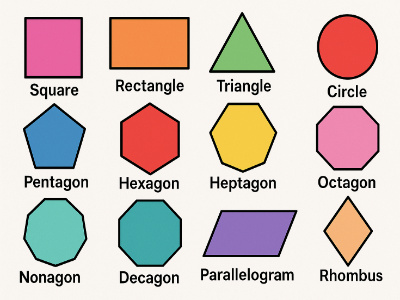
1. Tick the correct option. The shape of a mobile phone screen is usually a:
(a) Circle
(b) Triangle
(c) Rectangle
2. Fill in the blank. A carom board has the shape of a __________.
3. Is the following statement True or False? A coin has three corners.
Answer: __________
4. How many sides does a triangle have?
Answer: __________
5. Choose the odd one out.
(a) Door
(b) Blackboard
(c) Wheel
(d) Book
6. A square has ______ corners and ______ equal sides.
7. Match the shape to its number of sides.
Section B: Solid Shapes (3D)
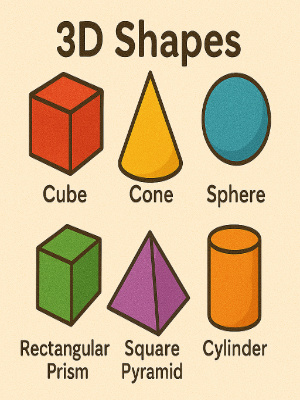
8. Which of these objects looks like a cone?
(a) A football
(b) A birthday cap
(c) A dice
9. A ball has the shape of a __________.
10. A can of cold drink is an example of which shape?
(a) Cube
(b) Cylinder
(c) Sphere
11. Can a dice roll like a ball? (Yes / No)
Answer: __________
12. Tick the correct action for a book.
[ ] It can roll.
[ ] It can slide.
13. Is the following statement True or False? You can easily stack many spheres on top of each other.
Answer: __________
Section C: Position and Location
14. The stars are in the sky. Are they above or below the ground?
Answer: __________
15. The fish swims _______ the water. (inside / outside)
16. Look at a clock on the wall. Is the number 12 at the top or at the bottom?
Answer: __________
Answer Key
1. (c) Rectangle
2. Square
3. False
4. Three / 3
5. (c) Wheel (it is a circle, others are rectangles)
6. 4 corners and 4 equal sides
7. 1-B, 2-C, 3-A
8. (b) A birthday cap
9. Sphere
10. (b) Cylinder
11. No
12. It can slide.
13. False
14. Above
15. inside
16. Top
How This Worksheet Helps You Learn?
Class 1 Maths Geometry worksheets are specially designed practice sheets that help Grade 1 students recognise and identify 2D and 3D shapes like circle, square, triangle, rectangle, and cube. Each printable worksheet offers coloring, tracing, and matching activities that build strong foundation skills in visual recognition and spatial awareness. These resources support both classroom and at-home learning, using clear instructions and large fonts for young learners.
Developed by educators for primary maths, these printable PDF geometry worksheets use real-life objects and engaging visuals to make learning fun and easy. Practicing with these class 1 maths geometry worksheets helps children connect geometry concepts to everyday surroundings, while strengthening their ability to draw, trace, and classify shapes.
Usage Tips for Parents/Teachers
- Print the worksheet and let your child circle or color the shapes independently for hands-on practice.
- Use real objects at home or class (like balls, books, or boxes) to link items to worksheet shapes.
- Encourage tracing and drawing activities to improve fine motor skills and shape recognition.
- Discuss each shape’s name, properties (sides, corners), and examples in daily life during the activity.
Explore Related Worksheets
- Class 1 Maths Worksheets Chapter 9 – Additional Grade 1 maths topics in practice format.
- Class 1 Maths Worksheets Chapter 11 – More geometry-related maths practice for Grade 1.
- 1st Grade Addition and Subtraction Worksheets – Combine arithmetic and shapes for a strong maths start.
What You Learned
This page offers a comprehensive set of Class 1 Maths Geometry worksheets that introduce young students to the basics of 2D and 3D shapes. Through matching, coloring, tracing, and real-life object identification, children practice visual recognition and spatial skills in a supportive format. These free, printable worksheets serve as a valuable resource for parents and teachers looking to make early maths learning engaging and effective.
FAQs on Geometry Practice Worksheets for Class 1: Identify, Trace & Match Shapes
1. What is geometry for Class 1?
Geometry for Class 1 introduces young learners to the basic properties of shapes and their presence in the world around them. The focus is on building visual recognition skills and foundational maths concepts.
- Identifying and naming common 2D shapes like circles, squares, triangles, and rectangles.
- Introducing basic 3D shapes such as cubes, spheres, and cones.
- Developing visual skills by matching, tracing, and coloring these shapes.
- Relating abstract shapes to real-life objects (e.g., a clock is a circle, a book is a rectangle).
2. What topics are covered in a Class 1 geometry worksheet?
A Class 1 geometry worksheet typically covers the identification, drawing, and properties of basic two-dimensional (2D) and three-dimensional (3D) shapes. These practice worksheets are designed to be fun and engaging for young students.
- Shape Recognition: Identifying shapes like Square, Circle, Triangle, and Rectangle.
- 3D Shapes Introduction: Learning about the Cube, Sphere, and Cone.
- Tracing and Drawing: Activities to improve fine motor skills by tracing and drawing shapes.
- Matching and Sorting: Exercises to match similar shapes or sort them into groups.
- Counting Sides and Corners: Understanding the basic properties of 2D shapes.
3. Are these Class 1 maths geometry worksheets printable?
Yes, these Class 1 maths geometry worksheets are designed to be easily printable and are available as a free downloadable PDF. This makes them a convenient resource for parents and teachers.
- Simply click the download button to save the free geometry PDF to your device.
- The layout is optimised for standard A4 paper for easy home printing.
- They feature large fonts and clear images, making them perfect for offline practice.
4. Do these shapes worksheets for Grade 1 include an answer key?
Yes, a complete answer key is provided with our shapes worksheet for Grade 1 with answers to help parents and teachers easily check the solutions. This helps in assessing a child's understanding of the concepts.
- The answer key allows for a quick and accurate assessment of your child's work.
- It promotes independent learning, as students can check their own answers.
- This feature makes it easy to identify topics where a student may need extra geometry practice.
5. What are the basic 2D shapes for Class 1?
The basic 2D shapes taught in Class 1 are flat shapes that can be drawn on paper and are defined by their sides and corners. These are the fundamental figures in 1st grade geometry worksheets.
- Circle: A round shape with no sides or corners.
- Square: A shape with four equal sides and four corners.
- Triangle: A shape with three sides and three corners.
- Rectangle: A shape with four sides (two long, two short) and four corners.
- Oval: An elongated circle, similar to the shape of an egg.
6. How does this worksheet reinforce concept retention?
This worksheet uses a variety of engaging activities to ensure students understand and remember geometry concepts effectively. The mix of tasks caters to different learning styles.
- Visual Learning: Uses clear images and real-life objects to connect abstract shapes to the real world.
- Repetitive Practice: Includes multiple tasks like coloring shapes, tracing shapes, and matching shapes to reinforce names and properties.
- Interactive Tasks: Encourages active participation, which boosts memory far better than passive reading.
- Simple Instructions: Allows young learners to work independently, building confidence and ownership of their learning.
7. What skills are built by this geometry activity for Class 1?
This geometry activity for Class 1 builds a range of foundational skills that are crucial for early mathematical development and cognitive growth.
- Visual Spatial Skills: The ability to recognise and mentally manipulate shapes.
- Problem-Solving: Activities like sorting and matching shapes require logical thinking.
- Fine Motor Skills: Tracing and drawing exercises improve hand control and precision.
- Mathematical Language: Students learn and use terms like side, corner, square, and circle correctly.
8. What is basic geometry for kids?
Basic geometry for kids is the study of simple shapes, sizes, and the positions of objects, introduced in a fun and interactive way. The goal is to make learning about shapes intuitive and engaging.
- It starts with identifying 2D shapes like circles, squares, and triangles.
- It progresses to understanding simple 3D shapes like cubes and spheres.
- Activities often include sorting, matching, and drawing to make learning hands-on.
- The main goal is to build visual recognition and spatial awareness, which are key for future maths skills.
9. How can I use this Grade 1 geometry worksheet at home?
This Grade 1 geometry worksheet is a perfect resource for reinforcing school learning at home. Its simple format makes it easy for parents to guide their children through the activities.
- Download and Print: Get the free PDF and print it for a screen-free activity.
- Guided Practice: Sit with your child to explain the instructions for the first few questions.
- Homework Help: Use it as extra practice to strengthen concepts taught in school.
- Check with Answer Key: After completion, use the provided answers to review the work together.
10. Can I use this worksheet digitally on a tablet?
Yes, while these worksheets are designed for printing, they can also be used digitally on a tablet or computer for a modern learning experience. The PDF format is versatile and easy to use across devices.
- Download the free PDF and open it in any PDF reader or annotation app on your tablet.
- Students can use a stylus or their finger to complete activities like circling the shape or tracing dotted lines.
- This provides a paperless, eco-friendly option for homework and on-the-go practice.
