




Zeise’s salt is:
[A]$Fe{{\left( {{n}^{5}}-{{C}_{5}}{{H}_{5}} \right)}_{2}}$
[B]$Cr{{\left( {{n}^{6}}-{{C}_{6}}{{H}_{6}} \right)}_{2}}$
[C]$K\left[ Pt\left( {{n}^{2}}-{{C}_{2}}{{H}_{4}} \right)C{{l}_{3}} \right]$
[D]$K\left[ Pt{{\left( {{n}^{2}}-{{C}_{2}}{{H}_{4}} \right)}_{2}}C{{l}_{2}} \right]$
Answer
 Verified
617.7k+ views
Hint: Zeise salt is the common name for potassium trichloro(ethylene)palatinate(II)hydrate. The anionic form of the zeise’s salt contains an ${{n}^{2}}$ethylene ligand.
Complete answer:
We find Zeise’s salt commercially in its hydrate form but anion is also stable and exists in air.
Zeise’s salt is named after its discoverer William Christopher Zeise. This salt is of historical importance as it is the first example of a transition metal alkene complex in organometallic chemistry.
Here we use the transition metal, platinum for the preparation of this salt. When platinum tetrachloride reacts with ethanol, it forms an adduct. If we add potassium chloride to this adduct, we obtain Zeise’s salt. We can write the reaction as-

This coordination complex is stable. It is present in crystalline form and the crystals appear yellow or orange in colour.
However, in air the anion of this complex contains an ${{n}^{2}}$-ethylene ligand and the geometry of this anion is square planar. Its structure is-
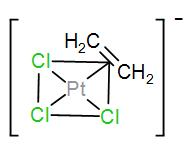
Here, as we can see in the structure, the carbon-carbon double bond is almost perpendicular to the plane of platinum chloride.
We can also prepare the hydrated Zeise’s salt by the reaction of potassium tetrachloroplatinate with ethylene and in presence of a catalytic amount of tin(II) chloride.
As we can tell from the above discussion that the formula of Zeise’s salt is $K\left[ Pt\left( {{n}^{2}}-{{C}_{2}}{{H}_{4}} \right)C{{l}_{3}} \right]$
Therefore, the correct answer is option [C] $K\left[ Pt\left( {{n}^{2}}-{{C}_{2}}{{H}_{4}} \right)C{{l}_{3}} \right]$.
Note: There is a model in organometallic chemistry named Dewar-Chatt-Duncanson model which explains how the metal, platinum (in this case) is co-ordinated to the carbon-carbon double bond.
Another compound was derived from the Zeise’s salt by eliminating potassium chloride and then dimerization. This compound was names Zeise’s dimer and its formula is${{\left[ \left( {{n}^{2}}-{{C}_{2}}{{H}_{4}} \right)PtC{{l}_{2}} \right]}_{2}}$.
Complete answer:
We find Zeise’s salt commercially in its hydrate form but anion is also stable and exists in air.
Zeise’s salt is named after its discoverer William Christopher Zeise. This salt is of historical importance as it is the first example of a transition metal alkene complex in organometallic chemistry.
Here we use the transition metal, platinum for the preparation of this salt. When platinum tetrachloride reacts with ethanol, it forms an adduct. If we add potassium chloride to this adduct, we obtain Zeise’s salt. We can write the reaction as-
This coordination complex is stable. It is present in crystalline form and the crystals appear yellow or orange in colour.
However, in air the anion of this complex contains an ${{n}^{2}}$-ethylene ligand and the geometry of this anion is square planar. Its structure is-
Here, as we can see in the structure, the carbon-carbon double bond is almost perpendicular to the plane of platinum chloride.
We can also prepare the hydrated Zeise’s salt by the reaction of potassium tetrachloroplatinate with ethylene and in presence of a catalytic amount of tin(II) chloride.
As we can tell from the above discussion that the formula of Zeise’s salt is $K\left[ Pt\left( {{n}^{2}}-{{C}_{2}}{{H}_{4}} \right)C{{l}_{3}} \right]$
Therefore, the correct answer is option [C] $K\left[ Pt\left( {{n}^{2}}-{{C}_{2}}{{H}_{4}} \right)C{{l}_{3}} \right]$.
Note: There is a model in organometallic chemistry named Dewar-Chatt-Duncanson model which explains how the metal, platinum (in this case) is co-ordinated to the carbon-carbon double bond.
Another compound was derived from the Zeise’s salt by eliminating potassium chloride and then dimerization. This compound was names Zeise’s dimer and its formula is${{\left[ \left( {{n}^{2}}-{{C}_{2}}{{H}_{4}} \right)PtC{{l}_{2}} \right]}_{2}}$.
Recently Updated Pages
Master Class 11 Social Science: Engaging Questions & Answers for Success

Master Class 11 English: Engaging Questions & Answers for Success
Master Class 11 Maths: Engaging Questions & Answers for Success
Master Class 11 Chemistry: Engaging Questions & Answers for Success
Master Class 11 Biology: Engaging Questions & Answers for Success
Master Class 11 Physics: Engaging Questions & Answers for Success
Trending doubts
One Metric ton is equal to kg A 10000 B 1000 C 100 class 11 physics CBSE
Difference Between Prokaryotic Cells and Eukaryotic Cells
How many of the following diseases can be studied with class 11 biology CBSE
Draw a diagram of a plant cell and label at least eight class 11 biology CBSE
Two of the body parts which do not appear in MRI are class 11 biology CBSE
10 examples of friction in our daily life