




Young insects undergo certain changes to become adults. Define this change. Compare the life cycle of a grasshopper with that of a butterfly.
Answer
 Verified
627k+ views
Hint: Animals, especially those belonging to kingdom Arthropoda, undergo a series of changes through different stages until it reaches the adult stage. These changes are important in these organisms' life cycle since they are closely related to the adaptive mechanisms they adopt for minimizing the external stress factors. Some organisms undergo a series of changes with several intermediate stages while some others will have just one stage.
Complete answer:
The series of changes young insects undergo before reaching the adult stage is known as metamorphosis. This process helps in reducing the competition among organisms and also in utilizing the resources which are different in different stages. The organisms undergoing metamorphosis possess different morphological appearances in different stages. There are two kinds of metamorphosis, complete and incomplete.
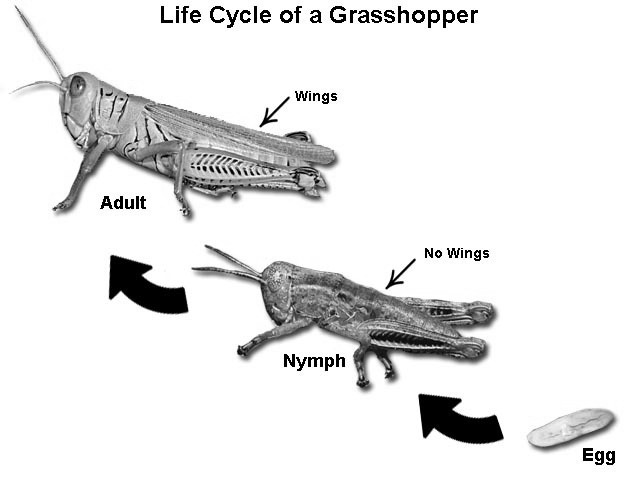
-In the life cycle of grasshoppers, there occurs only three stages of development, which are egg, nymph, and adult stage. The nymphs resemble the adult grasshopper in appearance, but they are devoid of wings and reproductive organs. Due to this reason, the metamorphosis of grasshoppers is considered incomplete.
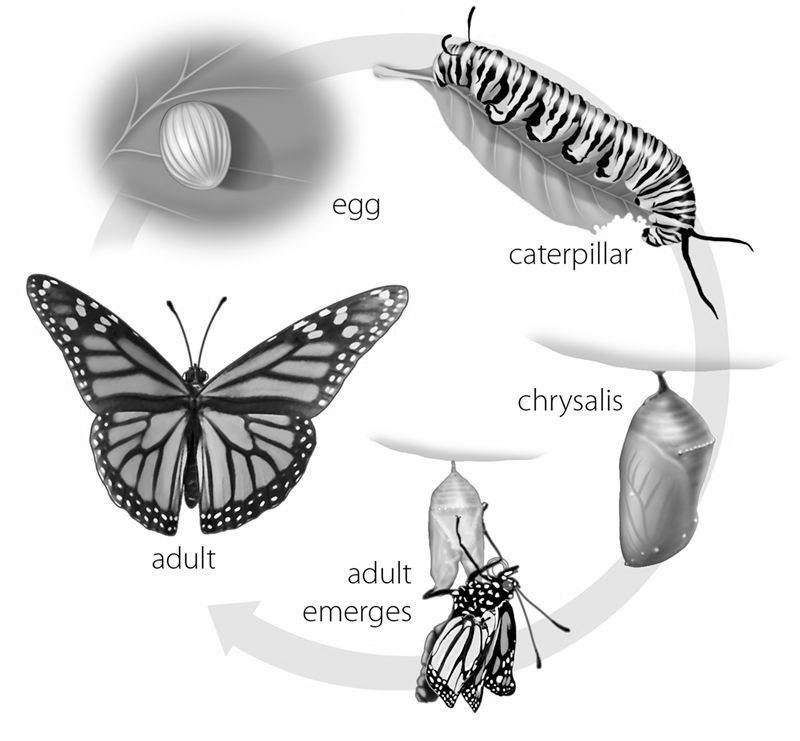
-In the case of butterflies, the metamorphosis involves several intermediate stages. The stage is the egg, larva, pupa, and adult stages. The larvae of butterflies are known as caterpillars which have a worm-like appearance, while the pupae is the stage developing inside a cocoon which gets developed into adult butterflies. Since all these stages are morphologically different, the process is known as complete metamorphosis.
Note: Many arthropods undergo the process of metamorphosis such as cockroaches. Amphibians like frogs also undergo this change, which helps them in increasing their survival rates, the larvae of frogs are known as tadpoles.
Complete answer:
The series of changes young insects undergo before reaching the adult stage is known as metamorphosis. This process helps in reducing the competition among organisms and also in utilizing the resources which are different in different stages. The organisms undergoing metamorphosis possess different morphological appearances in different stages. There are two kinds of metamorphosis, complete and incomplete.
-In the life cycle of grasshoppers, there occurs only three stages of development, which are egg, nymph, and adult stage. The nymphs resemble the adult grasshopper in appearance, but they are devoid of wings and reproductive organs. Due to this reason, the metamorphosis of grasshoppers is considered incomplete.
-In the case of butterflies, the metamorphosis involves several intermediate stages. The stage is the egg, larva, pupa, and adult stages. The larvae of butterflies are known as caterpillars which have a worm-like appearance, while the pupae is the stage developing inside a cocoon which gets developed into adult butterflies. Since all these stages are morphologically different, the process is known as complete metamorphosis.
Note: Many arthropods undergo the process of metamorphosis such as cockroaches. Amphibians like frogs also undergo this change, which helps them in increasing their survival rates, the larvae of frogs are known as tadpoles.
Recently Updated Pages
Which will be the least stable resonating structure class 11 chemistry CBSE

How many 5 digit telephone numbers can be construc-class-11-maths-CBSE
How do you find the angle of the resultant vector class 11 physics CBSE
Draw labelled diagram of the following i Gram seed class 11 biology CBSE
What is the need and importance of classification class 11 biology CBSE
The way in which the sparrows expressed their sorrow class 11 english CBSE
Trending doubts
One Metric ton is equal to kg A 10000 B 1000 C 100 class 11 physics CBSE
Find the value of the expression given below sin 30circ class 11 maths CBSE
1 Quintal is equal to a 110 kg b 10 kg c 100kg d 1000 class 11 physics CBSE
Draw a diagram of nephron and explain its structur class 11 biology CBSE
10 examples of friction in our daily life
Proton was discovered by A Thomson B Rutherford C Chadwick class 11 chemistry CBSE