




You want to erect a pole of height 10m with the support of three ropes. Each rope has to make an angle of $30{}^\circ $ with the pole. What should be the length of the rope?
Answer
 Verified
629.1k+ views
Hint: Use the fact that in a right-angled triangle the ratio of the adjacent side to the hypotenuse of an angle is equal to cosine of the corresponding angle. Hence prove that $AC=BC\cos 30{}^\circ $. Use the fact that $\cos 30{}^\circ =\dfrac{\sqrt{3}}{2}$ to determine the length of the rope. Verify your answer.
Complete step-by-step answer:
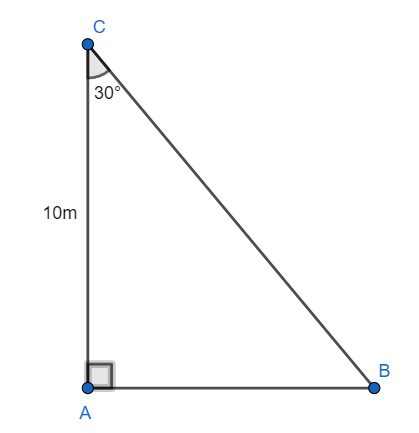
AC is a pole of height 10m. BC is a rope tied to the top of the pole making an angle of $30{}^\circ $ with the pole
To determine: The length BC of the rope
We know that in a right-angled triangle the ratio of the adjacent side to the hypotenuse of an angle is equal to the cosecant of the angle.
In triangle ABC, we have
BC is the hypotenuse and AC is the side adjacent to angle C.
Hence, we have
$\cos C=\dfrac{AC}{BC}$
Multiplying both sides by BC, we get
$AC=BC\cos C$
Since $\angle C=30{}^\circ $, we get
$AC=BC\cos 30{}^\circ $
We know that $\cos 30{}^\circ =\dfrac{\sqrt{3}}{2}$ and AC = 10
Hence, we have
$10=BC\dfrac{\sqrt{3}}{2}$
Multiplying both sides by $\dfrac{2}{\sqrt{3}}$, we get
$BC=\dfrac{20}{\sqrt{3}}$
Hence, the total length of the rope required is $\dfrac{20}{\sqrt{3}}\times 3m=20\sqrt{3}m$
Note: Verification:
We can verify the correctness of our solution by checking that BC = $\dfrac{20}{\sqrt{3}}$ satisfies the condition that $\angle C=30{}^\circ $
We have
$\cos C=\dfrac{AC}{BC}=\dfrac{10}{\dfrac{20}{\sqrt{3}}}=\dfrac{\sqrt{3}}{2}$
We know that $\cos 30{}^\circ =\dfrac{\sqrt{3}}{2}$
Hence, we have
$\begin{align}
& \cos C=\cos 30{}^\circ \\
& \Rightarrow C=30{}^\circ \\
\end{align}$
Hence our solution is verified to be correct.
Complete step-by-step answer:
AC is a pole of height 10m. BC is a rope tied to the top of the pole making an angle of $30{}^\circ $ with the pole
To determine: The length BC of the rope
We know that in a right-angled triangle the ratio of the adjacent side to the hypotenuse of an angle is equal to the cosecant of the angle.
In triangle ABC, we have
BC is the hypotenuse and AC is the side adjacent to angle C.
Hence, we have
$\cos C=\dfrac{AC}{BC}$
Multiplying both sides by BC, we get
$AC=BC\cos C$
Since $\angle C=30{}^\circ $, we get
$AC=BC\cos 30{}^\circ $
We know that $\cos 30{}^\circ =\dfrac{\sqrt{3}}{2}$ and AC = 10
Hence, we have
$10=BC\dfrac{\sqrt{3}}{2}$
Multiplying both sides by $\dfrac{2}{\sqrt{3}}$, we get
$BC=\dfrac{20}{\sqrt{3}}$
Hence, the total length of the rope required is $\dfrac{20}{\sqrt{3}}\times 3m=20\sqrt{3}m$
Note: Verification:
We can verify the correctness of our solution by checking that BC = $\dfrac{20}{\sqrt{3}}$ satisfies the condition that $\angle C=30{}^\circ $
We have
$\cos C=\dfrac{AC}{BC}=\dfrac{10}{\dfrac{20}{\sqrt{3}}}=\dfrac{\sqrt{3}}{2}$
We know that $\cos 30{}^\circ =\dfrac{\sqrt{3}}{2}$
Hence, we have
$\begin{align}
& \cos C=\cos 30{}^\circ \\
& \Rightarrow C=30{}^\circ \\
\end{align}$
Hence our solution is verified to be correct.
Recently Updated Pages
Master Class 11 English: Engaging Questions & Answers for Success

Master Class 11 Social Science: Engaging Questions & Answers for Success
Master Class 11 Maths: Engaging Questions & Answers for Success
Master Class 11 Biology: Engaging Questions & Answers for Success
Master Class 11 Physics: Engaging Questions & Answers for Success
Master Class 11 Chemistry: Engaging Questions & Answers for Success
Trending doubts
One Metric ton is equal to kg A 10000 B 1000 C 100 class 11 physics CBSE
Difference Between Prokaryotic Cells and Eukaryotic Cells
Find the value of the expression given below sin 30circ class 11 maths CBSE
Difference between physical and chemical change class 11 chemistry CBSE
Two of the body parts which do not appear in MRI are class 11 biology CBSE
Draw a diagram of a plant cell and label at least eight class 11 biology CBSE