



You soak seeds of beans and observe them after 2-3 days. What will be your observation?
Answer
 Verified
500.1k+ views
Hint: Seed germination is a fundamental process by which different plant species grow from a single seed into a plant. This process influences both crop yield and as well as the quality of the new plant. It can take place in a plant only if there is a suitable environment.
Complete answer:
Germination is the process in which a new plant is grown up from the seed. This term is given to those plants that rise from the sprouts as in angiosperms. It can take place only if the plant is given an adequate environment like water, sunlight, air etc.
Let us first know about the experiment:
1. Firstly wash and soak the seed in water for one day.
2. After this drain excess water from the petri dish and then leave the soaked seeds overnight in a petri dish and cover the seeds with wet cotton.
3. Then keep the cotton wet (it should not get dry).
4. After 2-3 days, do you see any new structure emerging from these soaked seeds?
OBSERVATION- New structures emerge from the surface of the seeds. These structures are light brown in colour with few hair-like structures on them.
CONCLUSION - The seeds germinate after being kept in moist conditions. These small structures called the baby root and the baby shoot: plumule and radicle when put into soil give rise to new plants. The figure below shows the stages of germination.
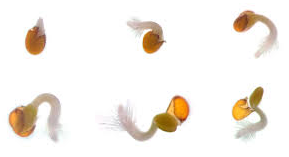
Note: Seed germination needs both external as well as internal conditions. The most important external features are water, temperature or light. Many plants need few other germinating variables too. It often depends upon seed variety and is closely linked to the ecological conditions of a plant's natural habitat.
Complete answer:
Germination is the process in which a new plant is grown up from the seed. This term is given to those plants that rise from the sprouts as in angiosperms. It can take place only if the plant is given an adequate environment like water, sunlight, air etc.
Let us first know about the experiment:
1. Firstly wash and soak the seed in water for one day.
2. After this drain excess water from the petri dish and then leave the soaked seeds overnight in a petri dish and cover the seeds with wet cotton.
3. Then keep the cotton wet (it should not get dry).
4. After 2-3 days, do you see any new structure emerging from these soaked seeds?
OBSERVATION- New structures emerge from the surface of the seeds. These structures are light brown in colour with few hair-like structures on them.
CONCLUSION - The seeds germinate after being kept in moist conditions. These small structures called the baby root and the baby shoot: plumule and radicle when put into soil give rise to new plants. The figure below shows the stages of germination.
Note: Seed germination needs both external as well as internal conditions. The most important external features are water, temperature or light. Many plants need few other germinating variables too. It often depends upon seed variety and is closely linked to the ecological conditions of a plant's natural habitat.
Recently Updated Pages
Master Class 11 Computer Science: Engaging Questions & Answers for Success

Master Class 11 Business Studies: Engaging Questions & Answers for Success
Master Class 11 Economics: Engaging Questions & Answers for Success
Master Class 11 English: Engaging Questions & Answers for Success
Master Class 11 Maths: Engaging Questions & Answers for Success
Master Class 11 Biology: Engaging Questions & Answers for Success
Trending doubts
One Metric ton is equal to kg A 10000 B 1000 C 100 class 11 physics CBSE
There are 720 permutations of the digits 1 2 3 4 5 class 11 maths CBSE
Discuss the various forms of bacteria class 11 biology CBSE
Draw a diagram of a plant cell and label at least eight class 11 biology CBSE
State the laws of reflection of light
Explain zero factorial class 11 maths CBSE