



XY is a line parallel to side BC of a ∆ABC. If BE ll AC and CF ll AB meet XY at E and F respectively, show that:
ar (∆ABE) = ar (∆ACF).
Answer
 Verified
626.7k+ views
Hint: We are getting 2 parallelograms here, which are ACBE and ABCF.
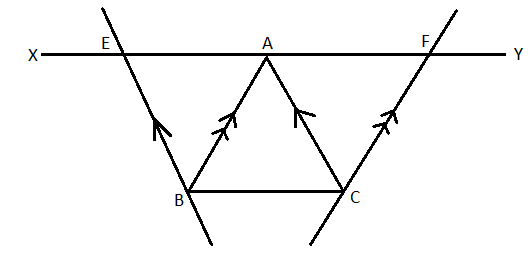
Since the base and height of the two parallelograms is the same, the area of the two parallelograms will also be the same.
Now, if we will subtract the area of the triangle ABC from the total area of the parallelogram, then, both the figures that are left will have the same area.
Complete step-by-step answer:
As mentioned in the hint above, the area of the two parallelograms is the same. And if we will subtract the area of the triangle ABC from the total area of the parallelograms, then, both the figures that are left will have the same area.
Therefore, we can say that ar (∆ABE) = ar (∆ACF) because after subtracting the area of ∆ABC from parallelograms these triangles are remaining.
Hence proved, ar (∆ABE) = ar (∆ACF)
Note: Let us know about parallelograms and the formula to calculate its area.
PARALLELOGRAM: A parallelogram is a simple quadrilateral with two pairs of parallel sides. The opposite sides of a parallelogram are of equal length and the opposite angles of a parallelogram are of equal measure.
Let us now know about its area.
To calculate the area of a parallelogram, we multiply the length of its base and height.
In other words, the product of the length of its base and its height is equal to its area.
Since the base and height of the two parallelograms is the same, the area of the two parallelograms will also be the same.
Now, if we will subtract the area of the triangle ABC from the total area of the parallelogram, then, both the figures that are left will have the same area.
Complete step-by-step answer:
As mentioned in the hint above, the area of the two parallelograms is the same. And if we will subtract the area of the triangle ABC from the total area of the parallelograms, then, both the figures that are left will have the same area.
Therefore, we can say that ar (∆ABE) = ar (∆ACF) because after subtracting the area of ∆ABC from parallelograms these triangles are remaining.
Hence proved, ar (∆ABE) = ar (∆ACF)
Note: Let us know about parallelograms and the formula to calculate its area.
PARALLELOGRAM: A parallelogram is a simple quadrilateral with two pairs of parallel sides. The opposite sides of a parallelogram are of equal length and the opposite angles of a parallelogram are of equal measure.
Let us now know about its area.
To calculate the area of a parallelogram, we multiply the length of its base and height.
In other words, the product of the length of its base and its height is equal to its area.
Recently Updated Pages
Basicity of sulphurous acid and sulphuric acid are

Master Class 9 Social Science: Engaging Questions & Answers for Success
Master Class 9 Science: Engaging Questions & Answers for Success
Master Class 9 Maths: Engaging Questions & Answers for Success
Master Class 9 General Knowledge: Engaging Questions & Answers for Success
Class 9 Question and Answer - Your Ultimate Solutions Guide
Trending doubts
Fill the blanks with the suitable prepositions 1 The class 9 english CBSE
Difference Between Plant Cell and Animal Cell
Find the sum of series 1 + 2 + 3 + 4 + 5 + + 100 class 9 maths CBSE
Distinguish between Conventional and nonconventional class 9 social science CBSE
What is pollution? How many types of pollution? Define it
Describe the 4 stages of the Unification of German class 9 social science CBSE