




X-rays are formed when a stream of electrons in an X-ray tube:
(a) Hits the glass wall of the tube.
(b) Strikes the metal target
(c) Passes through a strong magnetic field
(d) None of the above
Answer
 Verified
612.6k+ views
Hint: X-rays can be defined as electromagnetic radiation, with a frequency ranging from $3 \times {10^{19}} - 3 \times {10^{16}}$ Hz. Since they have high frequency they are also having high energy. Mainly used to find a defect in the skeleton part.
Complete step by step solution:
X-rays were discovered by a German physicist Wilhelm Röntgen. When he experimented on Crookes tube, X-rays were emanating from it. Now lets us take into how they are formed.
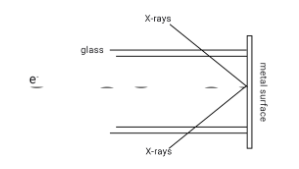
Let us look into the diagram. We have a glass envelope containing a vacuum. There is a metal surface at the end of it. To this we are passing high-velocity electrons which hit on the metal target to produce X-rays. This is how an X-rays are produced.
Hence, we can say that option (b) is correct.
Additional Information: Let us look into some of the properties of X-ray:
-X-rays have a shorter wavelength and high frequency
-It requires a high voltage to produce X-rays
-They can only travel in a straight line and do not carry electrons with them.
-They can also travel in a vacuum.
-It can capture the human skeleton defects
Uses of X-ray:
-Mainly used in medical science, to find a broken skeleton or any other defects inside the human body.
-In security services, it used to scan the baggage of passengers
-Astronomy, X-rays are emitted by celestial bodies and studied.
Note: Option (c) says that they pass through a strong electromagnetic field. They do not pass through the electromagnetic field whereas they are passed through vacuum. But there is electromagnetic radiation formed when the electron hits the metal surface. Also clearly, we can see the rest of the options are wrong.
Complete step by step solution:
X-rays were discovered by a German physicist Wilhelm Röntgen. When he experimented on Crookes tube, X-rays were emanating from it. Now lets us take into how they are formed.
Let us look into the diagram. We have a glass envelope containing a vacuum. There is a metal surface at the end of it. To this we are passing high-velocity electrons which hit on the metal target to produce X-rays. This is how an X-rays are produced.
Hence, we can say that option (b) is correct.
Additional Information: Let us look into some of the properties of X-ray:
-X-rays have a shorter wavelength and high frequency
-It requires a high voltage to produce X-rays
-They can only travel in a straight line and do not carry electrons with them.
-They can also travel in a vacuum.
-It can capture the human skeleton defects
Uses of X-ray:
-Mainly used in medical science, to find a broken skeleton or any other defects inside the human body.
-In security services, it used to scan the baggage of passengers
-Astronomy, X-rays are emitted by celestial bodies and studied.
Note: Option (c) says that they pass through a strong electromagnetic field. They do not pass through the electromagnetic field whereas they are passed through vacuum. But there is electromagnetic radiation formed when the electron hits the metal surface. Also clearly, we can see the rest of the options are wrong.
Recently Updated Pages
Master Class 11 English: Engaging Questions & Answers for Success

Master Class 11 Social Science: Engaging Questions & Answers for Success
Master Class 11 Maths: Engaging Questions & Answers for Success
Master Class 11 Biology: Engaging Questions & Answers for Success
Master Class 11 Physics: Engaging Questions & Answers for Success
Master Class 11 Chemistry: Engaging Questions & Answers for Success
Trending doubts
One Metric ton is equal to kg A 10000 B 1000 C 100 class 11 physics CBSE
Difference Between Prokaryotic Cells and Eukaryotic Cells
Find the value of the expression given below sin 30circ class 11 maths CBSE
Two of the body parts which do not appear in MRI are class 11 biology CBSE
Draw a diagram of a plant cell and label at least eight class 11 biology CBSE
10 examples of friction in our daily life